
 ">


Andrew Skurka on 6 Tips for Dry Healthy Feet
The below is a transcription. Minor edits have been made for clarity and readability, while preserving the original message and intent. This video is part of a new series on The Trek’s Youtube. Check out the full video and subscribe to our YouTube channel.Are you still trying to keep your feet dry with a waterproof boot like this one? Just give it up. In wet conditions, you’re never going to keep your feet dry. So in this episode, I’m going to teach you how to manage wet feet so you can stay comfortable on the trail.
If you’re interested in joining a guided wilderness expedition lead by Andrew Skurka, go to andrewskurka.com/guided-trips to learn more.
Hi, I’m Andrew Skurka. I’ve been backpacking for about 25 years. I was the first person to do the C2C route, which is 7,775 miles from Quebec to Washington. I was the first person to do the Great Western Loop, which was 6,875 miles around the American West. And I also did a 4,700-mile trip around Alaska and the Yukon, during which I spent a lot of time with very wet feet.
This is a weekly video series that I do with The Trek. We drop a new episode every Monday at noon Mountain Time. If you have questions or comments, please leave a comment below. Please also like and subscribe while you’re down there.
Today, we’re going to be talking about how to manage wet feet.
The conventional solution is to try to keep your feet dry. And you might try to do that with a waterproof boot or shoe like this.
This type of shoe either has a waterproof membrane on the exterior, or it has a normal shoe and then, on the inside, there’s basically a bootie made out of waterproof, breathable fabric, like Gore-Tex or any proprietary brand, like H2No or something like that.
These don’t work. I’ll just be honest. They totally don’t work. Don’t go to the store asking for waterproof shoes, thinking that these are going to keep your feet dry.
Water will come in over the tops of the shoe. So, for example, if you step in a creek that’s more than five inches deep, which you’ll have to do on a lot of trips, especially in real wilderness settings, water can also drip down your legs.
So, for example, you’re walking through a meadow with tall grass, and all the grass is soaked in dew or in rain, and the water will just drip down your legs.
Two other things happen with these.
One is that you just get wet from the inside. The waterproof, breathable fabric does not breathe that well. So, it will accumulate perspiration, and your feet will be hot, and your feet will be wet just from perspiration.
And then the last thing is that these shoes, they just kind of fail. This is a lot of moving, torquing action happening on your shoes and on that fabric. And the seams bust, and the fabric just kind of degrades over time.
So, your first trip, the shoes might be awesome, might perform exactly as you expected, but after a couple of weeks, you’re like, dang, my feet are getting wet. What’s going on with these waterproof boots? They’re guaranteed to keep me dry, or at least you’ve been told.
So, what I’m going to tell you to do is that instead of trying to keep your feet dry, just embrace the fact that they’re going to get wet and learn how to manage wet feet.
There are five things that you can do to help manage wet feet. We have one, two, three, four, five, actually, maybe six.
1. Wear Breathable Footwear
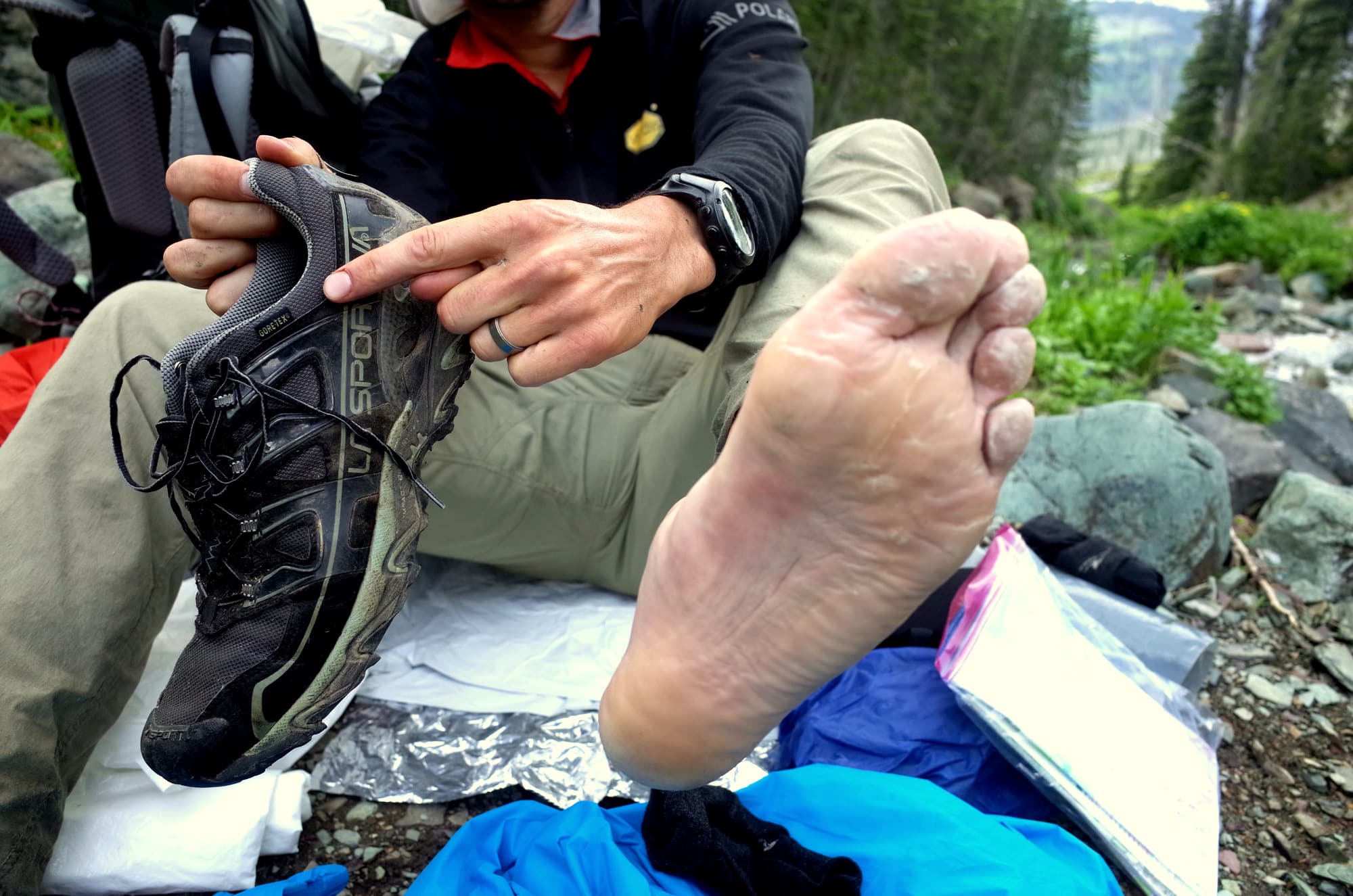
The first thing we want to do is that we want to just use ordinary breathable shoes like this one here. This is the La Sportiva Bushido.
It’s one of my favorite shoes. Historically, it has not worked well for everyone because it’s a pretty narrow shoe, but they also make it in a wide version. It’s not a great trail shoe because it doesn’t have a lot of cushioning, but for off-trail travel, like I love to do, it’s great.
Breathable shoes will do two things.
First is that they will expel the water more quickly because the water will just sort of get forced out of the mesh.
And the second thing that the breathable shoe will do is that because you have quite a bit more airflow going through the shoe, after your shoes get wet, they will dry out more quickly.
So, that’s number one: breathable footwear.
2. Wear a Thin, Quick-Drying Sock
The second thing you can do to manage wet feet is to wear a thin, quick-drying sock like this one.
This particular one, this is the Defeet Woolyator, and this was my favorite style of it. This is the Argyle.
Nowadays, Defeet makes another version of the Woolyator. It’s called the Woolyator Pro. It’s not the same sock. I don’t like it for backpacking nearly as much.
There are other sock brands and sock models that do something similar.
The key thing is that it’s thin. There’s no padding in here. A polyester sock will dry faster, but I prefer the wool.
It’s a little bit warmer when it’s wet. In fact, not a little bit. It’s quite a bit warmer when it’s wet.
And then the other thing is that I don’t find it to be nearly as slippery inside the shoe. I feel like polyester and nylon, they’re very slick fibers.
The reason that I wear a sock like this is because it just will dry more quickly.
Sometimes I can get it dry at night, particularly if I’m in a very dry environment. I’m thinking like Utah in May, where the nighttime lows are in the 50s. Maybe there’s a little bit of a wind. There’s very low humidity.
In most environments, though, you’re going to need daytime heat and daytime sun to get it dry.
Typically, what I will do is I will loop the sock that I need to get dry in my compression socks on the outside of my backpack to get it to dry. You can also sometimes wear the sock until it’s dry.
Inside the breathable shoe, it will dry so long as it’s warm enough and so long as it’s not continuing to get wet with ambient wetness. Like if it’s raining or if there’s dew on the ground or if you’re doing river crossings.
Okay, so that’s tip number two.
3. Take Off Your Shoes and Socks During Breaks
Tip number three to manage wet feet is that at any break that’s longer than like 15 minutes, maybe even 10 minutes, take off your shoes and socks when you break.
Usually, in a group setting, typically what we’ll do is we’ll announce, like, hey guys, we’re going to take a break. It is right now 11:15. We’re going to be, everyone needs to put their shoes back on starting at 11:30.
The point is you’re going to take off your shoes and socks.
And even the crazy thing is, like, even if it’s raining or even if it’s really damp, I’m always shocked at just how nice my feet can feel even after like 15 minutes of drying out.
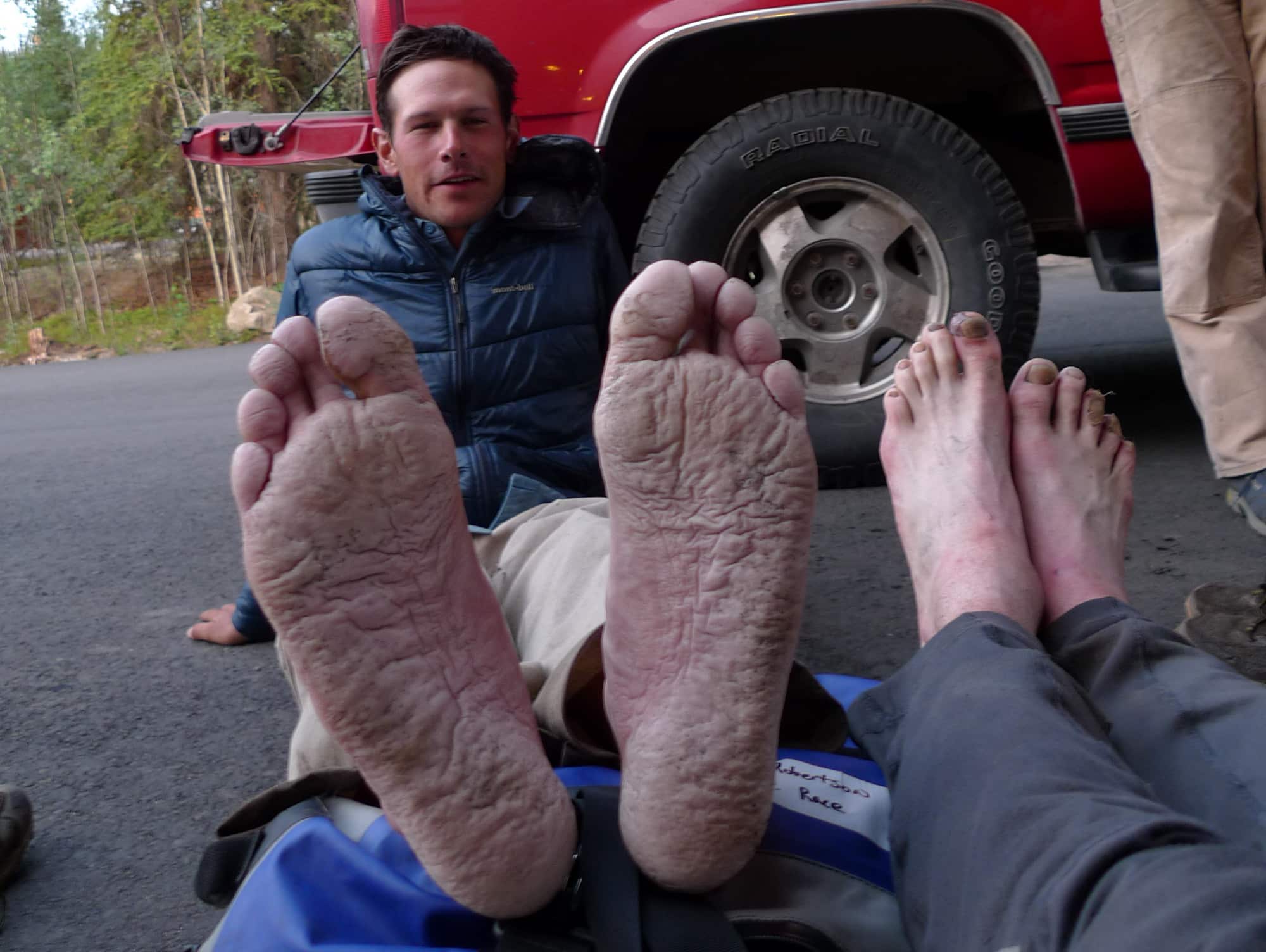
I think there’s a big difference between my feet being exposed to damp air but at least exposed to that air versus being stuck in a wet sock and a wet shoe where there’s like overwhelming humidity and wetness.
Okay, so that’s tip number three.
4. Use a Foot Balm
Tip four for managing wet feet—and I think this was like a real game changer for me early in my backpacking—what would happen is I would hike all day in wet feet, and even if I was taking off shoes and socks at rest breaks, I would still arrive at the end of the day and my feet were macerated and kind of sore.
And then I would go to bed at night and I would wake up in the morning and my feet felt like really rough, like really dried out, kind of very leathery, and then it’s kind of like painful to walk on.
So, my fourth tip for you is to carry with you some type of foot balm.
These are actually, like, I don’t even know where I got these, but the consistency is right and we’ll get a close-up of these in a second.
You’re looking for something with the consistency of maybe like petroleum jelly, something maybe that’s a little bit less viscous than petroleum jelly.
And, oh boy, I’m gonna… So, I am not a foot model, but what you’ll do is you…
And I also have a bunion in my right foot that’s giving me problems as I get older.
So, what happens is you arrive in camp and you take off your shoes and socks and you let your feet get thoroughly dried out. And then you take this balm and don’t be too stingy with it.
You don’t want to end up with a lot of excess, and you just rub it into the parts of the foot that feel driest. Usually that’s going to be like on the ball of the feet and on the pads of the toes. Get the heel and the edges of the heel.
So, just rub it all in there.
5. Carry Dedicated Sleeping Socks
And then once you’re done, you’re going to put on a dry sleeping sock.
Carry with you when you’re backpacking in wet conditions a dedicated sleeping sock. You never use it during the day. It stays buried deep in your pack inside of a waterproof pack liner.
After putting on this balm at night and just before I go to bed, I’m going to put on my dry sleeping sock and try not to like rub it off as you’re putting on your sock.
So, now I have a dry, warm sock and the foot balm.
And what you’ll notice is that when you wake up in the morning, your foot will feel—the skin will feel like it’s been kind of like conditioned. It’ll feel like a nice, hydrated leather skin feeling rather than being like dry and crispy and kind of sore.
So, that’s tip four, and the sleeping socks, that’s tip five.
6. Carry Bread Bags for Camp
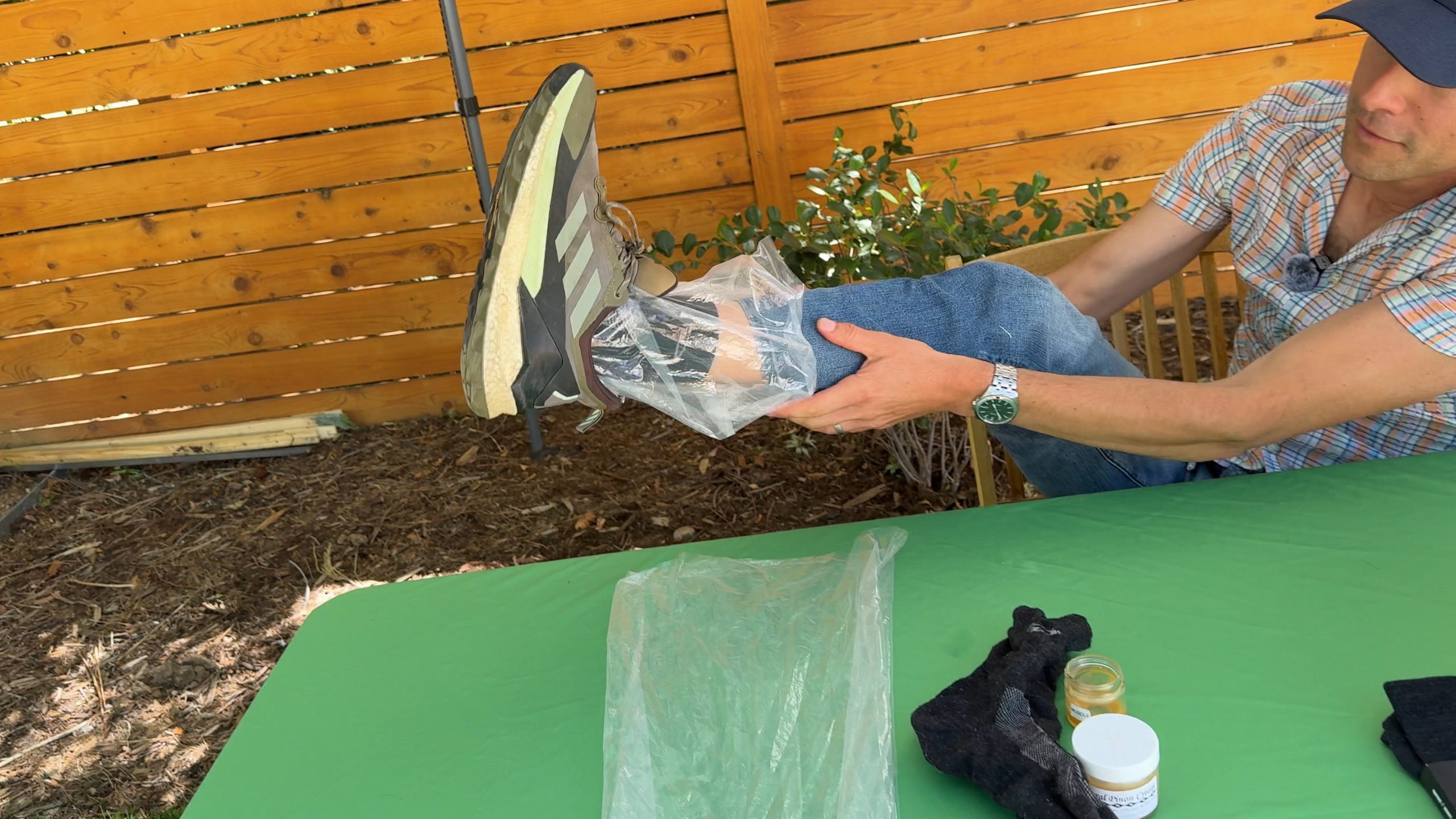
So, my sixth and final tip for how to manage wet feet is to carry with you a set of bread bags.
These bread bags—we go through a lot of these. So, we order them in bulk, I think by like the 100-count, and we get them on an online website.
Make sure that it’s a thicker material so that they can withstand some abrasion and some use. And this is your alternative to dedicated camp shoes.
Substantially lighter, I’d say they’re also warmer and much more packable.
You know, the sequence is a little bit flexible depending on your camp situation.
If you’re a thru-hiker, typically what you do is you roll into camp and you set up your shelter and you cook dinner in your vestibule and then you just go vertical, go horizontal, and you’re done.
But if you’re in like a group setting where you have wet shoes from the day and a pair of wet hiking socks, what you’ll do is you’ll come into camp, you’ll set up your shelter, you can get your feet warm and dry, maybe before dinner, you put on your balm and you put on your sleeping sock.
And then if you want to go hang out and cook dinner with everyone, you take your bread bag and you go over your shoe like this.
And now you have a waterproof system where your wet hiking shoe is not getting your dry hiking socks wet, and your foot is sort of nicely lubed and conditioning as you have dinner.
And then when you come back to your shelter to sleep, obviously all this comes off and you can just go to bed.
To Review: Six Ways to Manage Wet Feet
So, to review:
- Don’t wear waterproof boots for three-season backpacking.
- Wear a breathable shoe instead that’s going to quickly expel water and that also dry out in drier conditions.
- Wear a thin merino wool or polyester sock that will dry quickly and that also won’t retain a lot of water.
- At any break that’s longer than about 15 minutes, take off your shoes and socks to let your feet dry out.
- At night, apply a foot balm in order to condition your skin to make sure that your skin doesn’t dry out.
- Carry with you a dedicated pair of sleeping socks that never get used during the day and that stay inside your pack inside of a waterproof pack liner.
- Finally, carry with you some bread bags that you can use in camp instead of heavy, bulky dedicated camp shoes.
Now, that all sounds great, but I will, like, just forewarn you that, all things being equal, if I can keep my feet dry during the day, I prefer dry feet.
Hiking with wet feet, it’s not as nice as hiking with dry feet. But I think in a lot of environments—I’m thinking of like the rainy East Coast or I’m thinking of the Brooks Range of Alaska, where I’m heading next week—wet feet are just a reality. Totally unavoidable.
And instead of thinking that you can somehow keep your feet dry, you manage it in the same way that you would manage other environmental conditions.
What Happens If You Don’t Take Care of Wet Feet?
Yeah, so if you don’t take care of wet feet, the thing that’s going to happen most quickly is that your feet will get very macerated.
So everyone knows what macerated skin looks like, even if you don’t know the term maceration.
Like if you spend too long in like a hot tub or even like a bathtub, you’ll notice that the pads on your fingers and your feet, they’ll start looking like a raisin and they get kind of a little bit white and kind of wrinkled and definitely very soft.
So that’s what’s happening when your feet get wet, and macerated skin is just not as durable as dry skin.
So, you’re more likely to get blisters. It’s—it could be, I don’t want to say painful, but like you’re just going to be more tender on your feet if your skin is badly macerated.
So, that’s sort of like the first thing that will happen with wet feet.
The second thing, and this is more severe, is that when your feet dry out from being macerated, you could get cracked skin. And that’s one of the things that the balm is designed to prevent.
So instead of the skin on your feet being very like dry and papery and crisp and prone to cracking, this balm will help kind of condition that skin and just keep it all intact.
So that’d be issue number two.
The third thing that can happen with wet feet—and this would be more of a problem if your feet are wet and cold—is that you could end up with some sort of cold injury, also known as trench foot, where you start doing some damage to the nerve endings.
And that’s not a great time.
Like, I’ve had that before and have had, like, afterwards, weeks and weeks of tingling fingers and tingling toes because of that cold injury.
Managing Feet in Chronically Wet Conditions
No, my advice would not be different for individuals who are hiking in the rain for days on end or who are doing non-stop river crossings.
Maybe my advice actually would just be like, be more vigilant about these six things.
If you’re in an area where that’s not chronically wet, maybe you can get away with some of these. But if you are dealing with wet feet for days on end, like, you definitely need to be hyper-vigilant in keeping your feet healthy.
Yeah, it’s definitely going to be the case in areas that are really wet or really humid or cold enough that things don’t dry.
Your daytime shoes and your daytime socks, they’re just going to get wet and they’re going to stay wet.
A really good example of this type of location would be the Brooks Range of Alaska, where we’re hiking on a wet tundra because there’s permafrost underneath. So there’s just a lot of standing water and a lot of river crossings.
And in this location, our hiking shoes and our hiking socks, they get wet and they stay wet. They’re never dry.
And that’s really where these other things come into play: taking off shoes and socks during rest breaks, conditioning your skin at night, having a dedicated pair of sleeping socks.
That will all help mitigate the fact that you’re not able to get your feet dry ever while you’re actually hiking.
I have definitely suffered the effects of gnarly wet feet.
I’m pretty sure right now that The Trek is going to add a photo of my nasty wet feet from Alaska.
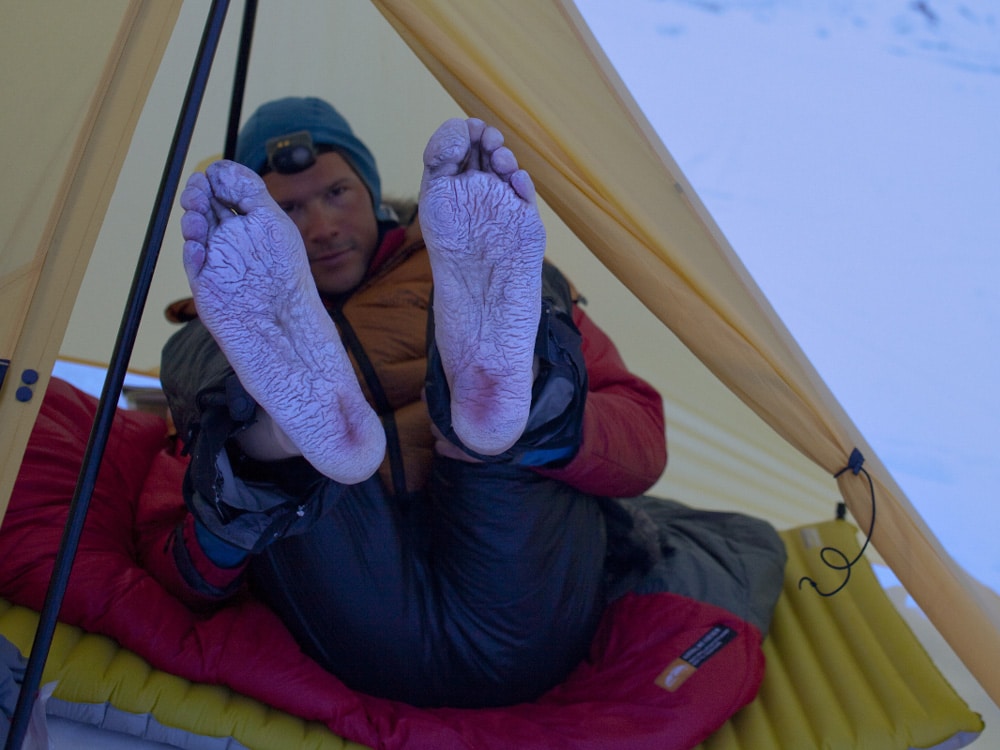
The extra context there is that you can see that there’s snow in the background. So, at that time of year, I was dealing with open river crossings because it was past breakup, so the rivers were open and I was having to ford open rivers, but there’s still snow.
So I’m in cold snow and I’m wearing a pair of ski boots, leather ski boots, that never dried.
So, yeah, I would consider myself an expert in managing wet feet.
Thank you very much for watching. This is a weekly video series that I do with The Trek. We drop a new video every Monday at around noon.
If you have questions about this particular video or if you want to add one for a future mailbag episode, please leave a comment below. Please also, while you’re down there, like and subscribe.
If you are interested in a guided trip, we’re full for the 2026 season, but we’ll be releasing our schedule in November of 2026 and opening up applications in December, and that definitely is your best chance. We have a two-week open application period, and that’s your best chance of getting on a trip in 2027. There will be more information about my trips in the description below.
All right, thank you. We’ll see you next week.
More From Andrew Skurka on The Trek
This post is part of Andrew Skurka’s weekly video series with The Trek. Catch up on the rest of the series:
- The Only 12 Backpacking Clothes You Really Need
- The Best $1 Backpacking Meal Ever
- 5 Rules for Leading a Great Backpacking Trip
- Eating Sticks of Butter (Q&A #3)
- Your Backpacking Questions Answered (Mail Bag #2)
- Your Weirdest Backpacking Questions (Q&A #1)
- “Stupid Light” Ultralight Backpacking
- Quitting Thru-Hiking Forever
- Why Most Backpackers Are Packing Wrong
- Why Most Backpackers Carry the Wrong First Aid Kit
- The Biggest Food Mistakes Backpackers Make
- Going Beyond AllTrails
- Mastering Ultralight Tents & Shelters
- Mastering Harsh Backpacking Conditions
- How to Poop in the Woods

This website contains affiliate links, which means The Trek may receive a percentage of any product or service you purchase using the links in the articles or advertisements. The buyer pays the same price as they would otherwise, and your purchase helps to support The Trek's ongoing goal to serve you quality backpacking advice and information. Thanks for your support!
To learn more, please visit the About This Site page.

Comments 2
I avoid waterproof shoes (although increasingly hard to find as they are all jumping on the bandwagon unfortunately). They make your feet sweat and then end up with painful wrinkles on your toes.
I found waterproof shoes to work well for most of the Appalachian Trail. Outside the 100 mile wilderness I never hit water that came over the top. My feet really don’t sweat.
But on other trails I’ve moved to normal trailrunners.