
 ">


Andrew Skurka on the Best Way to Eat Ramen While Backpacking
The below is a transcription. Minor edits have been made for clarity and readability, while preserving the original message and intent. This video is part of a new series on The Trek’s Youtube. Check out the full video and subscribe to our YouTube channel.
If you’re interested in joining a guided wilderness expedition lead by Andrew Skurka, go to andrewskurka.com/guided-trips to learn more.
This meal is not on a vanity license plate. It has never been memed by r/ultralightjerk. It’s not on a T-shirt, but it is our second-most-favorite client meal. It is kind of a little weird-looking, looks like some sludge in a Nalgene bottle, but in this video we’re going to make it, and that’s great because I’m starving and I can’t wait to get into it.
Welcome back to our cooking mini-series. You guys seem to have really enjoyed the recent videos I did on beans and rice and cheesy potatoes, so today I’m going to give you peanut noodles.
If you don’t know me, I’m Andrew Skurka. I was the first person to thru-hike the Sea-to-Sea Route and the Great Western Loop and to complete the Alaska-Yukon Expedition. For the last 16—actually, no, 17 years, I’ve been running a guided backpacking service. You can find more information at andrewskurka.com.
This is part of a weekly video series that I do with The Trek. We drop a new video every Monday at noon, and if you enjoy this video, make sure to check out the others and also please like and subscribe.
Before we get started, I’m excited to announce that we’re doing a live event on Saturday, December 5th, with Backpacker Radio. It’ll be at the Skylark Lounge in Denver, and if you’d like to go, you can get your tickets here.
What Makes Peanut Noodles Such a Great Backpacking Meal?
Let’s start by talking about what makes up this brown sludge. (Why do I keep calling it sludge? It’s delicious. I mean, that is just such a way to sell your meal short, but I digress.)
All right, so here we go. This meal, peanut noodles, weighs 5.7 ounces. It has 809 calories, which means that it has a caloric density of 141 calories per ounce, which is really high. And that makes this a fantastic backpacking meal.
I would say that this meal is definitely more conducive to groups. It’s really not meant for, like, a solo thru-hiker because you’re going to struggle to get all these ingredients in trail towns along the way. And also there’s some overhead weight in carrying it in some kind of bottle that isn’t going to leak all over your pack. So small groups, maybe like three or four people or more.
Personally, we’re using it all the time. It is on every single trip, and we’re usually running groups with eight to 10 people.
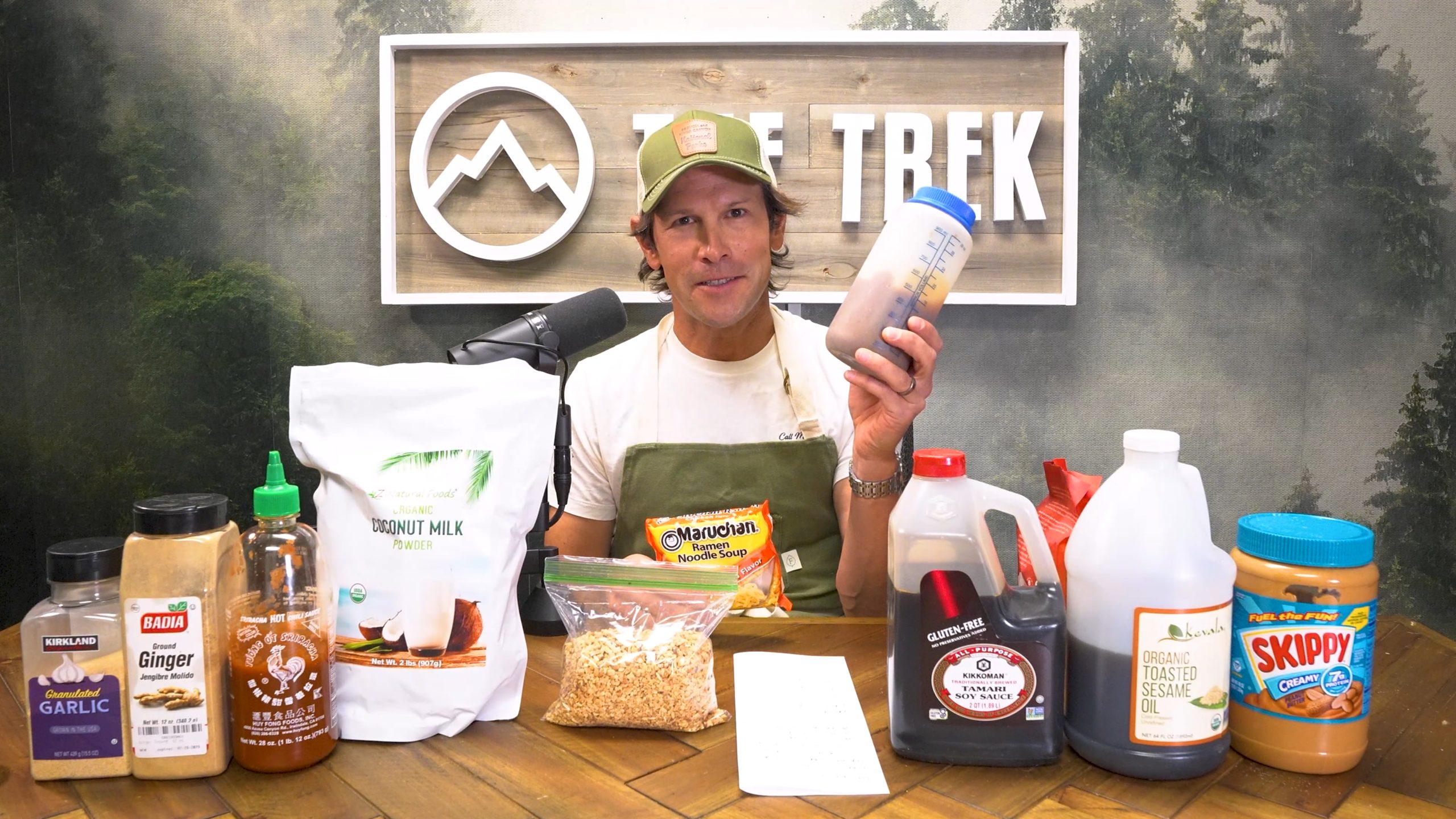
The Ingredients for Peanut Noodles
Each person is given an individual ration of ramen noodles. So it’s a three-ounce bag of ramen noodles. There are some gluten-free options, if you need that.
And then there are two group ingredients. Usually, we’ll send the group ingredients out where one person carries the group ingredient, and then at dinnertime, it all gets split up.
One of these group ingredients is a bag of roasted peanuts. This, per person, is 0.8 ounces. If you want to add a little bit of green to your meal, maybe you could use half the amount of roasted peanuts, so 0.4 ounces, and then maybe add some dehydrated peas for another 0.4 ounces.
The remaining group ingredient is the sauce. And let me give you the breakdown of this sauce.
Peanut Noodles Ingredients Per Person
| Ingredient | Amount |
|---|---|
| Ramen noodles | 3 oz |
| Roasted peanuts | 0.8 oz |
| Peanut butter | 1.3 oz |
| Toasted sesame oil | 0.2 oz |
| Soy sauce | 0.2 oz |
| Coconut milk powder | 0.1 oz |
| Garlic powder | 0.05 oz |
| Ginger powder | 0.02 oz |
| Sriracha | 0.03 oz |
| Fresh lime or powdered lime | To finish |
Of these items here, the ones that I would say are most critical: You definitely need the peanut butter. You definitely need the toasted sesame oil. You should have the soy sauce, and you should have your seasonings. I think you could probably get away without the coconut milk powder.
You definitely don’t need a fresh lime. That’s a really nice touch. And then sriracha would be optional, depending on whether you like your meals hot or not.
One field substitute is that you could very easily just add red pepper flakes instead of bringing out the sriracha.
How to Make the Peanut Sauce at Home
So here’s the deal. Making this sauce is messy. You’re going to want to do it at home, not in the field. So let me show you how it’s done.
One of the questions might be, why did you just give me measurements in weight? And it’s because you’re not going to make this meal for just one person. That’s kind of crazy.
So what you need is a postal scale. You need some sort of mixing bowl. And then you can just weigh the amounts as you put them in. This spares us from having to do the half a teaspoon of sriracha sauce. Or a cup of peanut butter, whatever it might be. So we’re just going by weights.
How to Store and Transport the Peanut Sauce
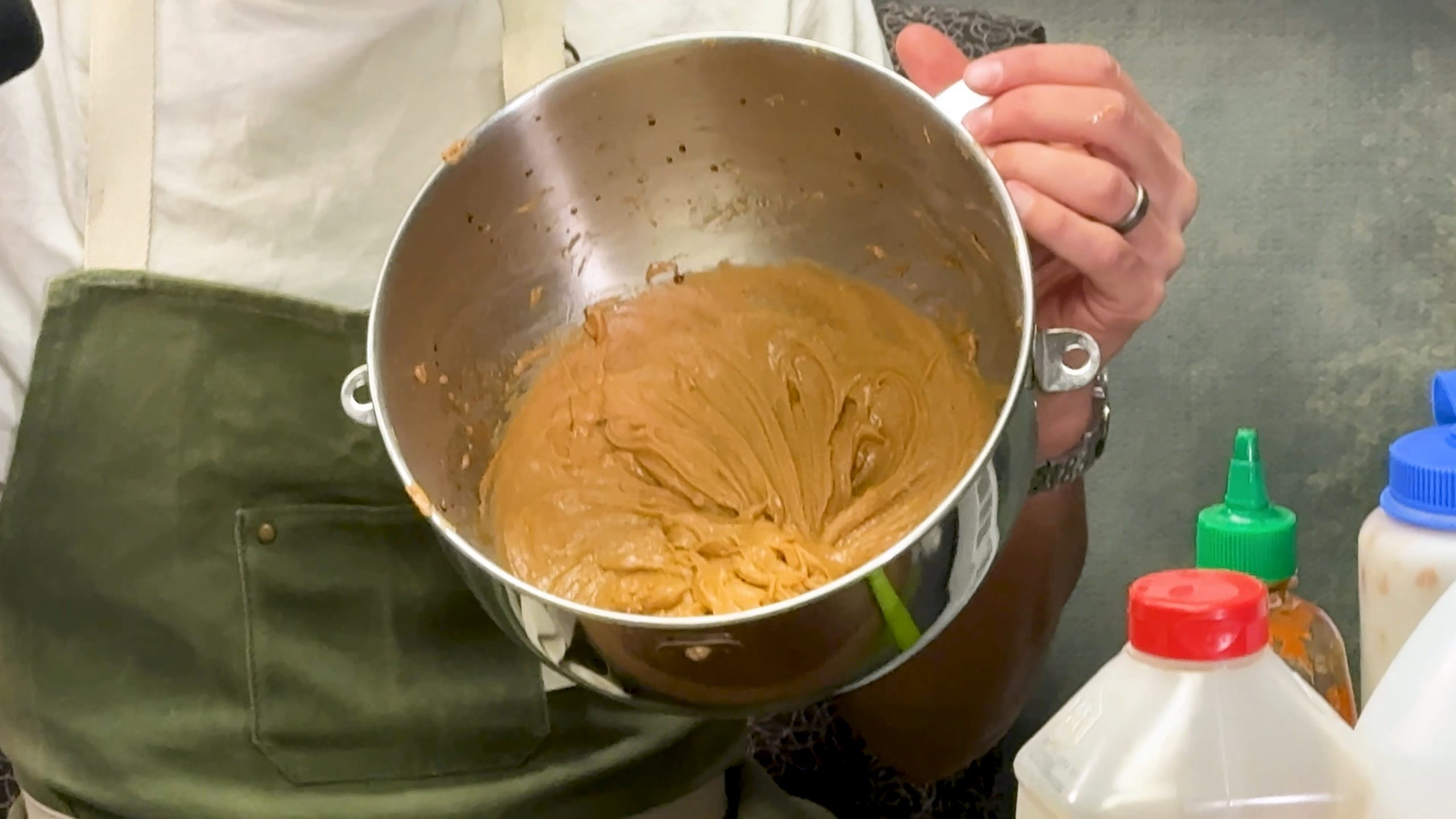
Okay, so your end result is this. This is the sauce, and you’re going to need a leakproof container to put it into. Our preferred method is putting it into a full one-liter Nalgene. And the Nalgenes have really tight lids. You’re not going to have a problem with that.
This is a messy meal. I’ll just be real. It’s a messy meal.
So if you’re going to make this, make it for a group. Make an amount that’s going to last you for the entire season. If I mapped it out and thought I would need, say, 30 servings for the entire season, I would just make 30 servings in April or May before the season really got started and put it in the refrigerator. And you’re not going to have to make a mess out of your kitchen and all of your utensils again.
How Long Does the Sauce Keep?
This will keep for a very long time, especially if it’s in a refrigerator. We typically make it at the beginning of the season, refrigerate it, and use it toward the end of the season. And we’ve never had an issue with it.
There’s lots of salt in here. All the ingredients are fairly shelf-stable. And then you add that refrigeration element, and it will definitely keep for a while.
It does have its limits. For example, that peanut butter is not going to be good forever, but in general, it’s pretty good.
So at this point, I’m going to go ahead and take our 10-person serving, and I’m just going to try to get it to pour into the Nalgene.
Peanut Noodles Are Good Enough to Eat at Home
This is probably a good time to mention—we’ll get Jess’s reaction—but I’m making a 10-person serving partly because I’m planning on leaving this Nalgene bottle here at The Trek office. And I thought that they could make it.
That’s kind of the nice perk about this meal. It’s actually good enough that you can have it at home.
It’s been a while since Amanda and I had it, but I used to just have some extra in the refrigerator. And on those nights where it’s like, “What are we going to make tonight?” this was kind of a useful standby.
Yeah. If you’re at home, my recommendation, instead of just having it be a carbohydrate bomb and a fat bomb, is to add some grilled chicken to it. Like blackened grilled chicken. It’s a really nice touch. And try to add some veggies too.
Okay. So at this point, we have our sauce. This is field-ready. And our next step is to replicate a scenario where we’re out in the field and we’re going to go ahead and cook a meal.
How to Prepare Peanut Noodles in the Backcountry
Suppose that we’ve now transitioned and we’re in the field. There are a couple of different ways to prepare this meal for a group or for an individual. And it’s going to differ a little bit, but let me give you the group arrangement, and then I’ll tell you how I would do it individually.
Step 1: Divide the Peanuts Into Individual Bowls
If you’re in a group, again, everyone will have their bag of ramen noodles. And then, if you’ve seen the other videos, you’re familiar with the red bowls.
I would have eight or 10 red bowls. And then I would put eight-tenths of an ounce of dried peanuts in each red bowl.
Step 2: Dilute the Peanut Sauce
Then I would take some purified water and fill up most of the bottle. This allows us to get the peanut sauce out easily. And then we kind of pass this around. It’s a little bit like the Shake Weight commercial.
You really build up those triceps. It’s much easier. If it’s really cold out, you might need to add hot water to it, but in most conditions, just simple water is fine.
I bet in slow motion this would be really funny-looking.
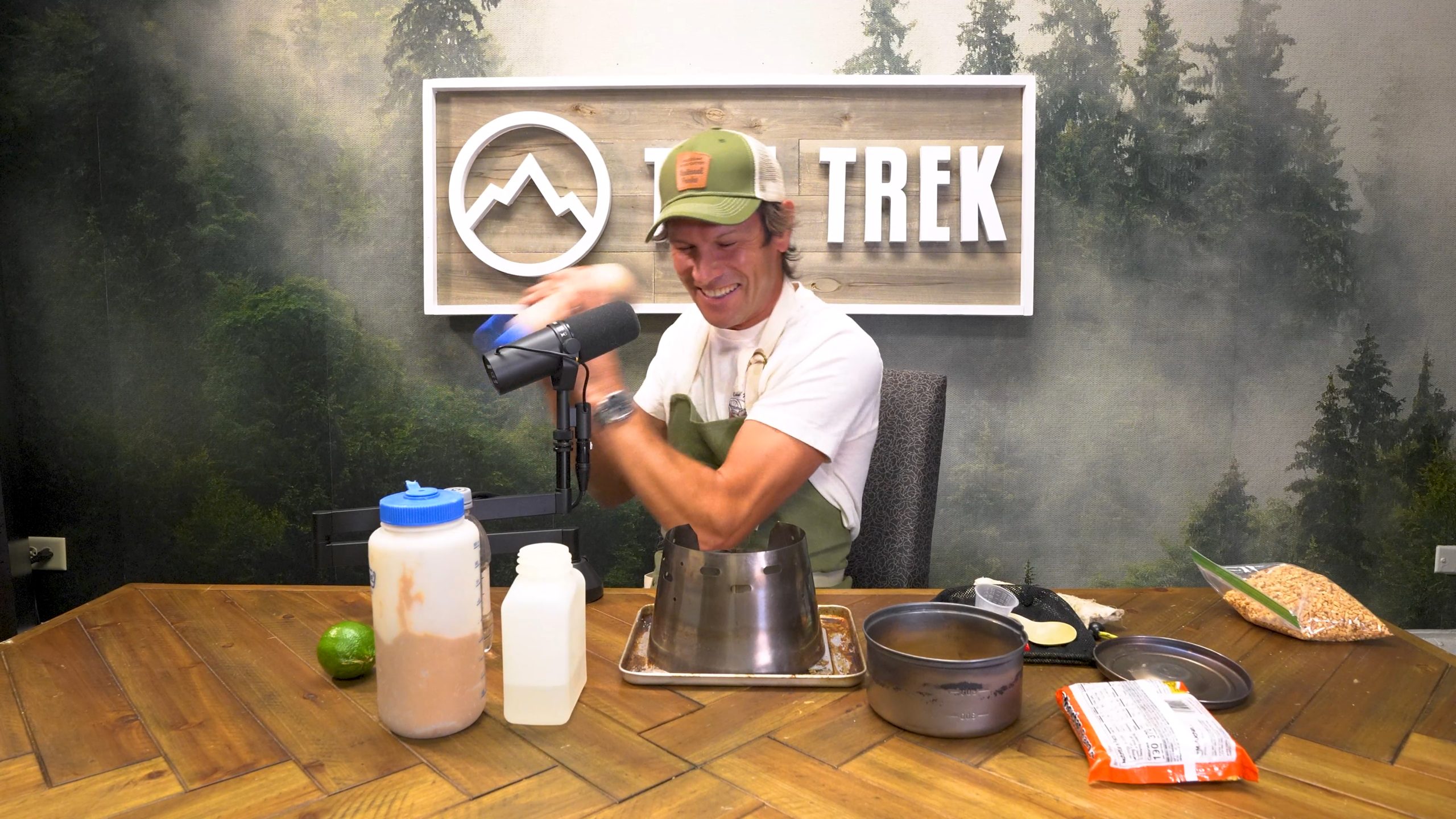
So we have our diluted peanut sauce.
Step 3: Distribute the Sauce
At this point, I would have everyone put out their individual pots, which already have the roasted peanuts in them. And I would go around and just decant about one-eighth or one-tenth of the peanut sauce into everyone’s pot.
I find that to get a clean bottle, you’re going to need to do two rounds of the water. So go around once for eight people, 10 people, four people, whatever you might have. Add some more water, shake it up again.
And it’s totally fine that by the second serving, you’re getting a pretty diluted peanut sauce, almost like a peanut sauce soup. That leaves you with a clean bottle without any calories left behind. And it also prevents, over the course of the rest of the trip, this former peanut sauce bottle from getting nasty and funky.
At this point, I have the toasted peanuts and the peanut sauce in my pot.
Step 4: Add Water and Ramen Noodles
I’m going to go ahead and add my personal water to make the meal. I think the recommendation for this is to have at least 10 ounces of water.
And then you’re going to take your bag of ramen noodles. I prefer to crush the noodles before I add them to my pot.
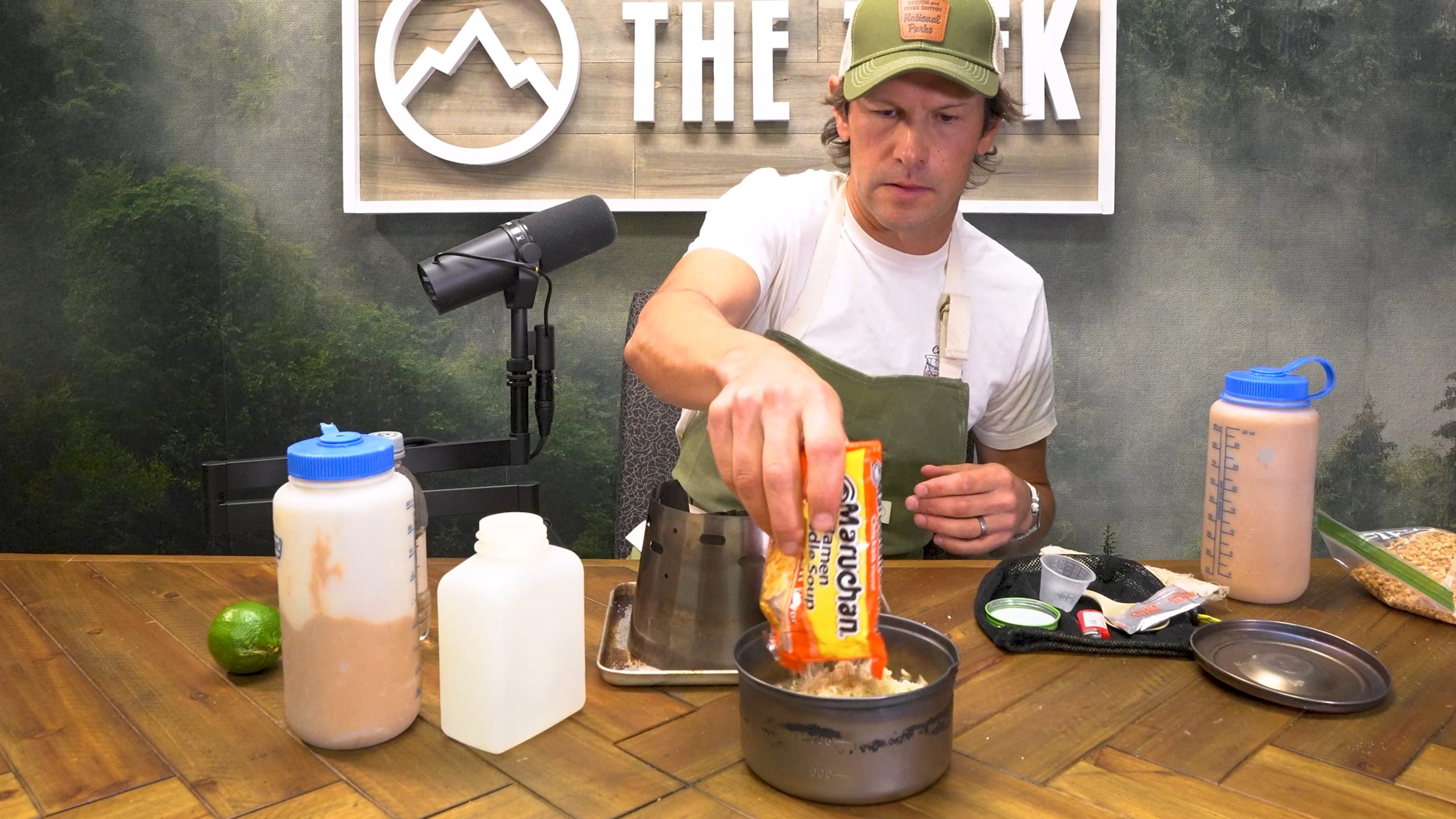
How to Avoid Boil-Overs and Burning the Sauce
With all the ingredients in the pot now, here’s what you really need to watch out for: boil-over. That is the big risk with this meal.
The at-home equivalent would be if you take cold water and put it on your stovetop, and then add marinara sauce and water and dried spaghetti noodles, and then turn your stove up to 10. You know what’s going to happen. You’re going to get this big explosion of sauce and noodles.
So when you start cooking this, you need to be very attentive. Extra water definitely helps in keeping that heat a little bit more manageable.
An Alternative Cooking Method
The way to avoid this risk of boil-over is that instead of putting all the ingredients in individual pots before you start boiling the water, you could do it at the end.
Go ahead and boil water, then add your noodles and get your noodles cooked. And then, at the very end, add your peanut sauce.
The reason we don’t typically do that in a group setting is that it’s difficult to decant one-tenth of the peanut sauce into each person’s bowl as they come up with their noodles that are already cooked.
If it’s a smaller group and you have plenty of peanut sauce, it’s much easier to do. But it would be sort of tragic to be the tenth person to get to the peanut sauce and there’s basically none left.
Keep Stirring to Prevent Scorching
Another thing to make sure of, if you do have all the ingredients already in the pot when you start cooking, is that you have to stir it. Definitely at the start, and then periodically.
Otherwise, the peanut sauce will kind of sit on the bottom, and you can actually scorch the peanut sauce long before you would ever even have water that’s warm enough for the noodles to cook.
Quick Peanut Noodles FAQ
What If Someone in Your Group Is Allergic to Peanuts?
Yeah, if either I’m allergic to peanuts or someone in my group is allergic to peanuts, this meal just probably isn’t realistic.
What we tell anyone who reports having an anaphylactic reaction to peanuts is that even with our best attempts, it’s very difficult for us to have a totally peanut-free, no-cross-contamination-risk environment. So we tell them just to bring their own meals.
Thankfully, we haven’t been having much of an issue—or any issue—with that.
Most of the clients that we work with are adults. I think it might be more common with youth. It might even be to the point where, if you work with youth and you don’t have a really good sense of their health histories, this meal may be a nonstarter.
The peanut allergy thing is real. You would not want someone to have an anaphylactic reaction out in the field. There are some solutions like EpiPens, but it’s not really how I want to be spending my evening.
Could You Substitute Almond Butter?
I’ve never tried to do it with almond butter or something like sesame seed butter or pumpkin butter. I don’t know. If someone wants to give it a whirl, let us know.
Can You Cold-Soak This Recipe?
You can definitely cold-soak this recipe. Yeah, the noodles rehydrate well even in cold water over time, and they do not need to be hot. In fact, this would be a great cold lunch item too.
Can You Add Chicken, Beef, or Other Protein?
You could definitely add dehydrated chicken. I’m not sure if beef would go as well. If I had to pick, I’d definitely go with freeze-dried chicken.
The other thing you can do is add those packets of bone broth. You can add that to this meal as well, just for some extra protein and some flavor.
What Additional Seasonings Work Well?
Speaking of flavor, let me address the seasonings. As a personal preference, I like to add about a half-pack of the ramen seasoning packet. Again, just for some extra salt and some extra flavor.
For seasonings, I don’t think it usually needs more salt. I like to add some cinnamon. I like to add, if I have it, some curry, maybe some extra garlic, and then some red hot pepper flakes.
Are There Any Other Common Pitfalls With This Recipe?
Not necessarily a pitfall. I think this meal, maybe even more than a lot of the others, does really well as a soup.
So today on the Front Range of Colorado, it’s 44 degrees and this drizzle, foggy rain thing. And this is just the sort of perfect meal that I would want to be having if I were sleeping on the ground tonight.
You can add lots of water to it. It’ll just really help warm you up. Make sure, if you do water it down, that you add a proportional amount of salt to make up for that so it continues to taste good.
Have You Ever Tried Putting Peanut Noodles in a Burrito?
Oh, I think—I don’t know if you could put this in a burrito. Maybe if it were really dry, you might be able to. Or actually, if you cold-soaked it and had added just enough water and no more, you could probably have it in a burrito.
But I like burritos. I don’t know if I would necessarily want this meal in a burrito.
Jess: “I’ve had it in a burrito.”
You’ve had it in a burrito? How’d it go?
Jess: “It was amazing.”
Okay. Yeah. I mean, but you know, thru-hikers are a different breed.
I remember multiple times on thru-hikes just eating ramen out of the package, like chewing on it like a sandwich. Or for extra variety, maybe you’ll put the seasoning packet in the package of ramen and shake it, and then you’re eating dry ramen with the flavor packet.
Finishing the Peanut Noodles
All right, Jess, I think we’re—yeah, so we’re starting to boil. And at this point, this is when you need to be careful. This is when the boil-over happens.
Ramen does not need to be boiled. It’s instant. So as soon as you start to see some bubbles happening, I think it’s time probably to take it off the heat.
And then, you know, when you start eating depends entirely on how hungry you are and how patient you’re willing to be.
I’m going to just give that a few minutes to cool down and to fully reconstitute. And it’ll also give me the opportunity to cut up this fresh lime.
More Backpacking Meals and Upcoming Videos
So there it is. That’s the peanut noodle meal. That’s the third one I’ve done as part of this cooking mini-series.
The other two have been the world-famous beans and rice with Fritos and cheese, and then the cheesy potato breakfast.
I think we’re going to do one more meal. At least it’ll be the mushroom bacon oatsotto. You can look for that in a future episode.
We drop a new episode every Monday at noon Mountain Time.
I think our next video after this one is going to be a Pacific Crest Trail gear list. That’s particularly relevant for the High Sierra, including the John Muir Trail, Sierra High Route, Yosemite High Route, and all the rest.
Also, don’t forget about the live podcast that we’re doing on Saturday, December 5th, at the Skylark Lounge in Denver.
And last but not least, we’re opening registrations for our 2027 guided trips on Monday, December 7th. You can find more information on my website, andrewskurka.com.
Thanks for joining us. Please like and subscribe, and we’ll see you next week.

This website contains affiliate links, which means The Trek may receive a percentage of any product or service you purchase using the links in the articles or advertisements. The buyer pays the same price as they would otherwise, and your purchase helps to support The Trek's ongoing goal to serve you quality backpacking advice and information. Thanks for your support!
To learn more, please visit the About This Site page.
