
 ">

Life After the AT: Nothing Fully Prepares You for Transitioning Home After a Thru-Hike
This is a guest post by Scott “Flyer” Hall. Full bio at the end.
It was a brisk morning in Maine, six miles from the Mahoosuc Arm summit. Exhausted after climbing three mountains over ten miles, our small group was cresting the fourth. I watched the wind drive clouds swiftly from the valley — rushing up and over the saddle between us and the next peak.
I paused to breathe, imagining all my mental clutter and exhaustion being carried away with those rushing clouds. It felt as if nature was hitting a reset button, preparing me for the final long challenge of the trip, the state of Maine, and reminding me I wasn’t alone.
We were in Maine. The final state. Nothing was going to stop us.
“We didn’t want it to end, and yet in some ways, we longed for it.”
“There it is,” one of my hiking buddies whispered as we all looked up together. His voice carried both excitement and reverence, as if speaking too loudly might break the dream we had been living for 2,200 miles.
At the summit of the final mountain on our northbound Appalachian Trail thru-hike, we drew close — arms draped across shoulders, heads bowed. To an onlooker, it might have looked like a team huddle or a moment of prayer, but it was more than that.
We knew the next hundred yards would be our last steps north, the final stretch of a journey defined by daily hardships, storms, heat, exhaustion, exhilaration, weight loss, and above all, brotherhood. We didn’t want it to end, yet in some ways we longed for it. After nearly five months away from home, we had been changed.
The Appalachian Trail runs roughly 2,200 miles from Springer Mountain, Georgia, to Mount Katahdin, Maine, through 14 states, with combined elevation gains equivalent to climbing Everest 16 times. For a northbound thru-hiker, that’s five to seven months of living in motion — starting in late winter cold, moving through mid-Atlantic summer heat, pushing through the mosquitoes and deer flies of New England that remind you none of it is over until it’s over.
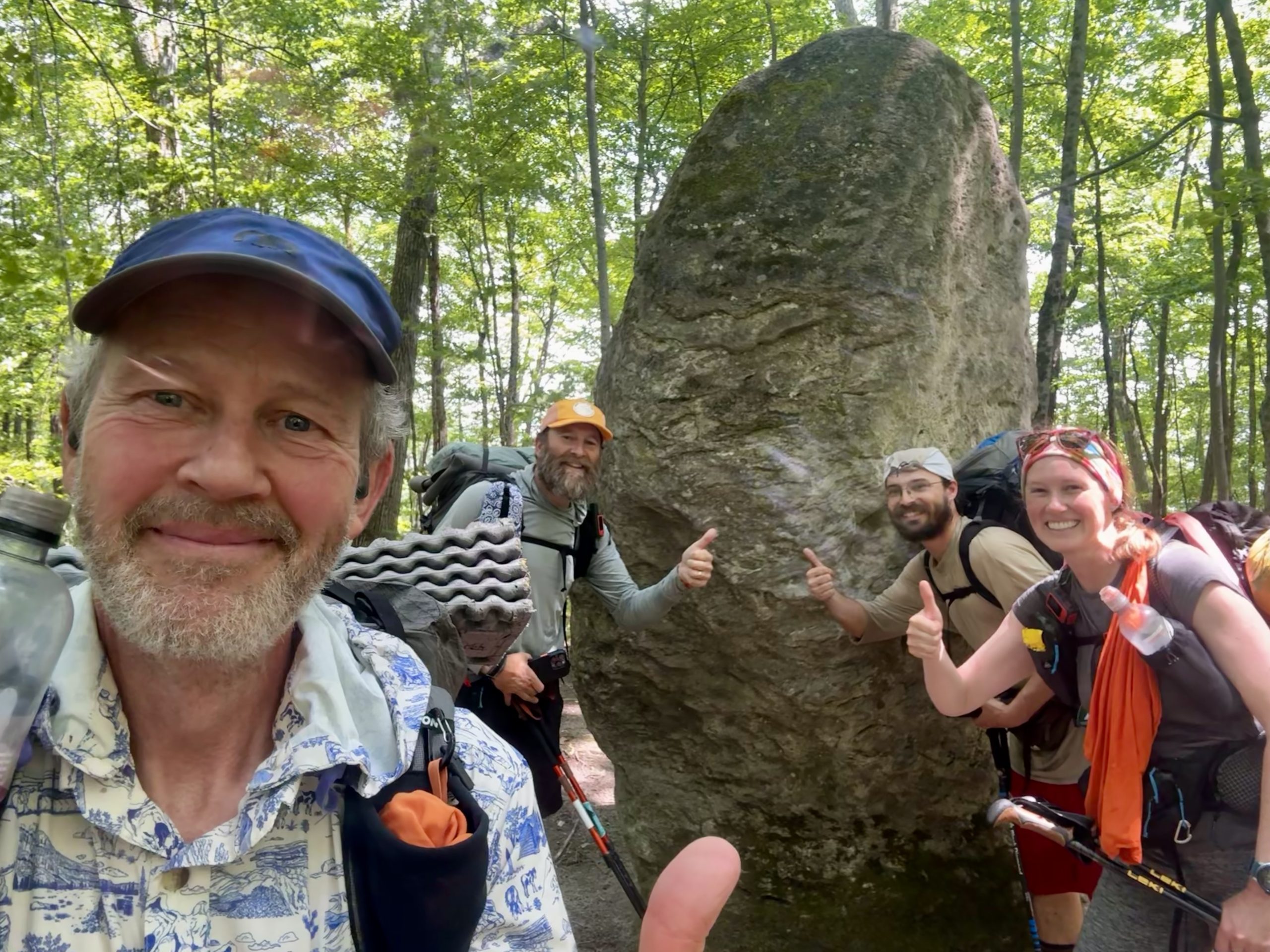
Flyer, Tuck, 54 Cold, and Nightowl. Photo: Scott Hall
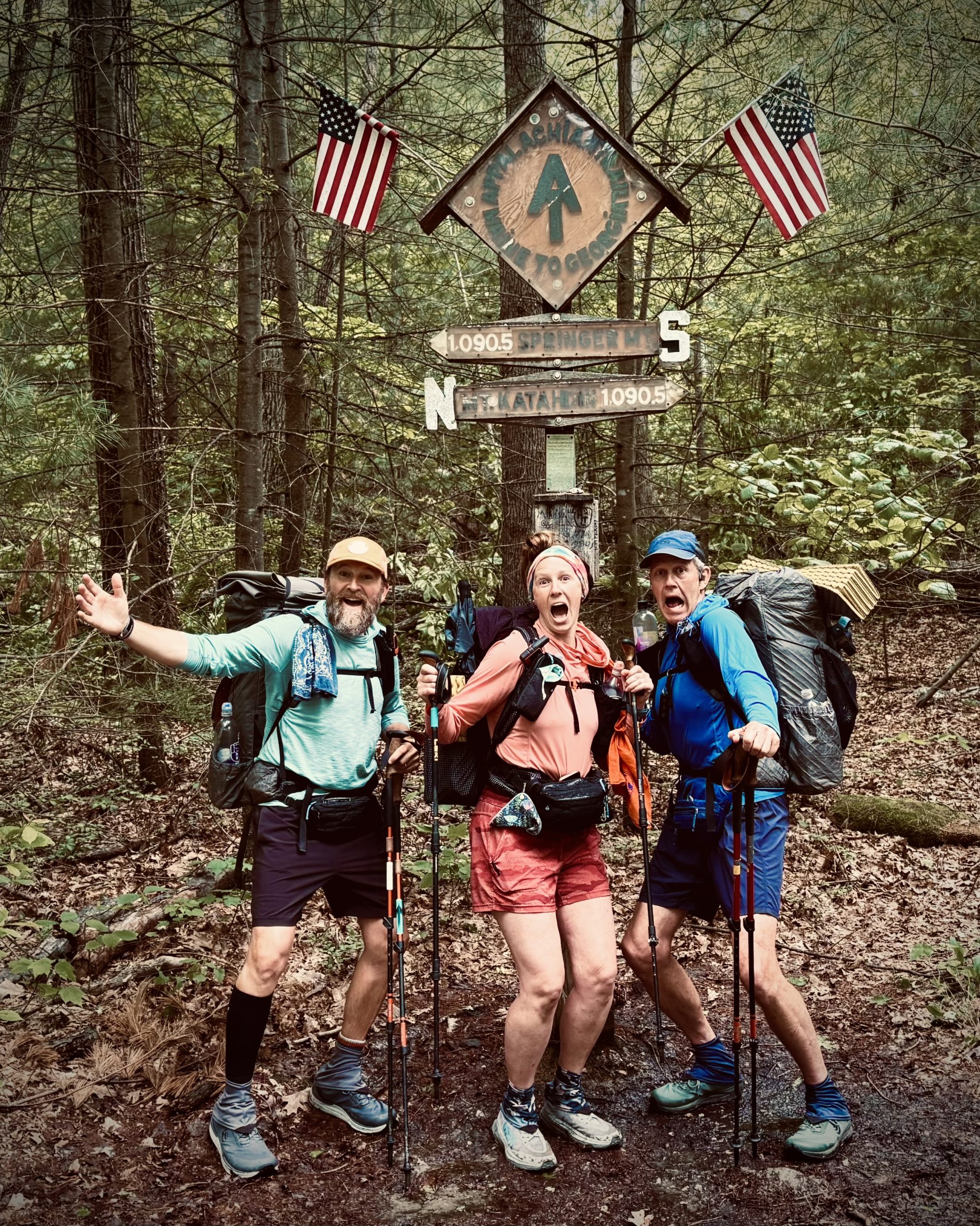
My own journey lasted 4.5 months. I started at 183 pounds and finished at 163. I hiked as “Flyer” — a professor and mental health therapist on my first sabbatical after 30 years, a trail name my students gave me that also happened to be our university mascot. I hiked with Tuck, 54 Cold, and Nightowl, each name its own small story.
Tuck, from Alabama, made a popular daily video log of his experience. Hiking for Alzheimer’s awareness in honor of his father, he had to leave the trail for two weeks in Tennessee — but he came back. 54 Cold got his name by hiking 54 miles alone through the Smokies to Hot Springs in a very cold March. He is one of the most quietly resilient people I’ve met.
Nightowl never quit, even when a sprained ankle forced her off trail in the 100-Mile Wilderness; she returned a month later to summit while we cheered her on from afar. These were the people I’d be walking away from when we descended Katahdin. First, however, we were laser focused on reaching its peak.
Psychologist Alfred Adler coined the term “fictional finalism” — the idea that what we perceive as a final goal doesn’t necessarily end there. There is a trail terminus, yes. But what follows is a transition: physical, psychological, social, and for many hikers, something closer to spiritual.
All thru-hikers know the former and may have heard about the latter. What they’re less prepared for is actually living it.
The Body Comes Home First
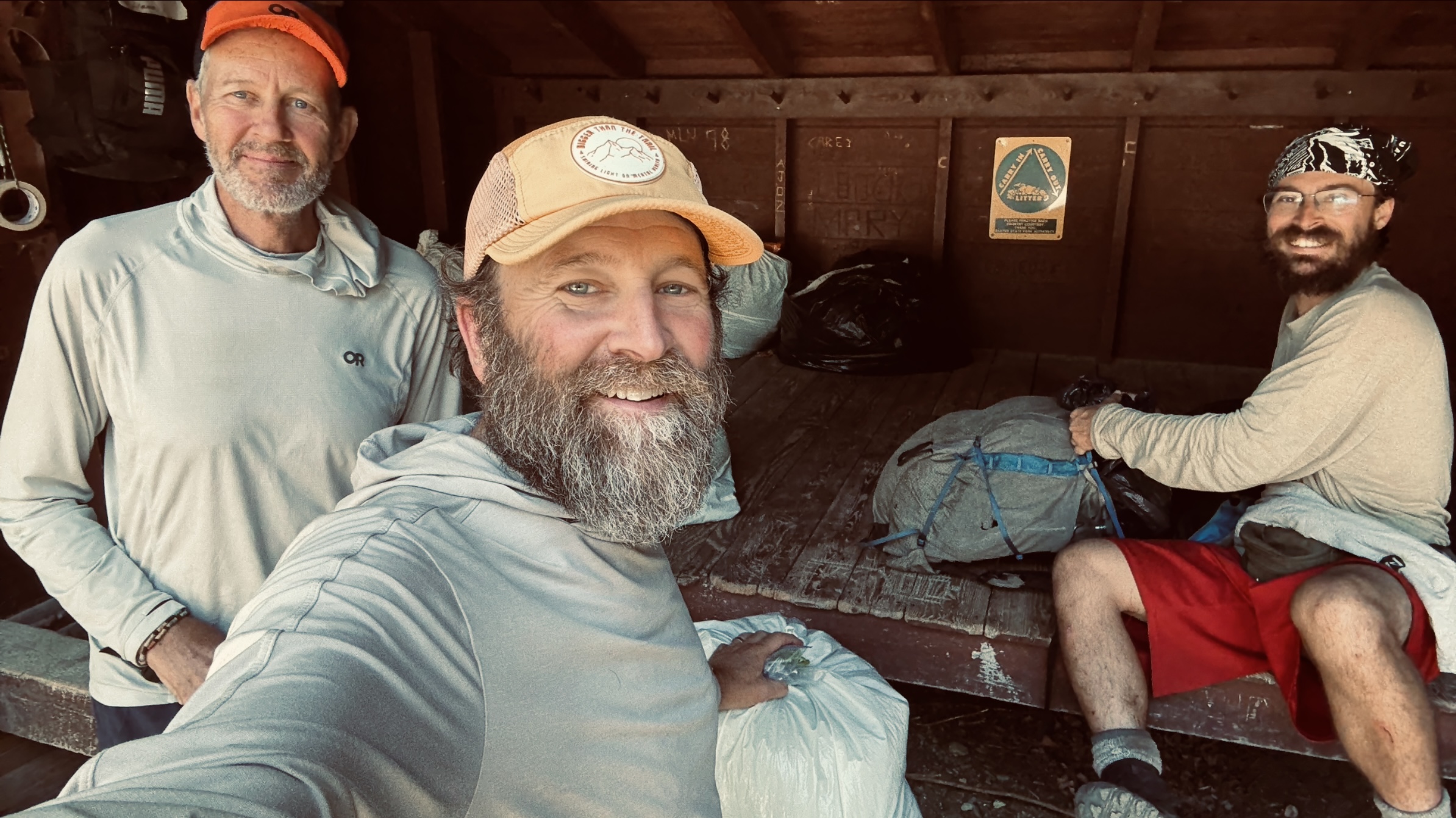
Flyer, Tuck, and 54 Cold after the summit. Photo: Scott Hall
Hiking 10 to 12 hours a day becomes the baseline your body calibrates to. Getting your “trail legs” — that synchronicity between mind and body where covering big miles over mountains stops feeling like dying — takes about two to four weeks.
Once you have them, movement at that scale starts to feel like the natural state of things. The farther up the trail you are, the bigger the gap becomes between what you consider an average day (20-plus miles) and what anyone at home would call reasonable.
And then it stops.
The return home is an abrupt shift in nearly every daily routine. You go from 10-plus hours of movement to a comparatively sedentary life, and the body doesn’t quietly accept the change.
Metabolism doesn’t recalibrate overnight — eating like a thru-hiker (4,000 to 6,000 calories a day) in a body that’s no longer burning it creates its own kind of challenges. Lingering aches and injuries follow you home as reminders of what the miles cost. For me, that meant neuropathy across the front of both feet. It took four months for the feeling to slowly return. Nine months later, there’s still a little numbness.
Sleep becomes its own relearning. On trail, “hiker midnight” is 9 p.m. You’re in your tent by 7 or 8, asleep from exhaustion, up again by 6 to start accumulating miles. Back home, that rhythm breaks — and the particular fatigue that made sleep so clean and immediate doesn’t follow you off the trail.
My first night home, I lay awake well past hiker midnight. My mattress felt overwhelmingly soft compared to my deliberately deflated trail pad, and the distant ceiling made the bedroom feel like a gymnasium. I missed my tent, where I could reach up and touch the boundaries of my world. When I got back, my nighttime routine slowly began to drift back toward binging Netflix until 11, then reading in bed before falling asleep.
What I missed most, however, was the sound of nature. I downloaded an app that woke me to birdsong in a mountain meadow. I slept with my window open just enough to feel a cool breeze. It’s funny how your nose catches the faintest movement of outside air. Ceiling-fan air simply cannot compare to a natural breeze.
Flyer and Scott
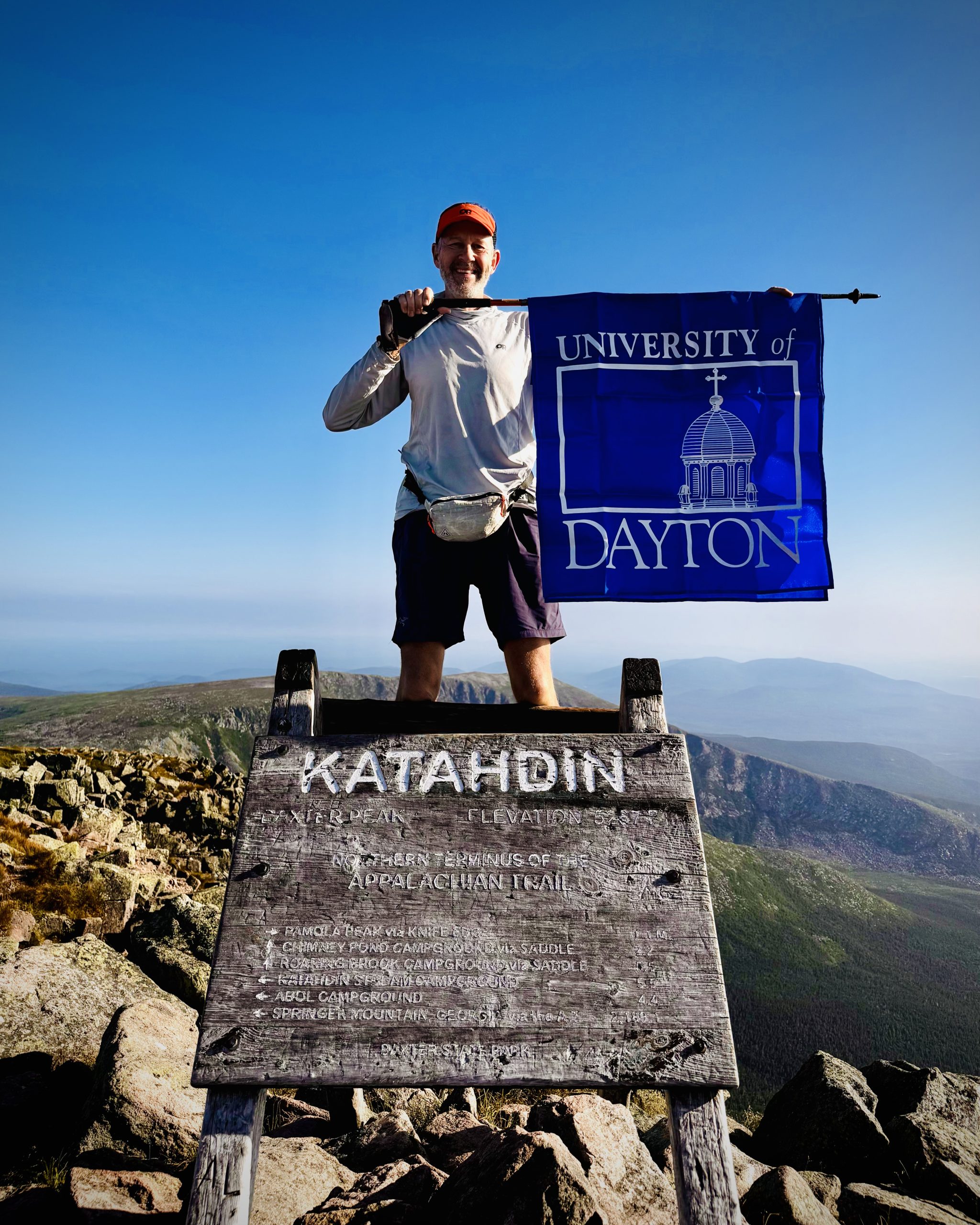
The author at the northern terminus. Photo: Scott Hall
Here’s something nobody warns you about: somewhere along 2,200 miles, you stop being who you were when you started. Usually, it happens before you get out of the Smokies.
On trail, I was Flyer. Back home, I was Scott (along with my professional title) — and with Scott came everything that name carried: the roles, the responsibilities, the accumulating weight of choices and commitments and expectations that I’d set down the day I started walking north.
Trail names keep life beautifully simple. There’s no past attached to them, no performance required. You’re just the person moving through the woods with everyone else who’s also just moving through the woods.
Returning from a thru-hike can bring what hikers call “post-trail blues” — feelings of loss, purposelessness, or low-grade depression after reaching the goal.
It has a clinical shape: identity disruption, loss of community, abrupt removal from a meaningful and structured daily purpose. But living through it feels less like a diagnosis and more like a particular kind of grief. You’re mourning a version of yourself and a way of being that you didn’t know you loved until it was gone.
“How could we be judged?”
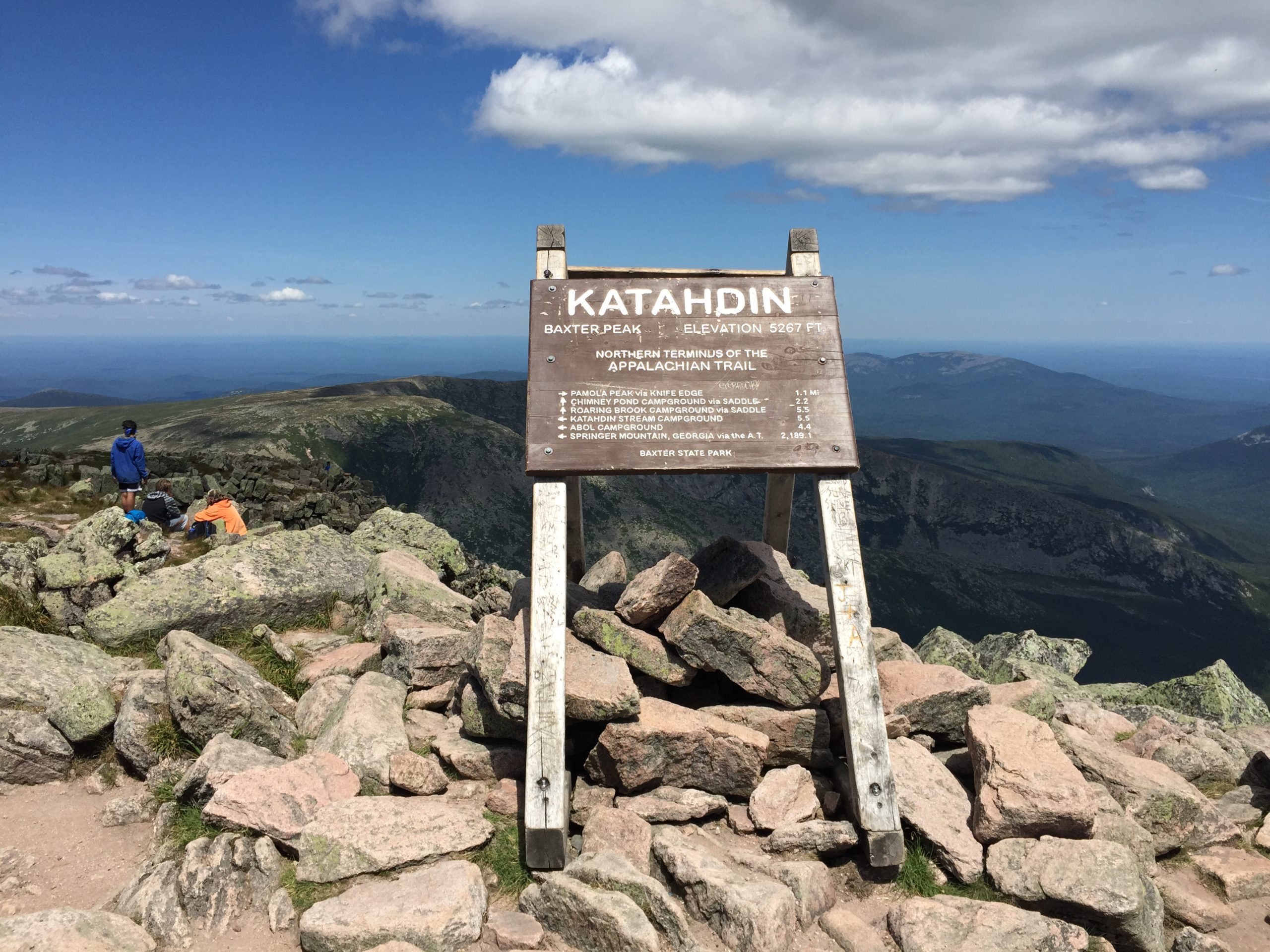
Photo: Wikimedia Commons
Part of what made trail identity so sustaining was the tramily — the trail family that forms and reforms across months of shared suffering and shared purpose. We spoke the same language, held the same goal, accepted each other without audition or judgment.
We’d hike miles alone sometimes, knowing the others were just ahead or just behind. Someone would stop for a moment off the side of the trail and the others kept walking — it was like an accordion at times, coming together at a water source, a lunch stop, or simply because we were done being alone and wanted the shared experience of picking our way through sketchy terrain.
We talked about life, transitions, career, relationships. We could be vulnerable without fear of being judged for it. How could we be judged? We were doing something only 1 in 4 people who attempt it ever finish. That knowing freed us from the fear of being seen as less than, or not good enough. Hard days, shared joys, struggles with people you supported, loved, and respected.
We spent about an hour on Katahdin. We had started hiking at 4 a.m. that morning, headlamps on and packs light, walking silently past tents where red lights were beginning to appear. We wanted the summit to ourselves — just our small group at the NOBO terminus. We took pictures and laughed. We cheered and shared tears. We called loved ones and ate our last power bars.
And then we started walking down as AT thru-hikers, class of 2025. We passed others coming up — a family of six with their own YouTube following, student groups, day hikers making their way up Abol Trail. They marveled at our completion. We just smiled and said, “It’s been an awesome journey.” We didn’t say much going down, because we all knew it was about to end.
Tuck’s family was waiting at base camp with a picnic table full of snacks and drinks. More pictures and laughter. 54 Cold was figuring out logistics back to North Carolina, Tuck was taking a long road trip home to Alabama with his wife. We gave our final hugs and said we’d keep in touch— connected by something shared that can’t be fully explained to anyone who wasn’t there.
I waited another hour for my brother to pick me up and drive me to Maryland to catch a flight home. I waved as the others drove off into the next chapters of their lives. That next hour was surreal. I was alone for the first time in almost five months. I crossed the little bridge near the ranger station and stared down into the shallow water below. I swear it was the clearest, cleanest water I’d ever seen.
Tuck’s was the last face I saw through the car window as they pulled out. Neither of us said anything. We just smiled and gave a slow lift of our hands to wave goodbye.
Coming Back to Noise
I finally arrived home in Dayton, Ohio, just a few weeks before the fall semester started. Routines were patiently waiting — the pantry needed stocking, the grass needed mowing, the plants needed to be moved throughout the house. My neighbors asked questions on walks, and I was glad to answer.
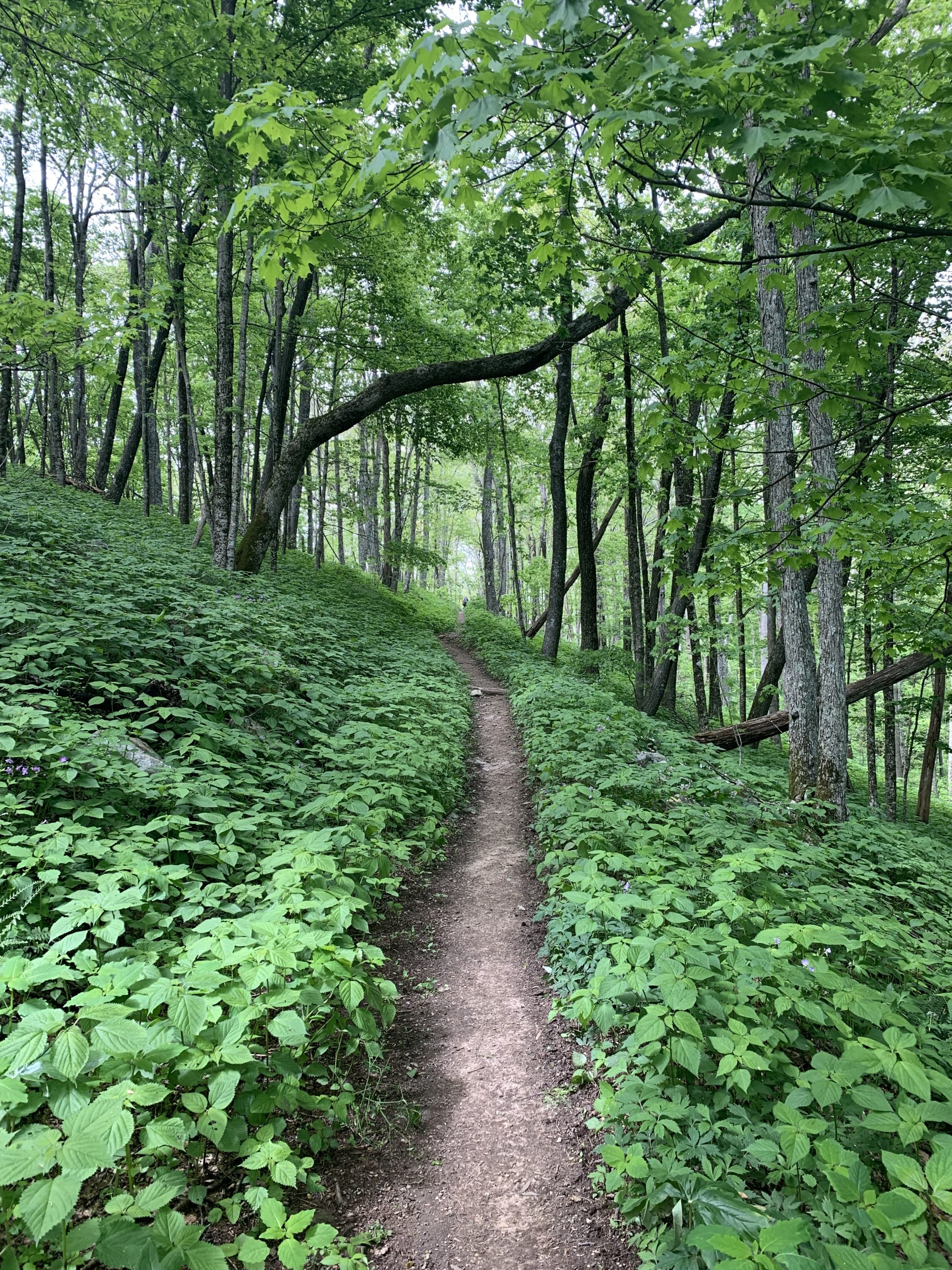
In the evenings, I’d wander through the local trails that connected with my neighborhood, letting myself drift, trying to see the roots and rocks and streams through the same eyes I’d carried from Georgia through Maine. I wanted my brain — my right brain, anyway — to not know the difference so that I would move and breathe like I did on the long trail. It helped. But it wasn’t the same.
The week after I got back, my colleagues threw a welcome-home gathering at a local pub. Big table, beer, appetizers. Conversation flowing everywhere — fast talking, quick gestures, loud voices, laughter, dishes clanking. I tried to jump in and found myself slowly pulling back, trying to fade into the background. My system couldn’t keep up. Too many moving parts, too many simultaneous inputs.
I excused myself, stepped outside, and just breathed. Looked around slowly. Got grounded. Then went back in. Later, a friend told me he’d noticed. “Man, I watched you really pull back.” He was right. What I’d once navigated without thinking now required intentional management.
It had started before that. When my brother picked me up at Baxter State Park the morning I summited, we stayed that night at a hostel in Millinocket. I loved it — the simplicity, the low ceilings, the window fan. My brother was visibly struggling with the gap between hiker luxury and his own.
The next morning we were on I-95, 80 miles an hour, music blaring, and he was giving me a running download on national politics. I had to ask him to turn the music down, slow the car, and stop the commentary. My nervous system was still calibrated for trail pace. The world outside it felt like an assault.
Moving from continuous trail life to back-home daily grind is a transition. When that shift is immediate it’s like skipping five gears at once — the chain comes off the sprocket, the ride becomes clunky, and it just doesn’t work.
The first department meeting was two weeks after I returned. Instead of sitting around a trail shelter, I sat on the sixth floor of an academic building. Surrounding a massive conference table, my colleagues looked entirely comfortable. Despite being a senior professor, I felt alien; the world off-trail moves fast, and it wasn’t slowing down for me to catch up.
Carrying It Forward
Flyer, Tuck, and Nightowl at the AT’s halfway marker. Photo: Scott Hall.
Getting back into the rhythm of work was, in some ways, the easiest part. I’d planned the timing deliberately — finishing before the fall semester — and I had something many returning hikers don’t: a professional context that was hungry for exactly what I’d just lived.
My teaching is rooted in ecotherapy and wellness. The hike wasn’t a detour from that work; it was the work. I realize I was an anomaly, however. Some people leave Katahdin and go back to a job that has nothing to do with what they learned about themselves in such a direct way.
I needed to believe that I was moving forward and not simply moving on. Moving on is when the blues can creep in because there’s a “leaving behind” vibe. Moving forward, however, suggests that although the journey has technically ended, I still carry the moments, feelings, friendships, hardships, lessons learned, and my evolved self into my life back home. We embody the whole journey which never leaves us.
For me, walking became the bridge to re-entry. Not AT-scale walking, but intentional movement through what was available — campus paths, the metroparks, local trails. I tried to bring the same quality of attention: soft gaze, slow movement, actually looking at what was around me. Not the AT. But nature. The distinction mattered less than the practice.
I thought often about what the trail had actually taught me — not the lessons you anticipate going in, but the ones that show up along the way. That being a minimalist is freeing. That built-in pause points aren’t weakness; they’re what keeps you moving.
Every three or four days on trail, we’d take a Nero or Zero — half-day or full day off trail in a town — and it was never a retreat from the goal. It was what made the goal possible. Back home, I started looking for the equivalent: the rhythm of hard effort and genuine rest, without the guilt about the rest.
There was also the matter of what I came back with that I didn’t expect: clarity. I reached a point on the trail — I can’t pinpoint exactly when — where thinking felt sharper, quicker, more trustworthy.
I’d started the hike feeling slow. Forgetful. Uncertain about my own judgment. Somewhere in those miles, that shifted. When I came to long stretches of mud with no way around, I didn’t hesitate. I reoriented instantly — stepping on roots, rock edges, the sides of the trail, planting my poles, moving without second-guessing.
The body knew what to do. And slowly, so did the mind. I don’t think that clarity disappeared when I got home. I think it’s what I’m still learning to trust.
What I’d Tell the Next Hiker

Flyer, Tuck, and 54 Cold at the Northern Terminus. Photo: Scott Hall
Give yourself more transition time than you think you need and pace yourself. What research on stress and recovery suggests — and what I’ve seen clinically — is that the body and mind need structured re-entry, not just willpower. You didn’t start the AT at full speed and the same goes for post-trail life.
Stay close to the trail community in ways that work for you. I joined the next year’s thru-hiker Facebook page to read postings and offer suggestions. Plan regular FaceTime calls with your tramily — the shared language matters. Find local paths intentionally; even a thirty-minute neighborhood walk helps the nervous system remember what it knows. Be patient with the sensory recalibration. The overload is real and it passes.
What doesn’t need to pass is the value you learned to place on being flexible, carrying less, and moving mindfully.
The Trail Doesn’t End at the Sign
The hike doesn’t finish at Katahdin. Most thru-hikers know that intellectually. What they don’t fully know — what I didn’t fully know — is how long the trail continues inside them, and in how many forms.
The Maine clouds I watched on that fourth mountain, carrying my clutter away over the saddle — I still think about them. The reset nature offered me in that moment wasn’t a one-time gift. It was instruction. The trail was showing me something about how to be in the world: lighter, slower, more attentive, less convinced that every input needs an immediate response.
Flyer was shaped on the trail and became a part of my identity. The part of me that brings wisdom from a journey that embraced freedom, connection, beginnings, and meaning. Flyer shows up when I walk around campus or take the six flights of stairs at work. He reminds me to bring a soft gaze when I watch a sunset, and to look for the best in people and offer a hand if needed.
That’s how I know the transition is working. Scott and Flyer is not an either/or choice. It’s a both/and. And I choose for it to always be so.
About the Author
Scott Hall, Ph.D., LPCC-S, is a Professor of Clinical Mental Health Counseling at the University of Dayton, where his teaching and research are rooted in ecotherapy and wellness. In 2025, he completed a northbound thru-hike of the Appalachian Trail under the trail name “Flyer,” a moniker gifted by his university students.
When he isn’t teaching or writing, Scott can be found practicing yoga, dreaming up new adventures to explore, and finding creative ways to share his love of nature and wellness with others.
Featured image courtesy of Scott Hall.

This website contains affiliate links, which means The Trek may receive a percentage of any product or service you purchase using the links in the articles or advertisements. The buyer pays the same price as they would otherwise, and your purchase helps to support The Trek's ongoing goal to serve you quality backpacking advice and information. Thanks for your support!
To learn more, please visit the About This Site page.

Comments 10
Scott, I don’t know how to thank you… This was such a beautiful read, my friend. It echoes my own beliefs, hopes and generally how to approach life. I don’t want to ramble, so just: THANK YOU. I hope to meet you on trail one day.
Bryan
Hey Bryan, thanks much for the kind words and glad my reflections resonated with you! Hope to cross paths along the way as we keep these life adventures going! Cheers
Scott “Flyer”
Flyer…. Great read. You really get a feel as to what the hike meant and did to you. Got me into the initial stages thinking of doing it. Thanks for sharing and for the insight.
Rob.
Hey Rob, thanks for the kind words and glad you’re thinking about the long trail! It’s wonderful and life changing! Cheers
Scott “Flyer”
Adding my smile to yours.
Peace brother
Peace to you, too, Brother 🙂
Thank you for a great article! My daughter and I just finished the Camino Frances and I have been section hiking the AT. I appreciate your suggestions for returning home- especially the idea of giving myself a nero or even a zero day at home!
Hey Carol, congrats to you and your daughter for completing the Camino Frances… no small feat! I’m glad my reflections are helpful, Carol.
Hope you have Happy Trails ahead!
Cheers
Scott “Flyer”
Well said Scott! You truly have a gift with writing and capturing the essence of what the transition truly looks like for most thru-hikers. Praying for your growth and future adventures!
Hey Remy! Thanks so much for the kind words and friendship along the way. You and your family “the 6 Pack” were truly an inspiration to us all and a joy to hike with whenever we crossed paths! I look forward to hopefully meeting up in 26/27. Until then… Happy Trails and Blessings to you and the family! Scott