
 ">
Shakedown and Training Before the Appalachian Trail
Now that I’ve officially announced my Appalachian Trail thru-hike, I’ve been flooded with the same question: How do you even begin to prepare for something like that?
My answer is simple, consistent miles. I hike nearly every weekend, and I spent most of last summer and fall backpacking. Enough miles and nights outside to build strength and momentum, and to finally separate “this might work” from “this absolutely does not.”
After roughly 400 miles and 25 nights outside, I’ve learned what earns its place in my pack and what’s getting left behind for my Appalachian Trail thru hike.
Over the next week or two, I’ll be sharing a full breakdown of the gear I plan to carry on the AT. But this post is less about gear list and ounces, and more about training, gear testing, and a recent winter overnight I completed in the White Mountains of New Hampshire.
The gear I carried on this trip isn’t exactly what I’ll be bringing on the AT, but it’s close.
Training Before the AT
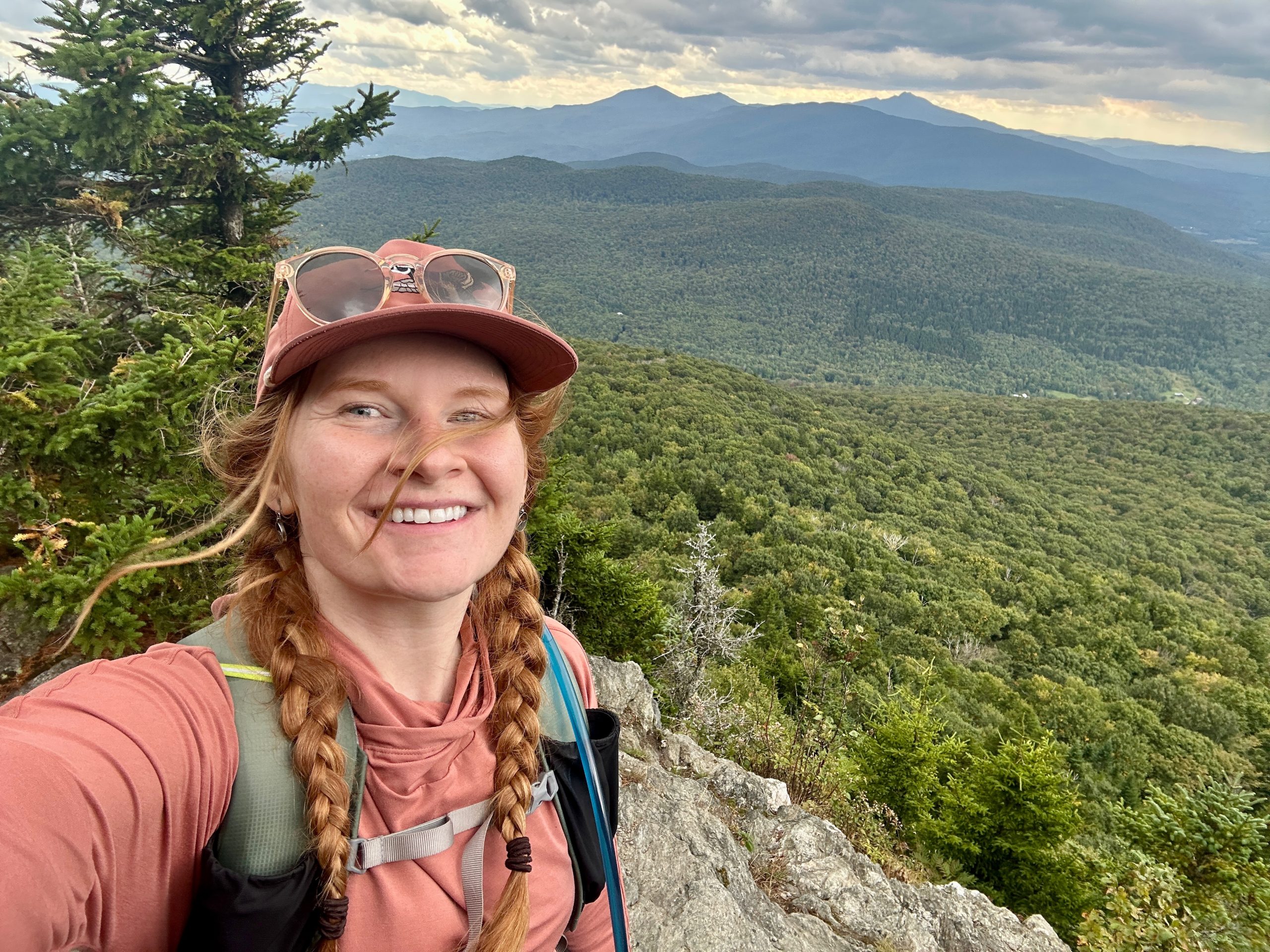
Although 2025 was filled with hiking and backpacking, my last overnight trip was back in mid-October. Since then? Not many big miles. Living in Vermont helps, though. I’m based in the state capital with direct access to Hubbard Park, which has become my go-to training ground. When I can’t get out to hike a mountain, I head there. I can usually crank out 7 to 10 miles on mixed terrain, not rugged, but enough to keep my legs honest.
Going forward, Hubbard is where I’ll start carrying my fully loaded pack. The goal is simple: don’t let my body be completely shocked by the weight when I step onto the AT in March.

Hubbard Park Trails
A Winter Overnight at Gray Knob Cabin
Now, let’s talk about this epic winter overnight over MLK weekend.
My hiking gals and I have had our eyes on Gray Knob Cabin for a while now. Managed by the Randolph Mountain Club, it sits on the northern side of Mount Adams and makes for an incredible winter basecamp. This was my third time hiking in the Presidential Range and my first time experiencing it in the winter.
Packing for the Whites in Winter
The Appalachian Trail actually runs just below Mount Adams’ summit, and thru-hikers can choose whether or not to bag the peak. Since this was a winter mission, I packed for all possibilities: snowshoes, microspikes, ski goggles – the full winter in the Whites toolkit. You never really know what conditions you’re going to get up there, and being underprepared isn’t an option.

This is the Gossamer Gear Gorilla 50 I’ll be taking on the Appalachian Trail. It’s a workhorse of a pack and perfect for four-season adventures; it held my microspikes and snowshoes like a champ.
Sleeping-wise, the cabin had foam mattresses for each guest, so I left my sleeping pad at home. Because we had a warm, solid shelter, I also left my tent behind. Instead, I brought my pillow and my 20-degree down quilt, the same ones I plan to carry on my thru-hike. I packed all the clothing I plan to sleep in on the trail as well: a microgrid fleece, merino baselayer tights, and extra socks.
Pack Weight Reality Check
By leaving my tent and sleeping pad at home, I shaved about two pounds off my pack, but I more than made up for it with snowshoes, multiple layers (including three pairs of gloves and mittens), down booties, microspikes, ski goggles, and a Nalgene instead of Smartwater bottles. In the end, my pack weight was probably very similar to what I’ll be carrying on the Appalachian Trail. I was honestly surprised by how well my body handled a fully loaded pack after nearly four months without backpacking.
One brand-new addition to my kit and something that will be coming with me on the AT is the new Garmin inReach Mini 3 Plus. This was a gift from one of my friends, so I didn’t have much time to get familiar with it before the trip. While at the cabin, I was able to activate it and let my fiancé back home see my location, which was reassuring. That said, I still need more time to put it through an adventure before giving a full review. That will come later, when I do an official deep dive into my gear list.
The Climb to Gray Knob
Now to the hike itself.
The climb from the Appalachia Trailhead to the cabin is 3.5 miles with roughly 3,000 feet of elevation gain. I’ve always found winter hiking easier in some ways. This time of year, the boulders and roots are buried under snow, which can actually make the trails easier to navigate.
There was a ton of fresh snow, a true winter wonderland. We probably should have put our snowshoes on sooner, but it felt like more work to stop and switch gear. Eventually, we made it to the cabin and piled our snowshoes, poles, and spikes outside the door.
When we stepped inside, it was around 30 degrees. The caretaker tended the woodstove around 4:30 p.m., and slowly the cabin grew cozier and cozier. By 8 p.m., it was 60 degrees and felt downright homey, the perfect end to a cold, snowy day.
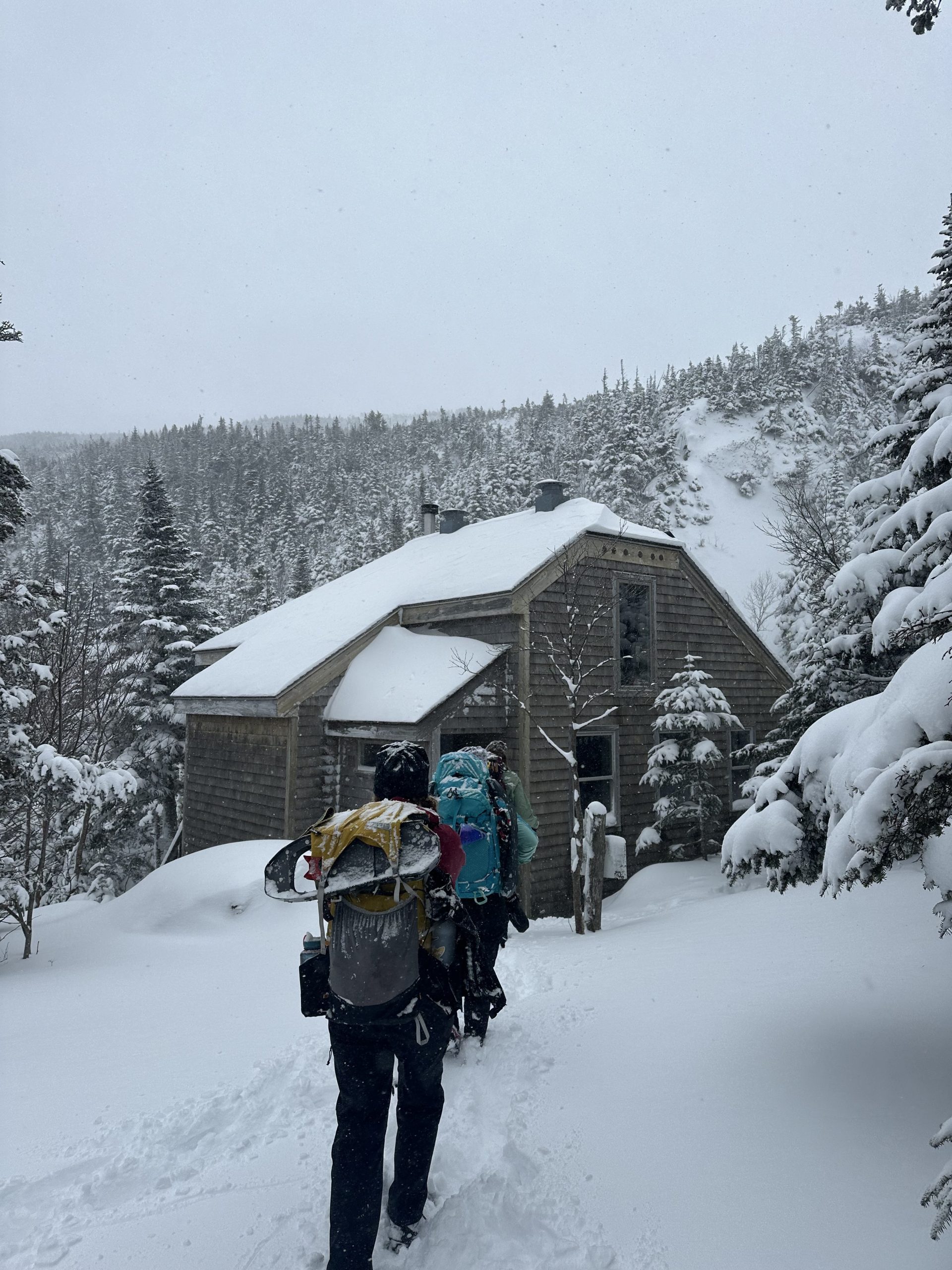
Arriving at Gray Knob Cabin, nestled at 4,372 feet just below the rocky outcropping on Nowell Ridge.
Above Treeline on Lowes Path
The next morning, over breakfast and coffee, we talked through our plans for the day. We were on the fence about attempting to summit Mount Adams. The forecast called for strong, angry winds and wind chills below zero. Since most of us had already hiked Mount Adams, we decided the summit wasn’t the goal. Instead, we just wanted to get above treeline and see what kind of views the mountains were willing to give us.
So we strapped into our snowshoes, bundled up, and headed out. At a junction, we turned onto Lowes Path to climb above treeline and immediately realized we’d be breaking the trail. There were no tracks ahead, just thigh-high snow drifts climbing steeply uphill, with visible swirls of snow being ripped off the ridgeline by the wind. That felt like our cue to stop, pull on our goggles, and add any layers we might want before stepping into a whole new vortex.
Stepping Into the Wind
Fully bundled, one big step at a time, we climbed through deep snow, weaving our way through gnarled fir, spruce, and boulders. Eventually, breaking above treeline, where patches of pale blue sky contrasted sharply against the bright white of the mountains.
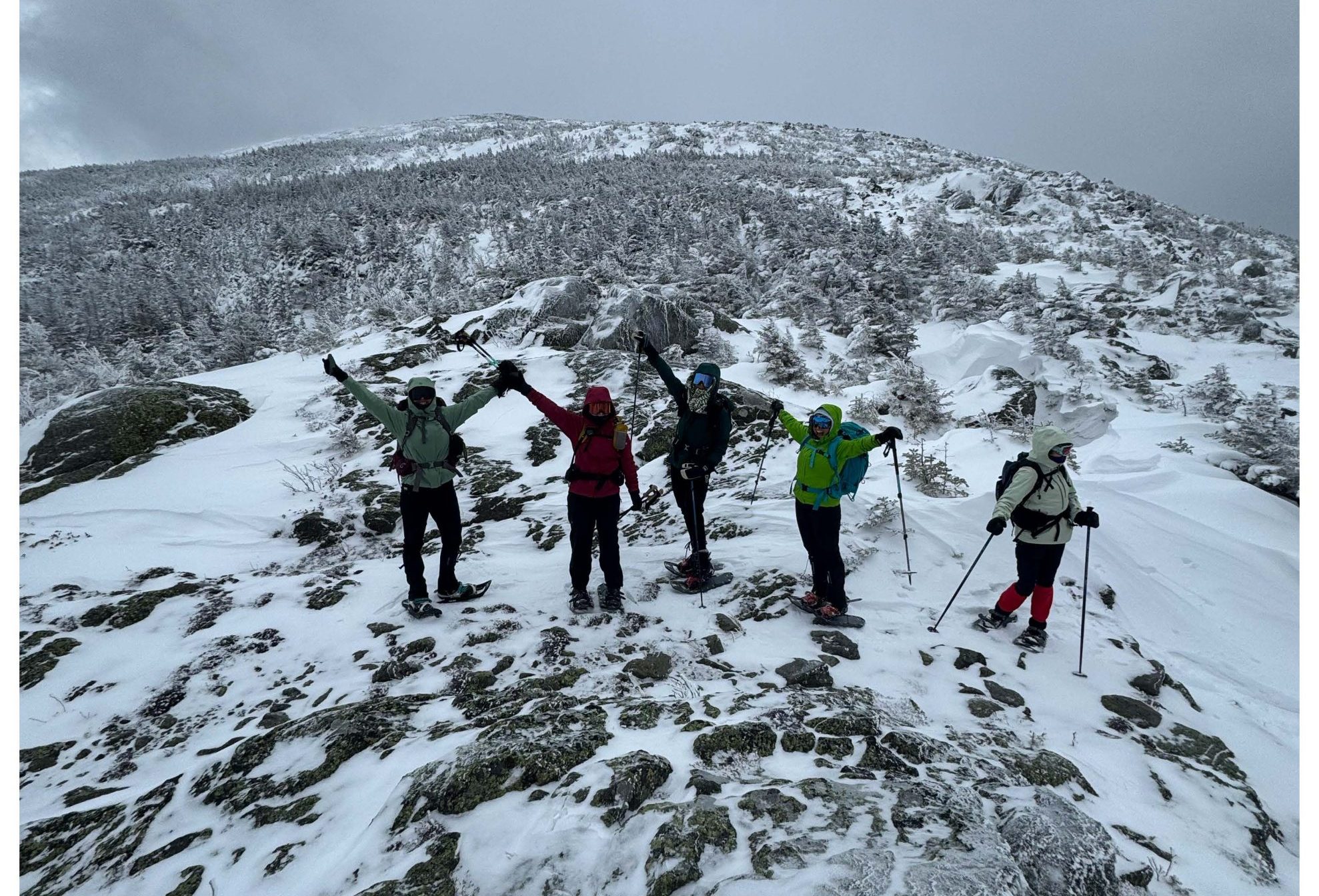
Lowes Path, above tree line, below Mount Adams with the gals.
Much to our surprise, all that bundling made a huge difference. Even with the wind whipping around us, I wasn’t cold. After snapping a few photos, we decided we’d gone far enough, and it was time to descend back to the cabin.
After arriving, we packed up our gear and started the trek down to our vehicles. But not before a quick side mission, we wanted to check out Crag Camp, another cabin managed by the RMC. A short, broken-out trail led us about 0.4 miles from Gray Knob. When we arrived, magnificent views of King Ravine unfolded below Mount Madison and Adams.
From there, we took a spur trail down, breaking the trail again and butt-sliding our way through the steeper sections. Eventually, we rejoined the trail we’d come up on and made it back to the cars, more than ready to celebrate with burgers and brews at Big Day Brewery.
What This Trip Confirmed
This hike confirmed a few important things. First: I’m still in good shape. My body clearly remembers what it’s like to carry a heavy pack. We covered 8 miles with 3,558 feet of gain and 3,537 feet of loss, not a big hike, but enough to be reassuring. I felt strong the entire time, which tells me my body is ready to handle the weight, mileage, and elevation when I step onto the Appalachian Trail in early March.
And the gear I brought for this winter overnight? It’s dialed. I trust it, I’m comfortable with it, and I know exactly how it performs in tough conditions. I’m confident this is a similar setup I’ll be carrying with me when my thru hike begins.


This website contains affiliate links, which means The Trek may receive a percentage of any product or service you purchase using the links in the articles or advertisements. The buyer pays the same price as they would otherwise, and your purchase helps to support The Trek's ongoing goal to serve you quality backpacking advice and information. Thanks for your support!
To learn more, please visit the About This Site page.
Comments 5
Badass AT prep hike!
We stayed at Grey Knob’s during a hike to Jefferson/Adams a long time ago. A very awesome hike. Mind you it was in the summer, but Bravo Zulu on your prep ! I have no doubt you are in shape for the AT.
Love this! Also born & raised Hoosier over here, now living in NC though. Can’t wait to read more about your prep and A.T. thru-hike! It’s such a wonderful trail full of wonderful people.
Awesome, it sure is beautiful up there! Out of curiosity, what’d you use to attach your snowshoes to your pack?
Hey James! I had enough room to use the fold-over lid of my pack to strap them down. I was worried that the spikes of the snowshoes would rip my pack but the material held up well! On different backpacks, I would use the side straps to buckle the snowshoes to, but with the Gossamer Gorialla, those side straps are very thin, and I was worried they wouldn’t hold the weight of the snowshoe.