
 ">


The Top Backpacks on the Appalachian Trail: 2025 Thru-Hiker Survey
In this next installment of the 2025 Appalachian Trail survey, we’re covering everything about backpacks! We take a look at the frame type and capacity hikers chose as well as their base weights and how they changed. As always, we’ll go over the top brands and models of packs that were used on the trail this year before wrapping up with some final thoughts on the trends we saw this year.
This year, we received 279 responses from the AT Class of 2025. If you’re using this as a resource to help plan your 2026 AT hike, make sure to sign up to take the survey yourself next year! Hit the button below to be notified when the 2026 AT Thru-Hiker Survey opens for submissions so you can help the Class of 2027 in their trail planning.
Sign Up to Take the 2026 AT Thru-Hiker Survey!
Frame Type
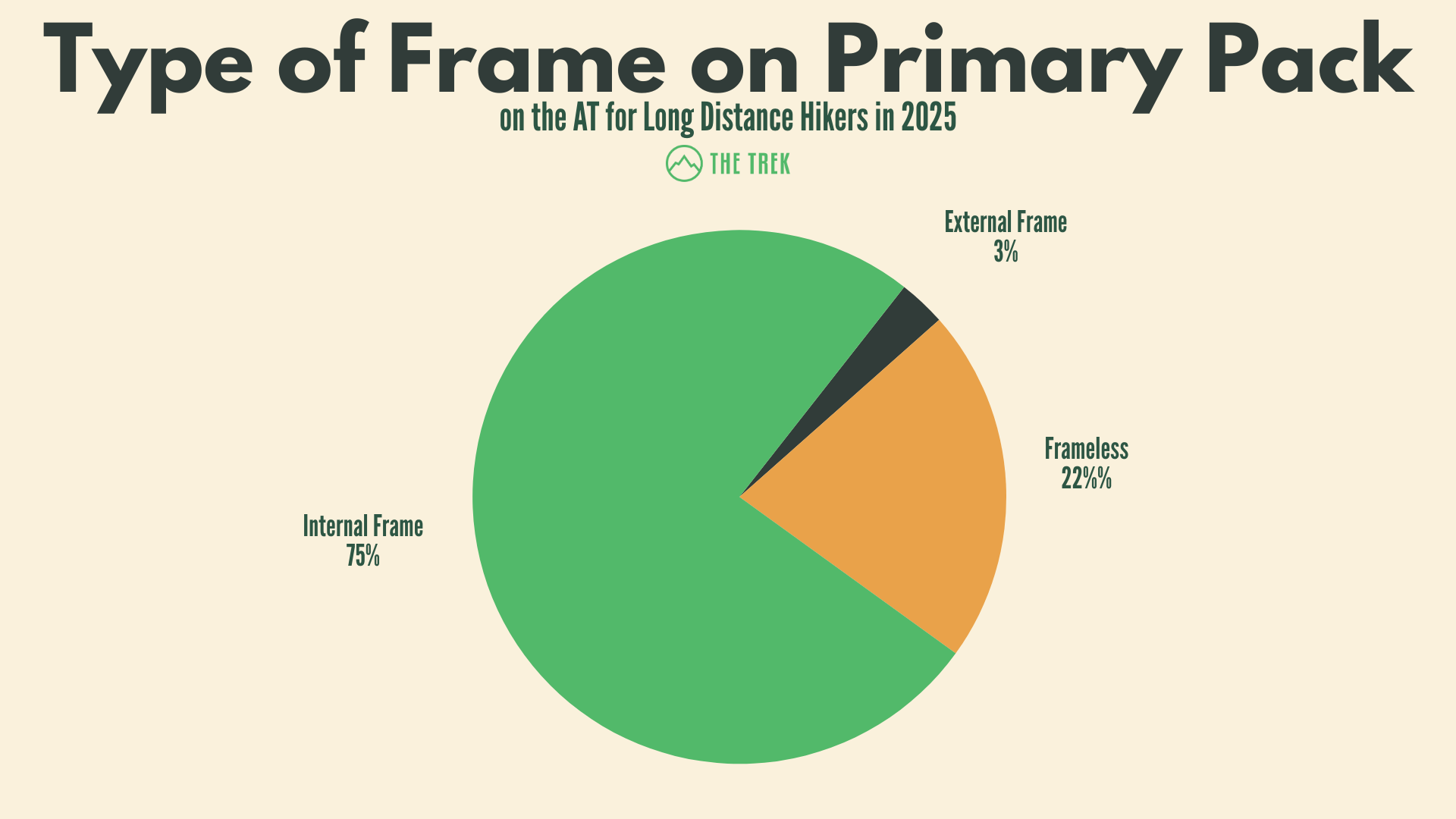
Internal frame packs have been the most popular type of pack on trail for quite some time.
Frameless packs have gained popularity since we started this survey 10 years ago, but the numbers have been largely stable for the past few years. However, this year we see a fairly large spike in frameless pack usage compared to last year’s 17%.
READ NEXT – Top Backpacks on the Appalachian Trail in 2024: The 2024 AT Thru-Hiker Survey (last year’s data)

While frameless packs have gained popularity over the years, internal frame packs continue to dominate. I doubt we will ever see that ranking switch, but it will be interesting to watch in the coming years to see if the gap between the two shrinks further. Additionally, I wonder in which year we will see our first survey with 0 respondents using an external frame pack.
Hikers Who Switched Packs

Packs aren’t commonly exchanged during a thru-hike: 71% of hikers this year kept the same pack throughout their hike. Of those who did switch, most chose a different model for their replacement pack. The few who did replace with the same pack often cited company warranties as their reason.
Some of the reasons hikers gave for switching to a new pack are as follows (lightly edited for spelling and grammar):
“I started SOBO with a frameless pack, but in November in Virginia, I changed to a Gossamer Gear Mariposa to accommodate my winter gear.”
“Switching from the Flash 55 to the Flash Air 50 (REI’s ultralight pack) made such a difference. I don’t think I can ever go back to a non-ultralight pack.”
“Zpacks Arc Haul Ultra wore out. My hip belt became squished, and also the pack did not stay comfortably on my back when not loaded with gear. Their hip belts are sized oddly, so this meant I had to buy a smaller hip belt on trail because my back was hurting too much to hike.”
Capacity

The most popular pack size fell between 50 and 59 liters, with the average pack capacity sitting at 53L. This is very consistent with previous years, as is the distribution curve across other sizes.
In previous years, we’ve looked at this data for section hikers and thru-hikers separately. However, this year, the average for thru-hikers was 52L while the average for section hikers was 54L. The difference does not appear significant this year.
Base Weight

We asked hikers what their base weight (the weight of all their gear minus worn items and consumables such as water and food) was at the beginning and end of their hikes.
Across all hikers surveyed, the most common range of starting base weights was 15-20 pounds, with most hikers falling in that range both at the start and end of their hikes. The spread across the weight ranges is similar to last year. You’ll notice that the majority of hikers are clustered toward the lighter end of the scale, but there is a long tail extending all the way past the 40-pound mark.
The average starting base weight for hikers was 20 pounds, and the average ending base weight was 18 pounds, meaning that, on average, hikers tended to drop two pounds of gear from their packs along the way.
Only a small handful of hikers were officially “ultralight” by the common benchmark of having a base weight below 10 pounds.
These numbers have stayed quite consistent over the decade of conducting this survey.
Top Brands and Models
Last but certainly not least, we asked hikers about their favorite backpack brands and models they used this year. Osprey was once again the top brand, but the top model this year is a tie between the Durston Kakwa and the ULA Circuit. The top brands remained remarkably stable from last year, except that HMG narrowly snagged the 2nd place spot from ULA, and Durston surpassed Gossamer Gear to take 4th place.
All of the top brands are listed below, along with some of their most popular models. The top models are listed in a table below. Hikers rated their level of satisfaction with each model on a scale of 1 to 10, with 10 being the most satisfied; those data are included in the table as well.

The three most-worn backpack brands on the AT in 2025 were Osprey, Hyperlite Mountain Gear, and ULA. Durston and Gossamer Gear packs also garnered a lot of answers, while the “Other” category encompasses brands receiving fewer than 3 mentions in the survey.
1) Osprey (61)
2) Hyperlite Mountain Gear (35)
3) ULA (32)
4) Durston Gear (27)
5) Gossamer Gear (22)
6) Zpacks (17)
- Arc Haul Ultra (12)
7) REI (14)
8) Granite Gear (7)
8) Gregory (7)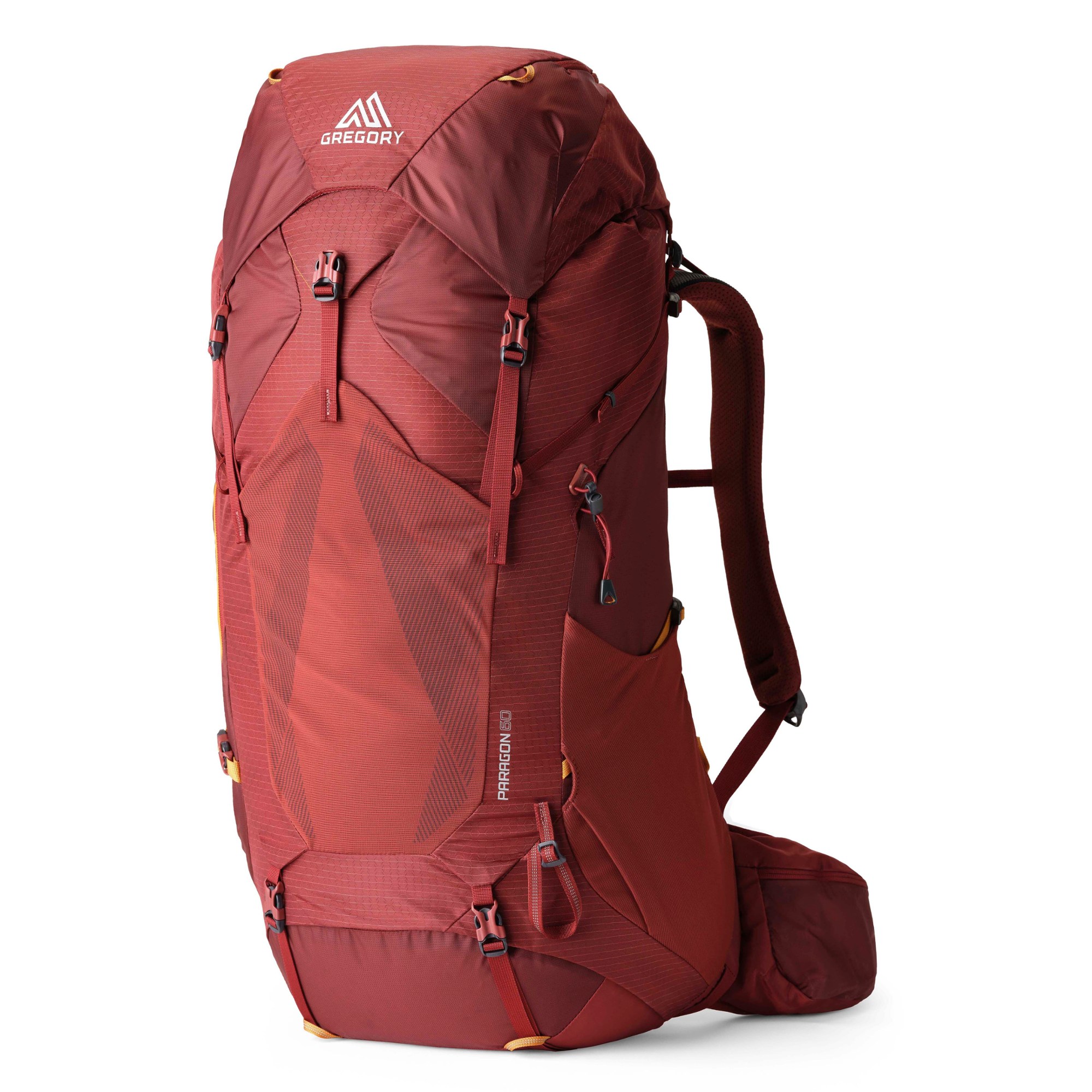
- Jade (2)
8) LiteAF (7)
- Curve Frameless (5)
- Curve Full Suspension (2)
Top Backpack Brands on the AT
| Rank | Brand | Responses |
|---|---|---|
| 1 | Osprey | 61 |
| 2 | Hyperlite Mountain Gear | 35 |
| 3 | ULA | 32 |
| 4 | Durston Gear | 27 |
| 5 | Gossamer Gear | 22 |
| 6 | Zpacks | 17 |
| 7 | REI | 14 |
| 8 | Granite Gear | 7 |
| 8 | Gregory | 7 |
| 8 | LiteAF | 7 |
Top Backpack Models on the AT
| Rank | Model | Responses | Satisfaction Rating |
|---|---|---|---|
| 1 | Osprey Exos/Eja | 33 | 8.9 |
| 2 | ULA Circuit | 24 | 8.5 |
| 2 | Durston Gear Kakwa | 24 | 8.4 |
| 4 | Gossamer Gear Mariposa | 14 | 7.7 |
| 5 | Zpacks Arc Haul | 12 | 7.9 |
| 5 | Hyperlite Mountain Gear Southwest | 12 | 9.0 |
| 6 | Osprey Atmos/Aura | 11 | 7.5 |
| 7 | REI Flash 55 | 10 | 7.6 |
Summary
- Internal frame backpacks continue to be the dominant choice, although this year saw a notable spike in frameless pack usage compared to the previous year’s 16%.
- 71% of hikers kept the same pack for the entire duration of their hike. Of the 29% who switched, most chose a different model, often citing comfort/fit adjustments or specific seasonal needs.
- The most popular pack capacity fell between 50 and 59 liters, with an overall average capacity of 53L. This average was consistent between thru-hikers (52L) and section hikers (54L).
- Hikers carried an average starting base weight of 20 pounds and an ending base weight of 18 pounds, dropping an average of two pounds of gear as they progressed.
- Osprey remained the top backpack brand overall, while the top individual model was a tie between the Durston Kakwa and the ULA Circuit.
Thank you!
Congratulations to all the Appalachian Trail hikers this year — and a huge thank you to all of you who took the time to fill out the survey! The upcoming post will cover stoves, rain gear, filters, and more. To stay up to date on the latest survey posts, make sure to subscribe to our newsletter.
More from the 2025 AT Thru-Hiker Survey:

This website contains affiliate links, which means The Trek may receive a percentage of any product or service you purchase using the links in the articles or advertisements. The buyer pays the same price as they would otherwise, and your purchase helps to support The Trek's ongoing goal to serve you quality backpacking advice and information. Thanks for your support!
To learn more, please visit the About This Site page.

Comments 2
You say ULA and Kakwa are the most popular model, but in the number Osprey Exos/Eja is higher, how come? Do you consider Exos and Eja to be different bags?
For years I’ve dreamed of one day hiking in America, but it now seems like that dream feels less tangible — and perhaps less safe — than it once did. In the meantime, I’ll keep finding inspiration and comfort in the stories shared on this blog.