
 ">


The Best Backpacking Sleeping Bags of 2026
We’ve established the best backpacking homes (tents!), beds (sleeping pads!), how to carry them (packs!) and now it’s time to choose your comforter (sleeping bag) for the next five to six months of your life. It’s a crucial piece of gear because it 1) weighs a lot, 2) usually costs a lot, and 3) without it, you’re in danger of a cold, miserable night at best or life-threatening exposure at worst.
Because a crappy night’s sleep is the fastest way to ruin the trip of a lifetime, you should opt for one of the best possible backpacking sleeping bags for your next hike. In assembling this list, we considered factors like weight, warmth, price, materials, and features to identify top-performing bags for every type of backpacker.
Looking for a quilt? Check out the Best Backpacking Quilts instead.
Quick Navigation
Best backpacking sleeping bags for thru-hiking this year:
- Feathered Friends Tanager (Best Hoodless Sleeping Bag)
- Zpacks Mummy Sleeping Bag (Lightest Mummy Sleeping Bag)
- Western Mountaineering UltraLite (Best All-Around)
- NEMO Riff 15 Endless Promise (Best Sleeping Bag for Side Sleepers)
- REI Magma 15 (Top Sleeping Bag on the Appalachian Trail)
- NEMO Forte 35 Endless Promise (Best Synthetic Backpacking Sleeping Bag)
- Kelty Cosmic 20 (Best Budget Down Sleeping Bag)
Best Backpacking Sleeping Bags for Thru-Hiking: FAQs
Sleeping bags are expensive and weirdly complex. Before we get into our picks for the best backpacking sleeping bags for thru-hiking, here are a few pointers to help make the decision easier.
What temperature rating should I use for thru-hiking?
Most Triple Crown trail thru-hikers should be fine with a bag rated between 15 and 30 degrees. You know yourself, though. If you tend to sleep cold, opt for something rated to a lower temperature. When in doubt, the rule of thumb is to go with a bag rated at least 10 degrees lower than the lowest temperature you expect to encounter on your hike. Alternatively, carry a lighter bag supplemented with a liner.
It’s important to keep in mind that for men’s and unisex bags, the temperature ratings listed in the product name (Nemo Forte 35, Kelty Cosmic 20, etc.) usually denote the lowest temperature at which an average warm sleeper might still feel comfortable (“limit”). Sleeping bags also have a secondary temperature rating (“comfort”) that indicates the lowest temperature at which an average cold sleeper might stay comfortable.
Check the label — the comfort temperature might be 10-plus degrees warmer than the number given in the model name.
For instance, the men’s Nemo Riff advertises the limit rating (15 degrees), but the comfort rating is 28 degrees. Big difference.
In contrast, women’s bags tend to advertise the comfort rating in the product name. This is because women generally run colder than men, so the comfort rating is more relevant.
Learn more about temperature ratings in The Ultimate Guide to Backpacking Sleeping Bags and Quilts for All Budgets.
Are sleeping bags or quilts better for thru-hiking?
Data suggests that quilts are more popular than traditional sleeping bags for thru-hiking. Quilts are more weight-efficient, but they tend to feel a bit draftier/not as warm as sleeping bags on the whole.
Quilts are essentially sleeping bags without the underside, saving the weight of a full-length zipper and part of the bulk. The idea is that when you lie on a down-insulated sleeping bag, the down compresses enough that it no longer insulates. Instead, it’s your sleeping pad that provides most of your insulation from the ground.
The general consensus is that most quilt models are not quite as warm as a mummy bag with the same rating. That being said, they are rapidly growing in popularity among thru-hikers: two-thirds of respondents to our annual Appalachian Trail Thru-Hiker Survey reported using a quilt on the AT in 2025.
Quilt aficionados appreciate the weight savings and freedom of movement their sleep system affords them. If you opt for a quilt, be sure to get a model wide enough to tuck around your shoulders to avoid drafts. Because you’ll be missing out on the thermal benefits of a traditional insulated mummy hood, you may want to consider wearing a beanie or a separate down hood on cold nights. If you tend to sleep cold and prefer a snug, tucked-in feel, go for a traditional mummy bag.
What’s the difference between men’s and women’s sleeping bags?
Women’s sleeping bags differ somewhat in size and shape from men’s and unisex sleeping bags, and the insulation is often distributed differently throughout the bag. They are also usually marketed with the Comfort temperature rating (see above). Despite these differences, there is no reason a woman can’t use a men’s bag or vice versa, depending on your needs and preferences.
Women’s bags have a different down distribution based on a general understanding of heat loss — for instance, a women’s bag might have a higher concentration of down around the torso and in the footbox.
Women’s-specific bags are also wider in the hips and narrower through the shoulder, and are often smaller in width and length. This means less empty space to heat up and keep warm.
As mentioned above, women’s bags are more likely to advertise comfort temperature ratings in their branding. For instance, the women’s Nemo Riff 15 bag is rated to keep an average cold sleeper comfortable at 18 degrees, while the men’s Riff 15 is only rated to keep an average cold sleeper comfortable down to 28 degrees. It’s worth noting that both of these sleeping bags cost the same — just saying.
Moral of the story: if you want the warmest possible version of a sleeping bag and your proportions allow it, opt for the women’s model.
What are fill power and fill weight in a backpacking sleeping bag?
Fill power indicates how lofty the down is, while fill weight indicates the amount of insulation by weight contained in a sleeping bag. Backpacking bags should have a fill power of at least 700, while the fill weight will be a function of the bag’s size and temperature rating.
Fill weight: The amount of insulation in a sleeping bag determines how warm it will be. Different insulation types (synthetic, down of varying fill powers) all have different weights for the same amount of loft, but looking at the fill weight is a good starting point when researching a bag’s warmth.
Fill ratio: This is the fill weight divided by the overall weight of the bag (including shell fabric and zippers). A bag with a lower ratio can still be warm — it might just mean it has more zippers or thicker fabric. However, the higher the fill ratio, the more efficient the bag’s design.

Down vs. Synthetic Insulation for Backpacking
Down is more compressible and has a better warmth-to-weight ratio than synthetic, making it the ultralight insulation of choice. On the other hand, it’s also much more expensive and won’t provide much warmth if it gets wet.
Goose vs. duck down: Duck down is less expensive than goose down, but you won’t find duck down loftier than about 650-fill. It also has more of a smell when it gets damp. In contrast, goose down is available in 850, 950, and even 1000-fill.
Hydrophobic down: Some down has a hydrophobic treatment that allows it to retain some loft (and by extension, warmth) if it gets wet, bringing it more in line with synthetic fill’s superior performance in wet conditions.
Synthetic fill: Synthetic (polyester) insulation goes by branded names like PrimaLoft and Polartec. It’s bulkier and heavier than down, but this might be a worthy tradeoff for budget-conscious hikers since it costs a fraction of what down costs. And technologies are continuing to evolve, with some synthetic fills like Climashield Apex feeling almost as warm and compressible as real down.
Should I get a sleeping bag with water-resistant down?
Getting a bag with water-resistant down is a good idea but not strictly necessary. Treated down will give you some added protection in case your sleeping bag gets wet (such as from rain or condensation inside of your tent). However, some experts feel that water-resistant down reduces the insulation’s performance under normal conditions.
Treated down will retain its loft and insulating abilities for significantly longer than untreated down, but you still need to prevent your bag from getting saturated. There are a few varieties of treated down on the market—keep an eye out for Nikwax, DriDown, DownTek, and HyperDry.
If you’re really concerned about your down getting wet, a synthetic sleeping bag is another option. As discussed above, this kind of insulation has some drawbacks. Synthetic fill has come a long way in the past few years, but down still has a higher warmth-to-weight ratio overall.
What features should I look for in a backpacking sleeping bag?
Popular sleeping bag features include a draft collar, two-way zipper, stash pocket, and pad sleeve. If you’re planning a long-distance trek, you may want to forgo some of these in favor of weight savings.
Two-way zipper: Half zippers save weight, but they’re not versatile. With two-way full-length zippers, you can open up the bottom to vent heat on warm nights.
Draft collar: An insulated tube that hangs around your neck and shoulders to cut airflow. Often optional.
Stash pocket: In cold weather, you’ll want to sleep with your electronics, water filter, and maybe a few other things. An internal pocket goes a long way toward maintaining order inside your bag in that scenario.
Water resistance: DWR shell fabrics, water-resistant down, waterproof footboxes … Anything you can do to avoid a sodden sleep system is a win.
Dark colors: Black/dark-colored bags absorb heat and dry faster than lighter colors. This one simple feature will save you time and help keep your bag in decent shape when it inevitably gets wet from tent condensation.
Responsible manufacturing processes: If you opt for down, ensure the insulation was ethically sourced by checking for Responsible Down Standard accreditation.
If it has a durable water repellent (DWR) coating, check that the brand is using PFC-free DWR, a more environmentally conscious choice that is quickly becoming the industry standard.
Other things to look for in this category include the use of recycled and/or Bluesign-approved materials, emissions-reducing manufacturing processes, and fair labor practices.
How do I care for my backpacking sleeping bag?
No matter what you choose, remember to treat your sack-o’-fluff with care. A sleeping bag is a big and important investment. It can mean the difference between a comfortable night’s sleep and sheer misery, keeping you safe in plummeting temperatures.
During sunny breaks, shake out your sleeping bag and let it dry in the sun. As often as possible, remove it from the compression sack to allow a full loft, and never store it compressed when you’re not hiking.
After a season of heavy use, wash your sleeping bag to keep it fresh and lofty for years to come. (Both down and synthetic sleeping bags require special care at the laundromat: read this article and maybe watch a few videos to ensure you don’t accidentally ruin your bag by washing it wrong.)
About Our 2026 Picks
Sleeping bags are simpler than tents and packs. They’re essentially bags of feathers, and the biggest variable will be choosing between a quilt or mummy bag (see above). There’s sufficient diversity in the sleeping bag/quilt market that we’ve chosen to break traditional sleeping bags and quilts into separate listings. For this review, we’ll focus on traditional mummies.
We’ve chosen a selection of bags that are lightweight, durable, and highly customizable — thru-hiker-centric models with good warmth-to-weight ratios. Be sure to check out all of the customization options for each model to fit your particular needs — many brands (especially cottage industry) have build-your-own options for fill power, temperature rating (all listings are in Fahrenheit), width/length, and even color.
Since so many of these models have an array of customization options, we’ve based our specs (price, weight, fill, dimensions, etc.) on the 20-degree stock model (or whatever rating is closest to 20 degrees Fahrenheit).
The following sleeping bags are listed in no particular order.
The Best Backpacking Sleeping Bags for Thru-Hiking in 2026
Feathered Friends Tanager (Best Hoodless Bag)
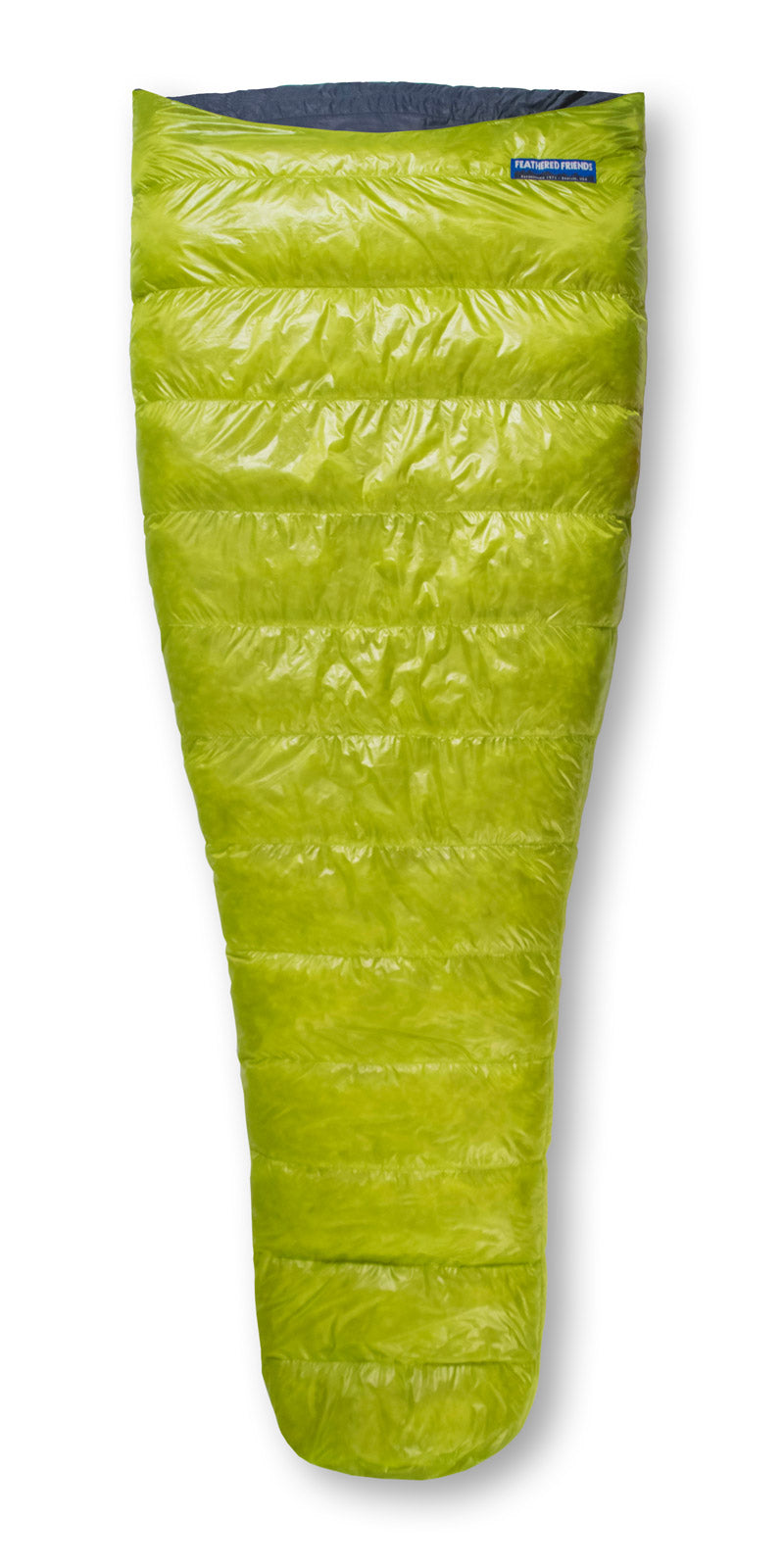
Best backpacking sleeping bags: Feathered Friends Tanager.
MSRP: $489
Weight: 19.9 ounces
Fill Weight: 13.2 ounces
Fill Ratio: 0.66
Comfort/Limit Temperature: n/a (not ISO-rated) but FF’s ratings are considered accurate for comfort — in this case 20 degrees
Insulation: 12.6 ounces of 950-plus-fill down
Details
Made in Seattle, Feathered Friends bags come with a hefty price tag, but the craftsmanship, customer service, and overall quality make their bags a worthy investment. The Tanager weighs scarcely more than a pound — less than many 20-degree quilts — but has many of the draft control benefits of a traditional sleeping bag.
The Tanager saves weight over a traditional mummy by using ultralight materials and eliminating not just the bulky hood, but also the zipper. You enter and exit by shimmying through the top opening.
A full two-thirds of this bag’s 20-ounce weight is devoted to down feathers, giving it the best warmth to weight ratio on this list. For hikers who don’t like the constriction of a mummy hood or simply don’t find a hood necessary, this is a great option from one of the best companies in the business.
Materials and Features
Insanely floofy 950-fill down is sandwiched between a Pertex Endurance 7D water-resistant shell and a 15D ripstop nylon liner. The collar has a drawcord so you can cinch it around your neck during cold weather.
Nobody’s Perfect
The Tanager’s hoodless, zipperless design isn’t for everyone: scooching in and out the sleeping bag’s narrow top opening can be tough. Some users also find it quite narrow. The difficulty of getting in and out or moving around inside the bag may lend itself to sleeping bag claustrophobia, even though it lacks a constricting hood. If you find yourself overheating, you also can’t unzip to dump heat.
The Tanager is designed to be paired with a lightweight, hooded puffy like the Feathered Friends Eos for optimal warmth on cold nights, which could be a drawback for folks who prefer not to sleep in their jackets. For a more traditional mummy design from Feathered Friends, check out their Hummingbird model.
Shop the Feathered Friends Tanager
Zpacks Mummy Sleeping Bag (Lightest Mummy)
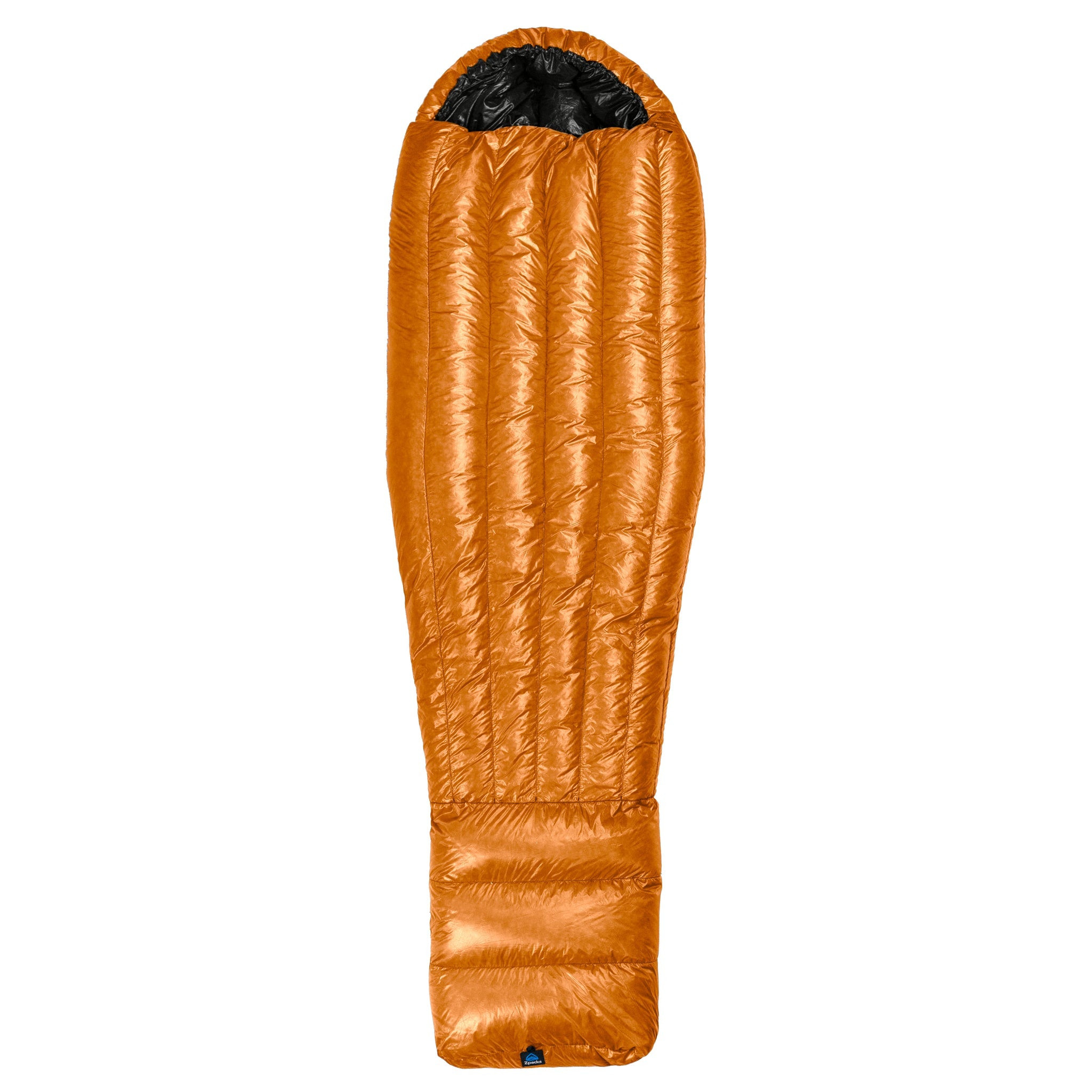
Best backpacking sleeping bags for thru-hiking: Zpacks Mummy
MSRP: $599*
Weight: 23.2 ounces
Fill Weight: 15.6 ounces
Fill Ratio: 0.67
Comfort/Limit Temperature: n/a (not ISO tested)
Insulation: 900-fill Muscovy duck down
*Price and weight/fill weight for the standard-medium size
Details
At 23 ounces, the Zpacks Mummy Sleeping Bag is taking our prize for the lightest mummy bag this year, although it just missed out on the Most Imaginative Name award. Maybe next year.
There are lighter sleeping bags on the market, but most of them shave weight by eliminating the hood or opting for an uninsulated false bottom — legitimate design choices, but for those who want the most traditional version of a sleeping bag, this Zpacks bag is your most ultralight choice. If you’re open to a somewhat unconventional design, we recommend checking out the 17-ounce Cumulus Aerial 330, which retains a traditional mummy taper and hood but has a false bottom and no zipper.
Zpacks sleeping bags aren’t rated according to ISO standards, but the brand says the 20-degree temperature rating roughly aligns with the ISO “transition” range, meaning it falls somewhere between Comfort and Limit. Our reviewer agrees and recommends that you upgrade to the 10-degree mummy if you’re looking for true comfort around 20 degrees Fahrenheit.
Materials and Features
The Zpacks Mummy’s scant weight penalty is all the more impressive considering that this is far from the most minimal design on the list. It has a two-way, full-length zipper that wraps around the bottom of the footbox, a design carryover from the brand’s hoodless Zip Around sleeping bag, and a draft collar that pairs with cinchable cords in the hood and around the collar to lock out cold air. The baffles are even 30% overstuffed in anticipation of eventual down compression.
Sow how did Zpacks make the mummy so light? The bag’s ultralight materials account for much of the weight savings, namely the high fill-power down and ultra-thin 7-denier Ventum ripstop nylon fabric. The fabric is treated with PFAS-free C0 DWR.
Nobody’s Perfect
Would be nice to see this actually ISO-rated so that meaningful temperature comparisons with other brands would be possible. Zpacks sleeping bags have honestly caught a lot of flak in the UL backpacking forums over the years, with some users saying the bags don’t live up to their temperature ratings and that they don’t trust the construction quality and ultralight materials.
Our reviewer observed an unusually high rate of down leakage from her bag, which could be due to the thin 7D fabric. Finally, it costs $579, which is … a lot.
Shop the Zpacks Mummy Sleeping Bag
Read our review of the Zpacks Mummy Sleeping Bag.
Western Mountaineering UltraLite (Best Quality Backpacking Sleeping Bag)

Best backpacking sleeping bags for thru-hiking: Western Mountaineering UltraLite.
MSRP: $640 – $685
Weight: 29 ounces
Fill Weight: 16 ounces
Fill Ratio: 0.55
Comfort/Limit Temperature: 25/14
Insulation: 850+ fill down
Details
A slim design and high-quality, made-in-the-US construction define this classic Western Mountaineering bag. The temperature rating is accurate thanks to smart down distribution, multiple shock cord cinches to protect against drafts, and a thick draft collar. The zipper stays blessedly snag-free, and the hood is deep enough to feel secure while moving around.
For ultralighters looking for a Western Mountaineering quilt (and who don’t sleep cold), the NanoLite weighs 11 ounces, retails for $380, and is rated to 38 degrees — about as high a temperature rating as most thru-hikers should risk.
It’s difficult to recommend a Western Mountaineering bag without also discussing Feathered Friends. Both of these US companies have a well-deserved reputation for excellence; in terms of build quality and premium materials, they are the best of the best. If you can afford a sleeping bag from either, you’ll probably be happy with your choice, so just pick the one with the specs you like best. The Feathered Friends Hummingbird is most comparable to Western Mountaineering’s UltraLite.
Materials and Features
The UltraLite has 16 ounces of 850-fill down and a beefy draft collar to seal the heat in and the drafts out. The shell is a tough yet breathable ExtremeLite technical fabric. The hood and collar both have shock cord cinches to seal you off from the elements. Plus, this is another brand made in the US.
Nobody’s Perfect
Like the Feathered Friends Hummingbird, the shoulders are on the narrow side, which is beneficial for heat retention, but some people might find it confining. It also boasts the same soul-crushing pricetag as the Hummingbird despite weighing a quarter-pound more (or, looked at another way, it weighs the same as the REI Magma below, costs $180 more, and is only a couple degrees warmer).
Shop the Western Mountaineering UltraLite
NEMO Riff 15 Endless Promise Men’s | Women’s (Best For Side Sleepers)

Best backpacking sleeping bags for thru-hiking: Nemo Riff 15
MSRP: $400 – $450
Weight (Riff 15): 39 ounces (women’s: 52 ounces)
Fill Weight: 19 ounces (women’s: 30 ounces)
Fill Ratio: 0.49 (women’s: 0.57)
Comfort/Limit Temperature: 28/17 (women’s: 18/5)
Insulation: 800-fill duck down
Details
Nemo’s signature spoon-shaped (or hourglass-shaped) cut was designed with side sleepers in mind. It leaves more room at the knees and elbows so you can roll, shift, and generally flop around unencumbered throughout the night. An integrated pillow pocket accommodates a spare puffy or hiking clothes just as well as an actual camp pillow, while the two Thermo Gill vents on the top of the bag can be easily unzipped to dump heat on warmer nights.
We also considered the Big Agnes Sidewinder for the “best for side sleepers” category, as that sleeping bag was purpose-built for side sleepers and tends to review well. But in our judgement, Nemo bags are higher quality overall, and the brand’s spoon shape design works well for side/rotisserie sleepers while retaining maximum versatility. The brand also wins points in the sustainability department.
All that being said, if you’re a serious side-sleeper, the Sidwinder is a bit cheaper and worth a look before you make a final decision.
Read our review of the NEMO Riff.
Materials and Features
The Riff is one of Nemo’s classic sleeping bags, but the 2024 model got a big update with its addition to Nemo’s Endless Promise collection. Essentially, the bag was redesigned with streamlined materials, rendering the entire sleeping bag fully recyclable. When your Riff is worn out, you can ship it back to Nemo on the company’s dime and they’ll make arrangements to have it recycled. Which is pretty awesome.
Worth noting: another Nemo sleeping bag on this list, the synthetic Forte, is also now fully recyclable. More on that later in the article. The Nemo Disco is also Endless Promise now, and is basically the Riff but made with somewhat lower-end materials at a higher weight and lower price point.
A generous 19 ounces* of high-quality 800-fill, Responsible Down Standard-certified down ensures that the Riff is plenty warm, and the PFC-free hydrophobic treatment on the insulation helps it to retain that warmth when wet. A DWR-treated 20D nylon ripstop shell provides an additional line of defense against moisture.
*Or, for the same price but significantly more weight, you could get a women’s bag with a whopping 30 ounces of insulation.
Nobody’s Perfect
The Riff is on the narrow side for a Nemo bag, streamlined for weight savings rather than luxury. For a roomier (and more affordable) bag that’s still friendly to side sleepers, check out the Disco (men’s/women’s). At 39 ounces for the men’s version, this 15-degree bag is the heaviest down sleeping bag on the list.
REI Magma 15 (AT Thru-Hikers’ Favorite)

Best backpacking sleeping bags for thru-hiking: REI Magma
MSRP: $399 – $419
Weight: 35.6 ounces (medium)
Fill Weight: 23.3 ounces
Fill Ratio: 0.65
Comfort/Limit Temperature: 21/9
Insulation: 850-fill water-resistant duck down
Details
Long-distance hikers skew heavily pro-quilt these days, and the AT is no exception. But as far as traditional mummies go, the Magma has been a clear favorite in our AT thru-hiker survey over the years. The Magma used to come in men’s and women’s versions, but it was revamped in 2024 and is now a unisex bag. However, it comes in nine different sizes ranging from Short Narrow to Long Wide, a reflection of REI’s push toward size inclusivity in their gear.
Comparing the unisex Magma’s specs to those of the men’s and women’s Magma of old, it appears that the new version falls somewhere in between the old men’s and women’s versions in weight, fill weight, and comfort rating, skewing closer to the specs of the former women’s version. For reference, the former women’s version weighed 36 ounces, had a fill ratio of 0.65, and had a tested comfort rating of 18 degrees.
Materials and Features
In addition to the new size range, the updated Magma also features a three-quarter length zipper that wraps over the chest a bit rather than going straight up to the shoulder, which is supposed to make it easier to get in and out of. It also has a small stash pocket for small items like a headlamp.
The fabric is now recycled ripstop nylon instead of name-brand Pertex Quantum.
Nobody’s Perfect
The Magma has a great warmth-to-weight ratio, but you pay for that coziness with a hefty 36-ounce weight penalty. While not a deal breaker, that does put this bag near the top of our list in terms of weight. Also, people appear to hate the stuff sack it comes with.
Nemo Forte 20 Endless Promise Men’s | Women’s (Best Synthetic Backpacking Sleeping Bag)

Best backpacking sleeping bags for thru-hiking: Nemo Forte
MSRP: $200 – $250
Weight: 53 ounces (women’s: 60 ounces)
Fill Weight: 18 ounces (women’s: 28)
Fill Ratio: n/a
Comfort/Limit Temperature: 29/18 (women’s: 21/9)
Insulation: Zerofiber 800
Details
Although synthetic sleeping bags can’t yet compete with down for weight and packability, they wipe the floor with their feather-filled competitors when it comes to budget. They’re also the sleep system of choice for vegan hikers and any others who eschew animal products in their gear.
Nemo’s signature Thermo Gills (the orange slash thingies in the picture above) can be opened to dump heat on warm nights or zipped up to trap heat when the mercury drops.
The Forte is significantly lighter than many other synthetic bags in a similar temperature range and is comparable in weight to many similarly warm 650-fill down bags.
The latest version of this sleeping bag also gives it a huge boost in the sustainability department. Keep reading to find out how.
Materials and Features
In 2023 the Forte became the first product in Nemo’s new Endless Promise collection. Basically, the Forte is Nemo’s first fully recyclable sleeping bag (the Disco and Riff have since joined the collection and are also now recyclable).
Rather than making the sleeping bag out of a bunch of different types of polymers, 90 percent of the Forte (other Endless Promise products) is made from a single material family — in this case, polyester — making it far easier to recycle.
Many components of the bag are made with recycled materials to begin with, too, keeping the whole resource stream nice and circular. The outer shell and inner lining are both made with 100 percent recycled polyester (ripstop and taffeta, respectively), while the insulation itself is Nemo’s new proprietary 100 percent recycled polyester fill, Zerofiber PCR.
When your Forte eventually crosses the rainbow bridge, you can request a return shipping label from Nemo and send the bag back to the company to be recycled.
Nobody’s Perfect
Falling between three and four pounds for both the men’s and women’s versions, the Forte is noticeably heavier than other bags on this list. Functionally, many hikers who really want a synthetic sleep system opt for a quilt instead to keep the weight under control.
Shop the Women’s Nemo Forte 20
Kelty Cosmic 20 Men’s | Women’s (Best Budget Down Sleeping Bag)
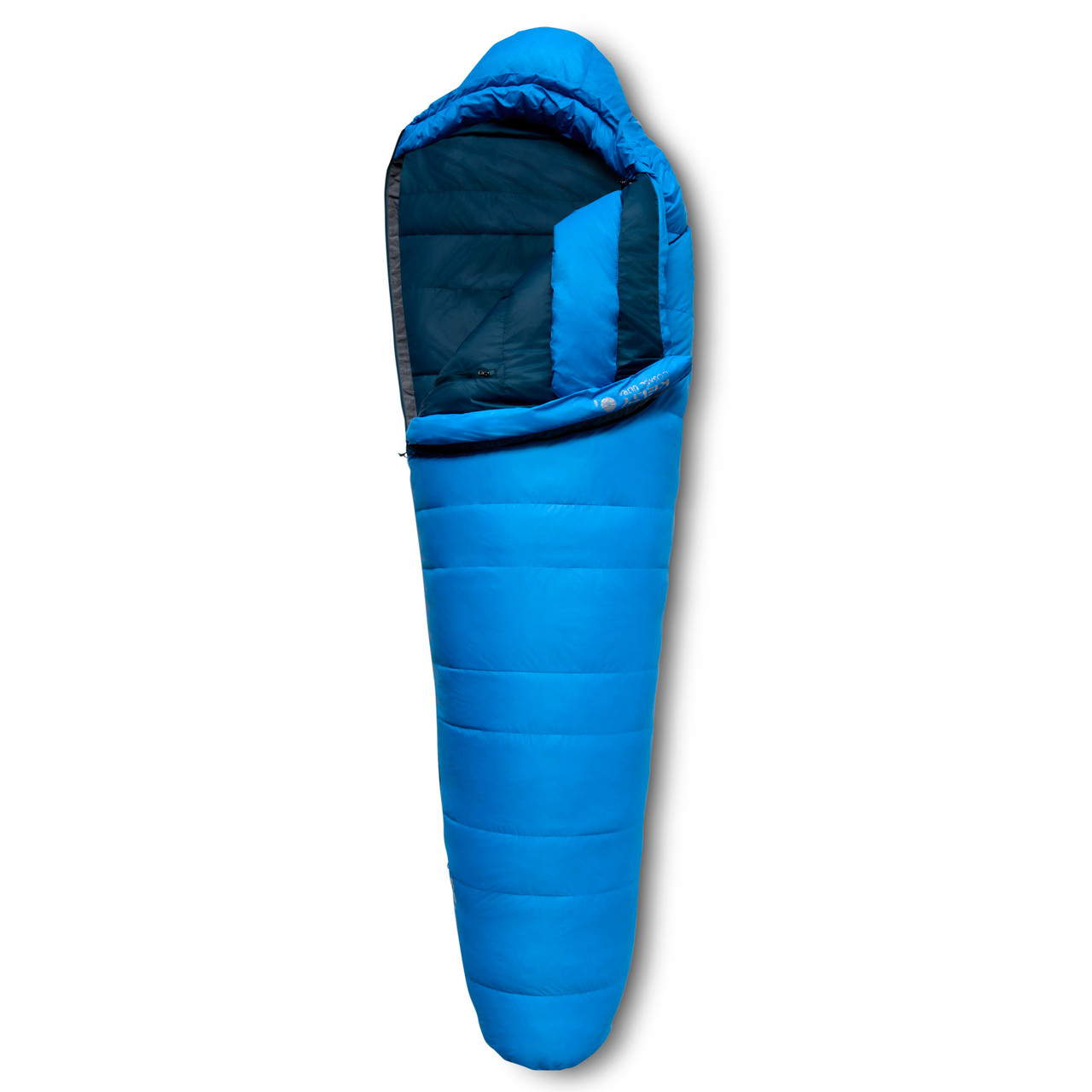
Best backpacking sleeping bags: Kelty Cosmic Ultra 20
MSRP: $190 ($240 women’s)
Weight (Cosmic 20): 35 ounces (women’s: 53 ounces)
Fill Weight: 14.3 ounces (women’s: 29.6 ounces)
Fill Ratio: 0.41 (women’s: 0.56)
Comfort/Limit Temperature: 31/21 (women’s: 25/13)
Insulation: 550-fill down
Details
We think the Cosmic does a reasonable job of balancing affordability and quality, making it an actual, realistic choice for budget backpackers. At 35 ounces for the men’s regular, the weight is quite competitive. (The women’s is a tougher sell at 53 ounces for only a few more degrees of rated warmth).
The bag’s 20-degree temperature rating (31 degrees for comfort) puts it well within the target temperature range for most thru-hikes. The Cosmic features trapezoidal box baffles, which allow down to pile up under the seams to minimize heat loss, and a trapezoidal footbox that allows your tootsies to lie more naturally.
Materials and Features
The Cosmic keeps the price down by using less-than-premium materials, including a combination of 20D recycled nylon taffeta + recycled 50D polyester taffeta for the shell and liner and 550-fill down for the insulation. While not the most ultralight,we appreciate Kelty opting for recycled and PFC-free fabrics, and the higher denier should boost durability as well.
The bag isn’t devoid of handy features, either. Kelty says its trapezoidal baffles trap more heat than traditional ones, and the bag has a two-way zipper so you can unzip from the bottom and vent your feet on warmer nights.
Nobody’s Perfect
Hikers for whom cost is a primary concern can still spend a lot less if they opt instead for an inexpensive synthetic model, but again, it’s going to weigh more. And it’s understandable given how much more insulation is in the women’s bag compared to the men’s, but it does kind of suck that the women’s version costs more than 25% more, given that many other brands keep the pricing the same between the two.
The Cosmic’s 550-fill down is a lot less lofty than the minimum 700 fill power we typically recommend in backpacking sleeping bags. You will be able to feel the difference: this bag won’t compress as much as higher-end down options.
Shop the Men’s Kelty Cosmic 20
Shop the Women’s Kelty Cosmic 20
More of the Best Backpacking Gear of 2026
Why should you trust us?
Because we’re so incredibly intelligent! Attractive, too. (Not to mention extremely humble).
But if that isn’t enough to impress you, there’s also the fact that everyone who contributed to this article is an experienced thru-hiker with thousands of on-trail miles under their belt. We’re gear nerds who love putting our equipment to the test on trails long and short, and we’ve tested dozens of sleeping bags in pursuit of a better night’s sleep in the backcountry.
Moreover, we survey hundreds of Appalachian Trail thru-hikers every year to learn about their behaviors, demographics, and — you guessed it — gear preferences. That means our picks for the best backpacking sleeping bags for thru-hiking aren’t just our opinions: they’re based on years of feedback from the thru-hiking community.
Check out AT hikers’ favorite backpacking sleeping bags for thru-hiking according to the 2023, 2024, and 2025 thru-hiker surveys.

Competence and backpacking proficiency personified.
Original article by Maggie Slepian. Alex “GPS” Brown, Rachel Shoemaker, and Owen Eigenbrot contributed to this list.
Featured image: Graphic design by Chris Helm.

This website contains affiliate links, which means The Trek may receive a percentage of any product or service you purchase using the links in the articles or advertisements. The buyer pays the same price as they would otherwise, and your purchase helps to support The Trek's ongoing goal to serve you quality backpacking advice and information. Thanks for your support!
To learn more, please visit the About This Site page.

Comments 19
Hi, I’d love know how many of the sleeping bags could accommodate a pillow in the hood area. It’s hard to tell from the photos. Thanks!
Thank you for the super informative article, this was extremely helpful as I am in the process of “upgrading” my bag. I currently have the REI Joule 21 which is a solid bag, but am looking for something warmer and am also hoping to find something that isn’t as constricting around the head/neck area. I was wondering if you or anyone had any recommendations for stomach sleepers? I know I’m not the norm and I have tried to change my sleep position as I know it’s not conducive to camping but if anyone has found a bag that has worked for them or one that they think might work, I’d really appreciate it! 🙂
I may be biased…. but no love for the Hyke and Byke?! 800-fill down for ~$200 and fun colored bags….. literally cannot beat it. A budget backpackers dream.
I’m in the market for a bag so I appreciate this article. I’m also looking at the Rab Mythic ultra 360. Any reason you decided not to include it in your analysis?
I have to note that the Magma is often on sale. That is the only way to buy it.
When you say „limit temperature is what keeps you from freezing to death“, that’s not quite accurate. The way you phrase it it’s more what is being referred to as „extreme temperature“ in general, and typically that’s well below „limit temperature“. The European standard for sleeping bags defines „limit temperature“ where a male sleeper in base layers can still get a decent night of sleep when crouched up in embryo position, ie no significant shivering.
Stefan, yeah OK that is a fair point. *Melodrama alert*
The post has been updated to reflect that more accurate language.
I disagree strongly with the statement that anything above 950 fp is “just fluff”. None of the brands you evaluated offer more than 950, so I’m skeptical that you even tried a 1000 fp product. Check out the Trailheadz Ethereal for example, or Jacks R Better Shenandoah. I get most people think there’s a point of diminishing returns, but until you’ve tried unicorn fur, I haven’t found it yet. 🙂
My entire kit was less than one of these bags! I probably spent less than $200 total and I camp in the snow.
Camping used to be a cheap activity.
Hey, Thomas, which bag do you use? Thanks.
In an otherwise professionally written article, why was it necessary to use vulgar language in the paragraph about stash pockets?
I have a Kelty Cosmic 20, and I’m in it right now. I paid not much over $100 for it new at an REI, but the big difference between the 21 degree rating and the 31 degree (or more) comfort temperature is a big deal. It is just like a lot of inexpensive bags. Their temperature ratings are bogus. If you want a bag that really performs down to it’s rated temperature, you are going to have to spend the money. Camping was never cheap.