
 ">


Best Trekking Poles for Thru-Hiking in 2026
Have you ever been hunched over while climbing up a steep trail, with your hands looking for somewhere to rest? Inevitably, when I don’t have trekking poles, my hands end up on my lower back or chest straps. These are not particularly powerful positions and can make it more difficult to breathe properly. With poles, I can power up hills in an efficient position and take advantage of more stability and coordination on tricky descents.
A strong yet lightweight pair of trekking poles is often a high priority on a thru-hiker’s wish list. Not only do they help with hiking efficiency, but many ultralight shelters require poles to pitch. But where do you begin to choose? Though the products may all seem similar at first glance, slight differences in design make a huge difference.

Poles are a massive help when I’m trying to get up to a summit quickly before sunset.
Quick Navigation
Leki Cressida FX Carbon (Best Women’s-Specific Poles)
Fizan Compact (Best Value Poles)
Durston Gear Iceline (Lightest Poles)
Black Diamond Distance Carbon Z (Best Fixed-Length Poles)
Diorite Gear Carbon Fiber Poles (Best Poles for Tall Hikers)
Cascade Mountain Tech Aluminum Poles (Best Budget Trekking Poles)
Pacerpole (Most Ergonomic Trekking Poles)
Trekking Pole Features To Look For
Why Use Poles
How To Adjust
How To Hold Your Poles Correctly
The Best Backpacking Trekking Poles of 2025
Leki Cressida FX Carbon Trekking Poles (Best Women’s Poles)

Best backpacking trekking poles: Leki Cressida FX Carbon
- MSRP: $230
- Weight (Pair): 17.2 oz
- Materials Used: Carbon shafts, cork handles
- Design: Z-folding with one flick lock adjuster
- Max Length: 120 cm
Why We Love These Poles
These poles are comfortable, intuitive, and durable. They’re smaller than most unisex poles, having been designed with smaller people in mind, and the handles are smaller to accommodate smaller hands as well.
For men and larger people who love the features of the Cressida, you might want to check out the Makalu FX Carbon, the Cressida’s unisex counterpart. This pole has similar features but is larger overall.
Features
- Ergonomic grip: The extended cork grips and rubberized grip head allow for a variety of grip styles, and the grip is designed to better fit a woman’s hand.
- Packability: The z-folding design makes these poles easy to store either inside or outside your pack. They pack down to a scant 16 inches, making them one of the most compact poles on this list.
Nobody’s Perfect
Despite being compact, these poles are on the heavier side. They’re also quite expensive — the highest price tag on this list. Because they’re designed for women, they’re shorter than your average unisex pole and thus might be too short to set up certain trekking pole tents.
They’re a great option for hikers looking for durable and packable trekking poles, but they’re neither the lightest nor the most budget-friendly option.
Women can and do use unisex trekking poles all the time — a women’s-specific option mainly makes sense if you have small hands and struggle to get a comfortable grip with standard poles.
READ NEXT – Leki Cressida FX Carbon Trekking Poles Review
Fizan Compact Poles (Best Value Poles)
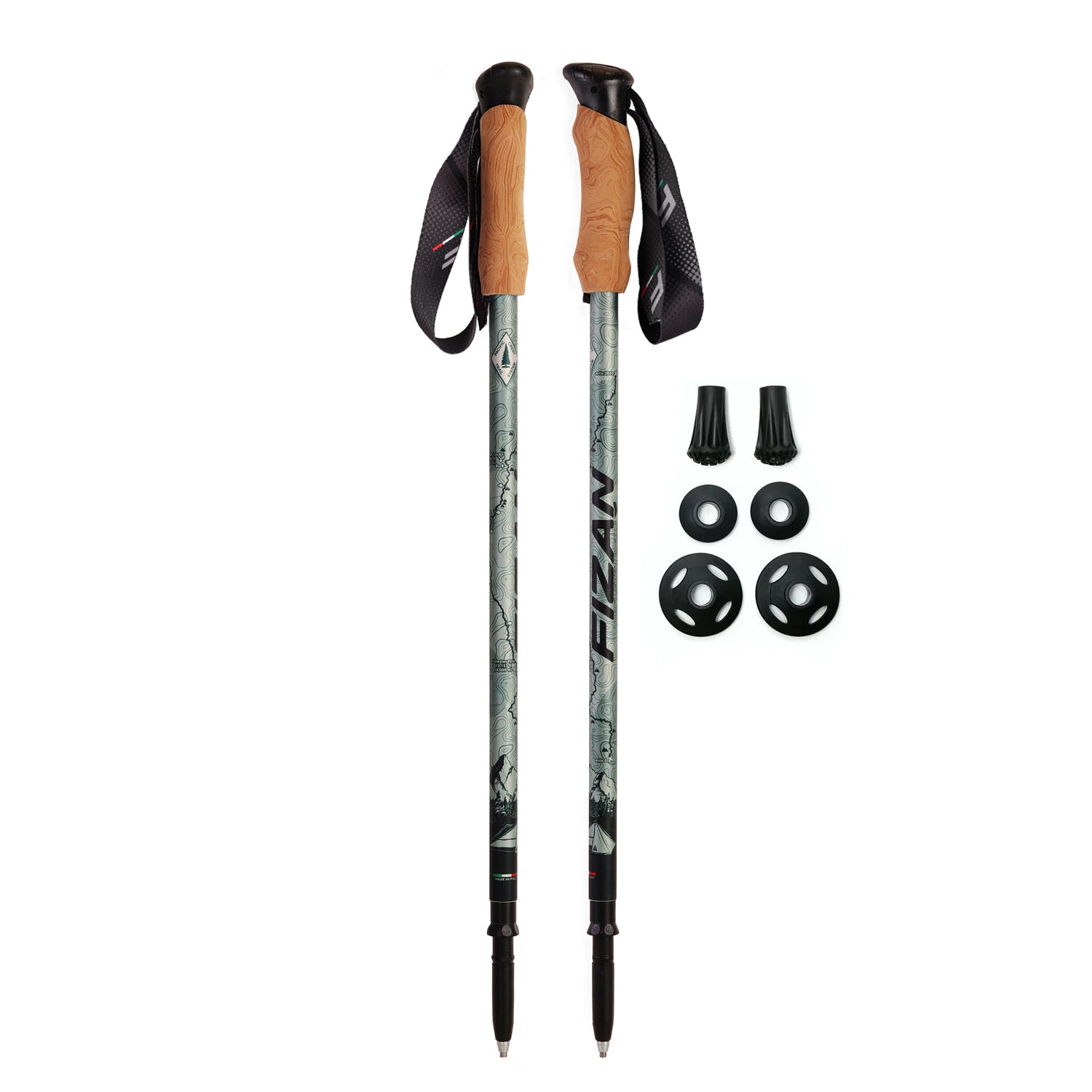
Best trekking poles for thru-hiking: Fizan Compact 3
- MSRP: $70 (Compact 3)
- Weight (Pair): 11.2 oz
- Materials Used: Aluminum shaft, EVA foam or EVA cork handles
- Design: telescoping with two “Flexy” twist locks
- Max length: 132 cm
Why We Love These Poles
These poles from Italian gearmaker Fizan are both extraordinarily lightweight, rivalling some of the lightest poles on the market, and remarkably affordable at just $70 for a pair. Trekking poles are typically among the more utilitarian gear choices a hiker can make, but Fizan gives you the opportunity to add style points with a variety of color choices and even special CDT and PCT editions at the same price point.
Features
- Three or four pole segments: We’re highlighting the three-segment version here, but the Compact 4 collapses somewhat smaller (2o inches) for a nominal weight and price hike.
- EVA foam or EVA “cork” grip: The EVA cork option is just cork-colored EVA and does not have the properties of genuine cork. Still, EVA foam is a standard grip material choice because it’s comfortable, lightweight, and relatively durable.
- “Flexy” internal locks: The length of these telescoping poles is determined by an internal twist-lock mechanism.
- Pack down very small: When fully packed down, their size is competitive with z-folding options (23 inches collapsed length for the Compact 3 or 20 inches for the Compact 4).
Nobody’s Perfect
Our reviewer found the plastic cap topping the handle to be uncomfortable and raised concerns with the accuracy of the Compact 4’s length markings. Hikers looking for the moisture-management properties of a cork grip will be disappointed to learn that the “cork” grip option on these poles is just a differently colored EVA foam.
READ NEXT – Fizan Compact 3 and 4 Trekking Pole Review
Durston Iceline Poles (Lightest Trekking Poles)

Best backpacking trekking poles: Durston Iceline
- MSRP: $189
- Weight (pair): 9.4 oz
- Materials Used: High-mod carbon fiber shaft, EVA foam grip, aluminum flick lock for upper segment and click-in lock for lower segment
- Design: Telescoping upper segment (bottom two segments click into place and are fixed in length)
- Max Length: 127 cm
Why We Love These Poles
Whether it’s a tent, a backpack, or — in this case — the Iceline trekking pole, Durston products tend to find themselves among the lightest gear in their class, while simultaneously being some of the most durable, functional offerings. The strapless version of the Iceline pole just edges out the Gossamer Gear LT5 as the lightest adjustable trekking pole on the market (once optional hand straps are added, the LT5s are actually lighter).
The Icelines have reliable flick locks rather than the twist locks favored by many UL poles and are made with high-quality, durable materials: high-modulus (stronger, basically) carbon fiber and proper aluminum flick locks rather than cheap plastic. The shaft diameter (18, 16, and 16mm for the three segments) is wider than most poles, enhancing durability.
Features
- Super lightweight: No doubt the sub-10 ounce weight will form the basis of the Icelines’ appeal for most people. Many poles weigh almost twice as much. Whether deployed or stowed in your pack, the difference in weight is noticeable.
- Compact collapsed size: The poles break down to just 49cm when fully collapsed, making them significantly more packable than most telescoping poles.
- Fixed-length lower connection, telescoping upper: The upper connection between the three segments is a durable aluminum flick lock, enabling each pole to telescope between 95 and 127 cm. The lower connection is a quick-connect button with no length adjustability. The bottom segment can be completely detached at this joint, which is why the poles pack down as small as they do.
- Wide diameter: The segments are 18, 16, and 16mm in diameter, respectively — wider than most poles. This increases stiffness and makes them less likely to snap, which is important for obvious reasons.
- Optional hand straps: The first batch of Icelines did not have hand straps, but they are optional in the newest batch for hikers who actually use them. The poles cost $10 more and weigh 0.8 oz more for a pair with straps.
Nobody’s Perfect
The poles do not come with mud baskets, so you will have to source compatible Komperdell baskets online yourself if you want some (or get Durston’s Iceline Accessory Kit). Necessary to keep the weight down, these poles only come with EVA foam handles instead of the premium cork some hikers swear by.
Finally, our reviewer points out that the carbide tip is exposed with no plastic housing to protect it as is typical for most poles, and because it’s a nonstandard tip, if it snaps you have to replace the whole bottom segment.
Read our review of the Durston Gear Iceline poles.
Black Diamond Distance Carbon Z Trekking Poles (Best Fixed Length Poles)

Best trekking poles for thru-hiking: Black Diamond Distance Carbon Z.
- MSRP: $220
- Weight (Pair): 9 oz (100 cm) | 9.3 oz (110 cm) | 9.9 oz (120 cm) | 10.4 oz (130 cm)
- Materials Used: carbon fiber shafts, extended foam handles
- Design: Z-folding fixed-length poles
- Max Length: 100 cm | 110 cm | 120 cm | 130 cm
Why We Love These Poles
Fixed-length poles absolutely have a time and place. Some hikers may only plan to use the added support for a specific type of terrain. Or, if you’re planning a relatively flat thru-hike, you might not need any adjustment. Perhaps the biggest draw for backpackers is that they weigh less than adjustable poles: depending on which length you opt for, the Distance Carbon Zs are among the lightest poles you can get.
They’re also easy to use — no guesswork, no fiddling with a fussy locking mechanism, no worries about one of the sections suddenly collapsing. You don’t even have to break stride when pulling them off the side of your pack.
Features
- Extremely easy deployment: These poles deploy in about five seconds. All you have to do is snap the shaft into place by pulling on the top piece. This is extremely helpful for hikers who like to stay on the move, and store or use poles quickly, depending on the terrain.
- Lightweight construction: Between the carbon fiber shafts and the lack of added materials to make the length adjustable, these are some of the lightest poles on the market. The aluminum Distance Zs are also quite light at a lower price point.
- Extended foam handles: The foam handles extend below the typical grip area. This helps to increase the usability of these poles, even with the fixed length. Reaching your hands further down on the grip “shortens” the poles for steeper climbs.
- No telescoping sections to collapse on you: There’s nothing worse than trusting your weight to a trekking pole on uneven terrain and having one of the telescoping sections collapse on you. Happily, that risk doesn’t exist with these fixed-length poles.
Nobody’s Perfect
Obviously, lack of versatility is a huge downside for fixed-length poles. They’re really best used for either mostly flat terrain or if you only plan to use poles on the ascent or descent exclusively.
Diorite Gear Telescopic Carbon Fiber Poles with EVA Foam (Best Poles for Tall Hikers)
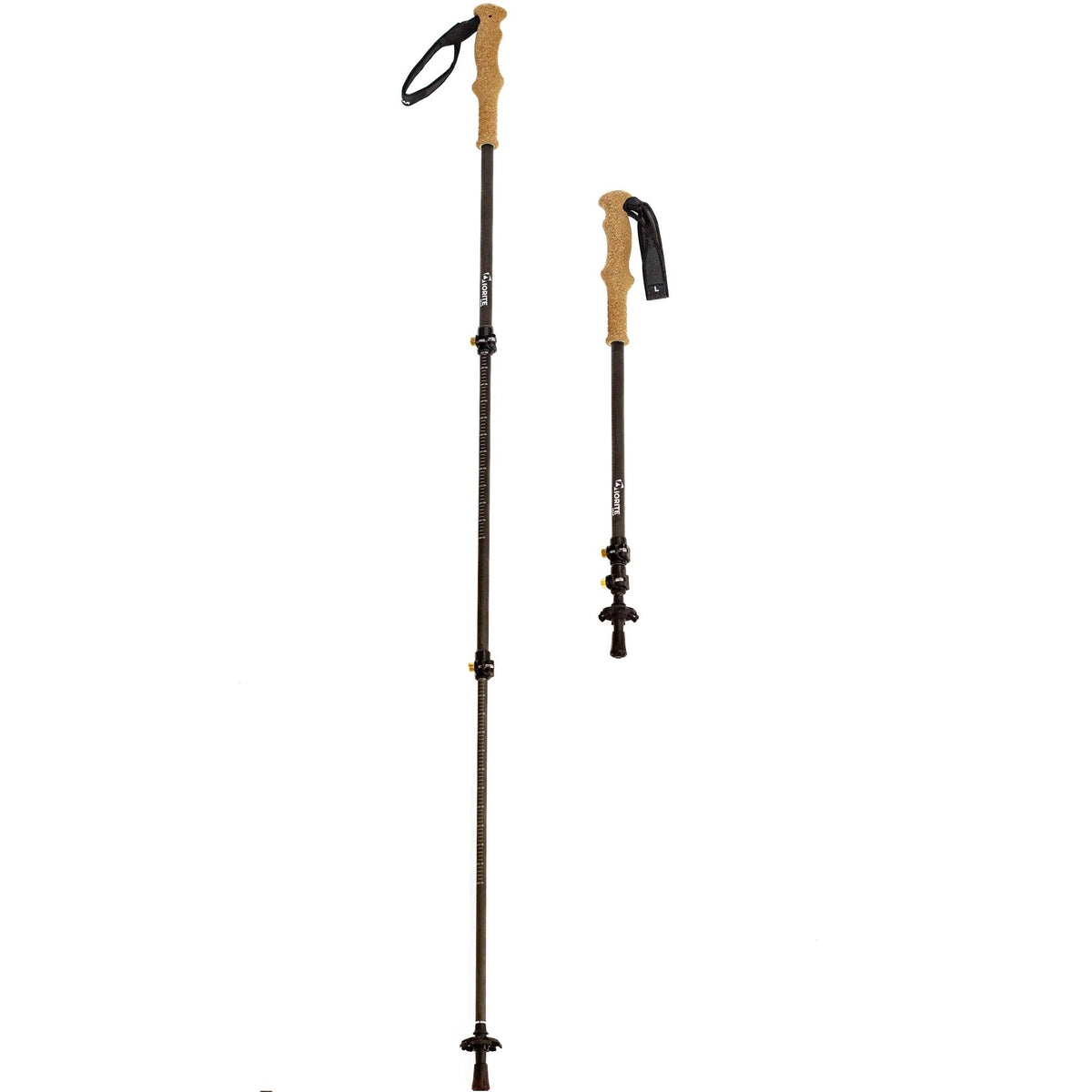
Best trekking poles for thru-hiking: Diorite Telescoping Poles
- MSRP: $180
- Weight (Pair): 14.8 oz
- Materials Used: Carbon fiber shaft, extended EVA foam handles
- Design: Telescoping with double flick lock
- Max Length: 158 cm
Why We Love These Poles
We love supporting small businesses, and the Diorites are made in the US by Portland-based Minimalist Gear, the parent company of Cnoc. Telescoping from a collapsed length of 71 centimeters all the way out to a whopping 158, these poles have the greatest functional length of any on this list, making them great for tall hikers or tall tents like the Zpacks Altaplex.
These poles are fully modular, so you can replace any individual section that breaks, as well as the carbide tips.
Features
- EVA or foam handle: EVA foam makes for a comfy handle that’s extra long to accommodate a variety of grip positions. Diorite also makes a genuine cork-handle pole.
- Replaceable tips: Unlike many poles, the tips are modular and easily replaceable. This is a valuable feature since the tips often wear out well before the rest of the pole.
- Adjustable polyester and microfiber straps: The straps are wide and plush with microfiber interiors for comfortable wear around the wrist. They’re also color-coded (yellow on the left and green on the right) so you don’t mix them up.
- Can be bought as singles or pairs: Like the Zpacks Minimalist above, you also have the option to buy just one Diorite pole if you need a replacement or prefer to hike with just one pole.
Nobody’s Perfect
The poles only collapse to 28 inches (71 centimeters) which is still fairly long for storing in your pack. They’re also one of the priciest poles on this list.
READ NEXT – Diorite Gear Carbon Fiber Trekking Poles Review
Cascade Mountain Tech Aluminum Quick Lock Trekking Poles (Best Budget Trekking Poles)

Best backpacking trekking poles: Cascade Mountain Tech Aluminum
- MSRP: $30
- Weight (Pair): 20.8 oz
- Materials Used: Aluminum shaft, cork handle with extended EVA foam grip
- Design: Telescoping with two external flick locks
- Max Length: 137 cm
Why We Love These Poles
Not everyone wants to spend upwards of $200 on hiking sticks. At 21 ounces, these bad boys aren’t ultralight by any stretch, but they’re light and functional enough to make sense for backpacking — at a fraction of the cost of premium poles. They’re a great choice for beginners and budget-conscious thru-hikers alike.
Carbon fiber edition: Cascade Mountain Tech also makes a popular carbon fiber pole — with fun colorways! — at 16.6 ounces for the pair. The MSRP is $65, but you can sometimes find them for slightly less on Amazon or at Costco.
Features
- Spare parts available: You can replace virtually every component of the pole individually, extending your poles’ lifespan and saving you even more money in the long term (not to mention keeping your poles away from the landfill for longer).
- Adjustable nylon webbing straps: The straps can be tightened or loosened to adjust the fit and width.
- Hybrid cork/EVA handle: Cork feels better in the hand, but it’s also heavier than EVA. CMT’s hybrid approach maximizes functionality while minimizing weight.
Nobody’s Perfect
The main drawback of these poles is their weight, which is about twice as much as the lightest options on this list. If weight is a huge pain point for you but you’re on a budget, the Fizan poles mentioned earlier in this list might be a good compromise solution. But at $30, this is the true budget option.
Durability could also be an issue with these poles, especially if you go with the carbon fiber version — we’ve read several accounts of them snapping at inopportune times. Still, plenty of other hikers have had them last a full thru-hike or longer, and it’s hard to argue with the price point.
Carbon Fiber Dual-Lock Pacerpole (Most Ergonomic Design)

Best backpacking trekking poles: Pacerpole
- MSRP: £127 (roughly USD 170 in mid-March 2026, check the exchange rate before purchasing)
- Weight (Pair): 20.1 oz
- Materials Used: Carbon fiber shaft, plastic
- Design: Telescoping upper segment (bottom two segments click into place and are fixed in length) and angled handles to increase stability and propulsion
- Max length: 133cm
What We Love About These Poles
Added to our list by popular demand. Most trekking poles are distinguished by incremental differences in material and design — but the Pacerpole is a fundamentally different approach to trekking pole design, and we love seeing the innovation. The angled handles look odd, but they are designed to improve posture, stability, and power on-trail.
The Pacerpole eschews the traditional hand-strap, which would ordinarily be a controversial move since many hikers use the straps to increase their power/propulsion, especially when ascending. However, the angle of the poles’ unique handles is intended to achieve largely the same amount of thrust, and Pacerpole claims this design does a better job of it anyway.
The handle is what makes this pole unique, and Pacerpole isn’t pretending otherwise. If you already have a pair of trekking poles you like, you can just swap the top segment for a pair of Pacerpole tops for £85 (the tops are available in 18 and 6mm diameters to accommodate different pole sizes).
Features
- Unique angled grips: These angled handles are the main selling point of the poles. They’re left- and right-hand specific, comfortable to grip, and make it easy to control where you plant the tip. Users say the design helps them to maintain good posture when walking, and according to Pacerpole the grip angle “resulted from extensive anatomical and biomechanical research, designed to integrate with the hand as a contoured platform for controlling your arm’s power transmission.”
- Modular: All parts are easily replaceable, and the brand actively encourages users to just get the top segment with the handle and attach it to an existing trekking pole. You can also get fun add-ons for these poles, like a camera mount or a neoprene overmitt for rainy/chilly weather.
- Fixed-length lower connection, telescoping upper: In a similar design to the Durston Iceline poles, the three segments making up the Pacerpole are joined by two different connections: a flick lock at the top that allows the poles to telescope between 97 and 133 cm, and a click-in, non-telescoping connection lower down.
Nobody’s Perfect
At 20 ounces they’re far from ultralight, although if the claimed improvements in power and form materialize for you, the extra ounces could be worthwhile. Pacerpole is a small UK-based company; while the upcharge for international shipping is extremely modest, hikers in the US and other countries should anticipate slower shipping times and potentially more difficulty in replacing parts during a thru-hike.
The grip angle may make pitching a trekking pole tent more awkward, although some users say they manage it just fine.
FAQs
Features to Look For in the Best Thru-Hiking Trekking Poles
Aluminum vs. carbon fiber shaft: Aluminum and carbon fiber are the two most common materials found in trekking poles. Aluminum poles are more durable and less sensitive to temperature changes but significantly heavier than carbon poles. Carbon poles are lighter but more brittle and generally more expensive.
Flick lock vs. twist lock adjustment: The two most common adjusting mechanisms are flick locks and twisting locks. Flick-lock poles use a little lever that will unlock the pole pieces so you can slide the sizing up or down. Twist locks require you to twist to the left to release the pole and twist it right to close it.
Flick locks are very convenient but tend to loosen over time and require tools to fix. On the other hand, twist locks are a bit more of a pain to adjust but are easier to repair in the field.
Foam vs. cork handles: The poles included in this article use either foam or cork handles. Foam handles are cushier, but they don’t wick moisture as well. In other words, if you tend to sweat a lot, foam handles become slippery and can even leave black marks on your hands. Cork handles feel a bit rougher to the touch for some, but they do a much better job of wicking moisture.
Some poles also feature extended handles. This gives the hiker ability to adjust their grip depending on the terrain.
Telescoping vs. Z-Folding: Lightweight trekking poles are typically designed one of two ways: telescoping and z-folding. Telescoping poles typically have higher ranges of adjustability. They use either twist or flick-lock technology to expand into different sizes. However, they don’t pack down quite as small as a z-folding pole.
Z-folding poles break into three different sections connected by an internal cord. They pack small enough to fit even onto the side of a trail running vest. However, they typically have only one or zero points of size adjustability. Because of this, they won’t have as great of a range of size manipulation. The shafts of folding poles are thinner
since the sections don’t need to slide into each other. This makes them lighter but also potentially less durable. On the other hand, they don’t need twist- or flick-lock mechanisms, which means fewer breakable components.
Should I use trekking poles on my thru-hike?

You typically want trekking poles fixed at a length where your elbows are at 90 degrees
Most thru-hikers and backpackers do use trekking poles. Poles help protect your joints, improve your stability on tricky terrain, and give you more power on steep climbs. Also, many ultralight tents also require trekking poles for setup.
Trekking poles are extremely helpful for both the uphill and downhill. On the ups, the poles help propel your momentum forward and hike in a continuous rhythm. I find that when I don’t have poles, my hands make their way to my back on steep hills, and I cut off proper breathing.
On the downhills, your poles act as extra limbs to help navigate tricky terrain. They also reduce the impact on your knees and ankles by absorbing some of the downhill shock on your body while you cruise long descents. Additionally, they help you to navigate obstacles like stream crossing by providing extra stability.
What length should I set my trekking poles to?
If your poles are adjustable, set the length so that your elbows make a roughly 90-degree angle when the pole is planted.
This is why most poles are adjustable: so they can become a bit longer on the descents and shorter on the ascents. I highly recommend adjustable poles. Fixed-length poles mainly make sense if you’ll only use the poles occasionally and want to keep the weight down, or if you only plan to use them on either the ups or downs but not both (or if you’ll be hiking mainly on gentle terrain).
While there are size charts depending on your weight, it’s best to measure yourself. If you’re shopping in person, you want to grab the pole upside down underneath the basket and adjust it to the length where your elbow is at 90 degrees. This will be the size of your poles on flat terrain. I recommend choosing a size with roughly five centimeters of adjustability in each direction from your flat-ground size.
What is the right way to hold trekking poles?
Some people prefer to grip their poles firmly by the handles, while others hold them “ski-style” by feeding their hands up through the bottom of the strap and holding the handle loosely so the top of the strap runs between their thumb and index finger. Both methods work.
The “regular” grip is intuitive and lets you slide your hands up and down the handles to adjust the pole’s functional length depending on the slope angle. Some manufacturers now make poles with extra-long handles for just this reason.
Meanwhile, the “ski” grip allows the pole to swing more freely and lets you plant it firmly without having to keep a death grip on the handle.
To sum up: trekking poles are helpful for just about every uphill athlete. They’re wildly popular among backpackers because of their momentum and impact-absorbing benefits. Furthermore, most ultralight shelters require trekking poles to pitch. Whether weight, price, or packability is your main priority when selecting poles, there’s a great option here for every hiker.

Aaaaaand one of my favorite trekking pole benefits is their compatibility with ultralight shelters.
Featured image: Graphic design by Chris Helm.
Our list of the best backpacking trekking poles is updated annually. It was originally written by Katie Kommer and was last updated by our editorial staff on 18 March 2026.

This website contains affiliate links, which means The Trek may receive a percentage of any product or service you purchase using the links in the articles or advertisements. The buyer pays the same price as they would otherwise, and your purchase helps to support The Trek's ongoing goal to serve you quality backpacking advice and information. Thanks for your support!
To learn more, please visit the About This Site page.

Comments 14
this is really good post, thank you for sharing with us
Great article – but where are the Cascade Mnt Tech carbon fiber poles on your list?
Hard to take this article seriously when only name brands are considered. The CMT cork-handled carbon poles are <$60 and you can get aluminum ones for $30. I’ve used the CMT poles for 1500 trail miles and find it very difficult to imagine there’s $150 of extra value in the name brands. (My carbon/cork poles were $50 at time of purchase.)
Over my travels, I’ve seen the CMT poles just as much (or more) as Leki and BD. In fact, I can purchase my exact carbon cork poles on Amazon for $53 and have cheaper/lighter poles than the “budget” option in the article.
huge oversight imo not to include cascade mountain tech poles. hard to justify paying up for anything else.
Great article, I duck tape 12 ounce lead sinkers to my poles when I am day walking but take them off for backpacking.
So many of the pictures show handles that are not black. I had no idea foam handles now come in cork colors
Disappointed to not see Cascade Tech and BD Ergo Cork. The Ergo sets this pole off from all the others. Pacer Poles would also have been one to look at.
Could you include Pacerpoles in your 2024 survey, I have been hiking with them for over 27,000 thru hiking miles so far, and they truly have made all the difference, saved my wife and me on countless occasions, and kept the tent over our heads
Used CMT carbon fiber poles for 2 years/1100 miles and ended up switching back to their aluminum version. Their carbon fiber shafts are just too thin for use on trails with more technical terrain such as talus fields or creek beds where the tip may see a momentary lateral (bending) load. After snapping a few carbon poles in the Sierra and switching to their aluminum version, I have only good things to say about their reliability. The lever locks and handles are extremely well built and reliable. The carbide tip inserts don’t last for more than 600 miles and can’t be replaced which is my only gripe. If you are trekking on less demanding trails, CMT’s carbon fiber may work for you. Would not use the carbon fiber variant on something like the Pacific Crest Trail. CMT figured out how to make a great product with a very respectable price point.
Fizan poles are still lighter than anything on here. Have been using mine since 2014, still hiking hard.
Though I love the weight of the Durston Iceline I’m sadly reverting to my CMT carbon. First time out with my 2025 Icelines and lost balance log walking and caught myself with the pole. It bent the aluminum joint where the lower section snaps in. Durston wouldn’t cover under warranty but did offer a discount on lower section. I just don’t trust these anymore. I’ve put way more stress on my faithful CMT’s so dumping the Icelines before I get spoiled by the light weight.