
 ">

Farewell CDT, Hello PNT
It’s not a great idea to begin a thru-hike with your homeward trip already booked. Your plans are undoubtedly going to change, and a deadline will limit your options. It wasn’t ideal, but it was the situation I found myself in when setting out for the Pacific Northwest Trail.
- July 7 2025. Boise to East Glacier via Spokane.
- July 8. East Glacier to Chief Mountain via the CDT.
- July 14. Chief Mountain to the western terminus of the PNT.
- September 16. Seattle to Boise.
If everything went to plan, I’d have three days to get from the PNT’s western terminus to Seattle. Even if my schedule slipped by a day or two, I figured I’d still be able to make it. Whatever happened, missing the flight back to Boise wasn’t an option.
So, with a strong sense of deja vu, I boarded the Greyhound bus to Spokane. (My CDT journey in 2023 started the same way.) Nine hours later, I heaved my comfortable old pack onto my back, and strolled half a mile to Riverfront Park. After that, I spent a couple of hours in the shade of a tree beside the visitor center, watching the world go by.
The kids shrieked and gasped as they played in the fountain. Their parents wilted in the 90℉ heat and direct sun. The shadows lengthened. Eventually, unable to ignore my rumbling stomach any longer, I headed for the nearest fast-food place.
With one final street to cross, mere steps from the restaurant, I stepped off the curb. A sound halfway between a rip and a snap emanated from beneath my right arm, and a shoulder strap tore away from my backpack’s hip belt.
In Memoriam
As far as everyone else was concerned, it was a 2007 REI Aconcagua. To me, “The Passenger” was a backpack that had earned its trail name. It never gave me a reason to complain, and was a reliable companion for the duration of two National Scenic Trails and countless shorter hikes.
As the years passed, signs of wear and tear accumulated until I could no longer ignore them. The Passenger’s bright red fabric faded, its seams started to fray, and the frame began poking through the bottom of the hip belt. A deer nibbled the padding of one of the shoulder straps, a chipmunk chewed a hole in one of the pockets, and a mouse stole all of the gray bungee cords.
Two years ago, I bought a replacement backpack which quickly proved to be a disaster. The Passenger, I hoped, was capable of one more adventure this summer, but I was wrong. The timing of its demise was simultaneously the best and the worst.
Out of this world
I quickly checked my phone for the location of the nearest REI. It was a 30 minute walk, and the store would be closing in an hour. I was sweaty and thirsty by the time I arrived. The sales associate looked slightly bemused as I explained the situation, but he listened intently, and quickly ruled out all but three of the backpacks in store. Almost as quickly, I reduced the shortlist to one: the Osprey Aether 65. I paid for it, transferred my gear, and asked the associate if he’d mind disposing of my old pack. The Passenger deserved better. It was an unceremonious end to years of distinguished service.
Still, I couldn’t help but feel lucky as I wandered back towards downtown. I stopped for dinner, lingered long enough to test the patience of the waitstaff, then concluded my wandering at the Amtrak station. At 1:15AM, when my train arrived, I realized that Lady Luck expected the scales to be balanced. I took my seat next to a friendly woman who apparently didn’t need sleep. Her preferred topic of conversation was politics, and her preferred volume was too loud for a train car in the small hours. She dozed off about the time a faint glow started illuminating the sky above the eastern horizon.
The train was an hour late into East Glacier, and I took another half hour to get organized. The weather was warm and sunny; breezy at lower elevations, windy higher up. As I started hiking, I felt a familiar mix of apprehension and excitement, typical for day one. The scenery, too, seemed familiar. I was retracing my first steps on the CDT from 2023.
Into the wild
I met two pairs of SOBO CDT hikers on my way to Two Medicine, and plenty of day hikers as I descended to the valley floor. At the ranger station, I collected my backcountry permit with only one minor update to my itinerary. One of the campgrounds on my list was closed due to bear activity, so the ranger moved me to the nearest alternative, a few miles away.
The store was busy, Two Medicine campground was busy, and the next day, the first few miles of trail were busy. The sky was initially clear, but clouds moved in as I began the climb to Pitamakan Pass. The air remained warm, and conditions were perfect all the way to Atlantic Creek, my destination for the day. In Glacier National Park, the park service imposes a limit of 16 miles per day on backcountry permits booked in advance. It felt slightly self-indulgent to start an hour later than normal, and still be finished by 1:45PM.
I shared the campground with a group of four experienced backpackers, and a guided-tour group of eight. Their guide had hiked the PCT, but for the other seven, it was their first ever day of backpacking. They’d hiked four miles, their excitement was palpable, and I eavesdropped as the guide patiently answered their questions.
Bad weather
Next morning, I left after the group of four, but before the group of eight. There was rain in the forecast, judging by the overcast sky, but I was hopeful I’d beat the weather to my next campground, just 11 miles away. I climbed quickly to Triple Divide Pass, hurried down the other side, crossed an old, overgrown burn area, and followed the creek to Red Eagle Lake. A brief shower greeted me at the campground, followed by a second, slightly longer shower while I was choosing a site. I dived inside my tent as shower number three started, and it turned into a downpour that lasted an hour.
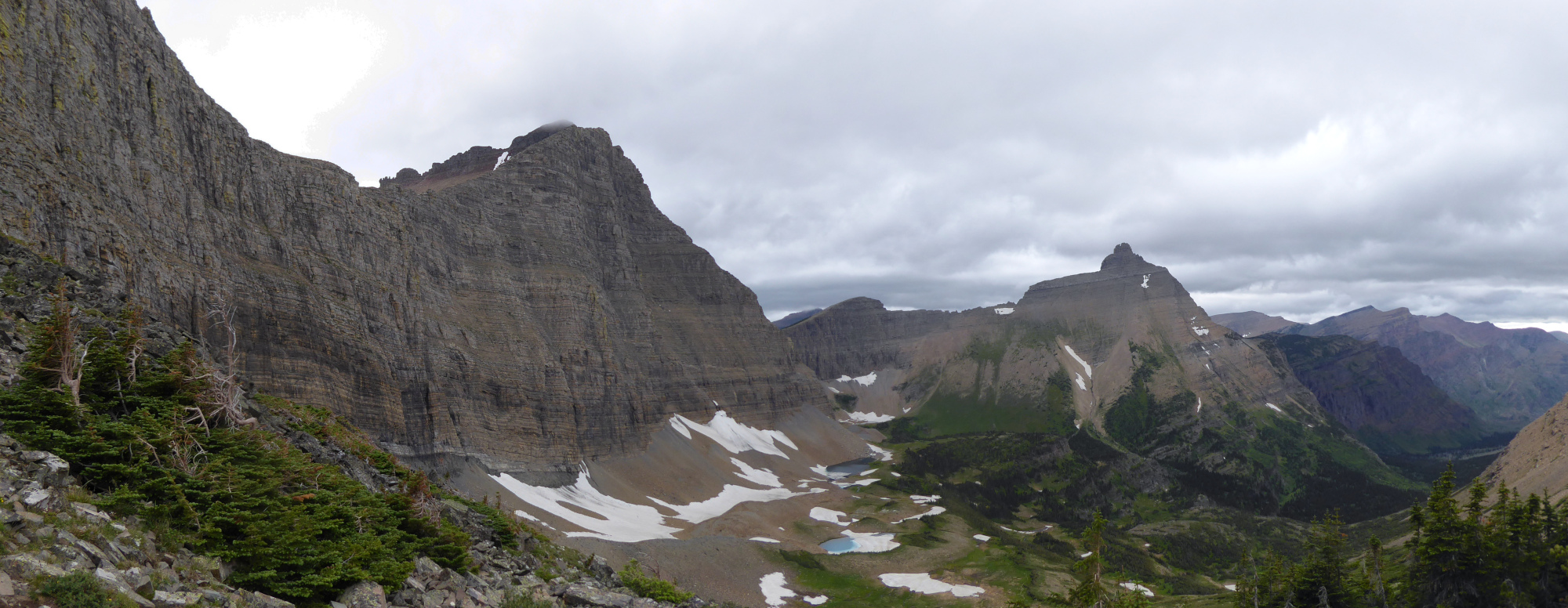
The north side of Triple Divide Pass.
The group of eight got soaked, I found out later. Regardless, they all seemed in good spirits as they sat around the campfire at the food preparation area. Two of them were meticulously drying their boots by the fire, but I think the rest realized it wasn’t worth the effort. I’m sure everyone’s shoes were waterlogged within 15 minutes of leaving camp the next morning. Mine were, courtesy of the overgrown trail, and I had no doubt there’d be plenty more soggy-sock days in my near future.
Good weather
About two miles after I left camp, and about half a mile to my right, a wolf began to howl. A moment later, another wolf joined in, and their synchronized call went out across the valley. Less than half a mile (I’m guessing) to my left, a much larger pack answered. The back and forth continued for some time, and I picked up my pace slightly.
Under a clear sky and warm sun, I followed the trail across some flat terrain, crossed Red Eagle Creek (again) on a swaying suspension bridge, and climbed a small rise. Saint Mary Lake came into view, covering the valley floor for several miles in both directions. I headed west along the southern shore, accompanied by the distant sound of traffic on Going-to-the-Sun Road, the chugging of tour boats, and long after each boat passed, the lapping of waves along the shoreline.
By now, the trail was so overgrown that all of my clothes were dripping wet. At last, I emerged from the jungle at Virginia Falls, and joined a wide, well-maintained trail. I squelched my way through the crowds of clean, dry tourists, stopped to wring out my socks, and soon arrived at my next campground.
Bear behind
Half an hour before sunrise, I unzipped my sleeping bag and began preparing for departure. I’d only be hiking 14 miles, but I figured that the sooner I left, the sooner I’d arrive at Many Glacier Hotel, and the sooner I’d have some real food.
I completed the 3000 foot climb to Piegan Pass just after nine, and started the descent. The views on both sides of the pass were spectacular, but I didn’t waste time stopping for a break. As I descended the final set of switchbacks, I noticed signs of recent bear activity. Every few hundred yards, a large patch of vegetation had been excavated, and the remains littered the trail. The soil in each hole was still damp, and I guessed I was following in the footsteps of a Grizzly.
Sure enough, about a quarter mile after the switchbacks, in an open area between the trail and the creek, I saw the bear. With its back to me, less than 50 yards away, the hump of muscle between its shoulders was obvious. It was the size of an adult female, or perhaps a small male. The direction of the breeze and the noise of the creek meant that it was unaware of my presence, and it continued browsing without a care in the world.
I watched the bear for about 30 seconds before realizing it wasn’t going to cross the creek. It was following the creek, which would lead it back to the trail. I hurried onwards, through a small stand of trees, and in less than 100 yards, arrived at a bridge. When I tentatively checked upstream, the bear hadn’t yet arrived. I crossed quickly, and didn’t slow down until I reached the hotel.
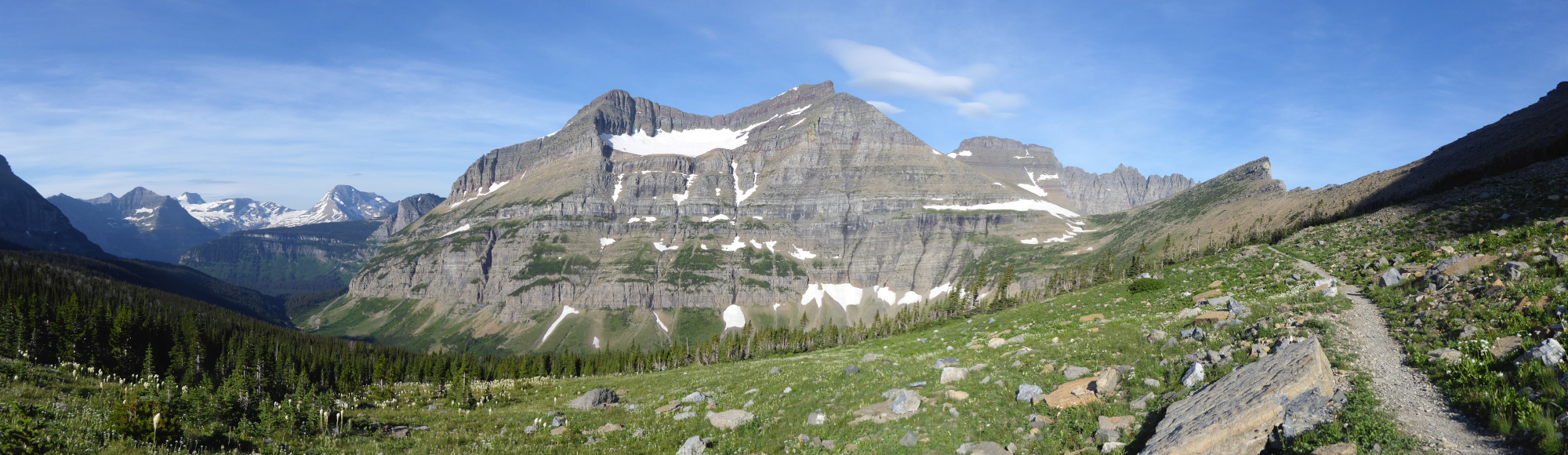
Finishing the climb to Piegan Pass.
Border ahead
Upon arrival, I went straight to “Heidi’s Snacks” for lunch. While I ate, I charged my phone and pondered what else I needed to buy. The temporary closure of the nearby Swiftcurrent area meant that Heidi’s was my only resupply option. Fortunately, I’d planned ahead. I had four evening meals left, and all I needed were four days’ worth of snacks. I spent another $95, separated day one’s food, and packed my bear can with the rest. Then I dumped my food and toiletries in the nearby bear-box, put up my tent at the temporary campground, and returned to the hotel to hang out.
Ptarmigan tunnel, a shortcut to my final campground on the CDT, opened for the season several days before I arrived in Glacier National Park. Next morning, that’s the direction I went. There was a nice view on either side of the tunnel, but the theme for most of the subsequent miles was “green tunnel.” The Gable Creek campground was empty when I arrived, but a few hours later, another guided-tour group of eight showed up. I chatted with some of them that evening, but only their guide was up and about when I left the next morning.
It was six mostly-flat miles to the Canadian border, and I arrived just before nine. In swirling cloud and low visibility, I approached the Customs and Border Protection building. An officer emerged. He’d obviously learned that the hiker smell would linger in his office. I told him I just wanted to touch the monument, and he warned me to stay on this side of it. He went back inside, and I kept an eye on the Canadian building as I advanced.
“BACK UP!” shouted the Canadian official. I froze.
Done, done, onto the next one
There were two cars at his checkpoint, and the second vehicle was too close for his liking. He gestured that it needed to reverse. I heaved a sigh of relief. Sparking an international incident wasn’t on my to-do list. I took a few more steps, and at arms length, slapped a hand on the monument. CDT: complete. PNT: underway.
I turned around, and headed for the Pacific Ocean.
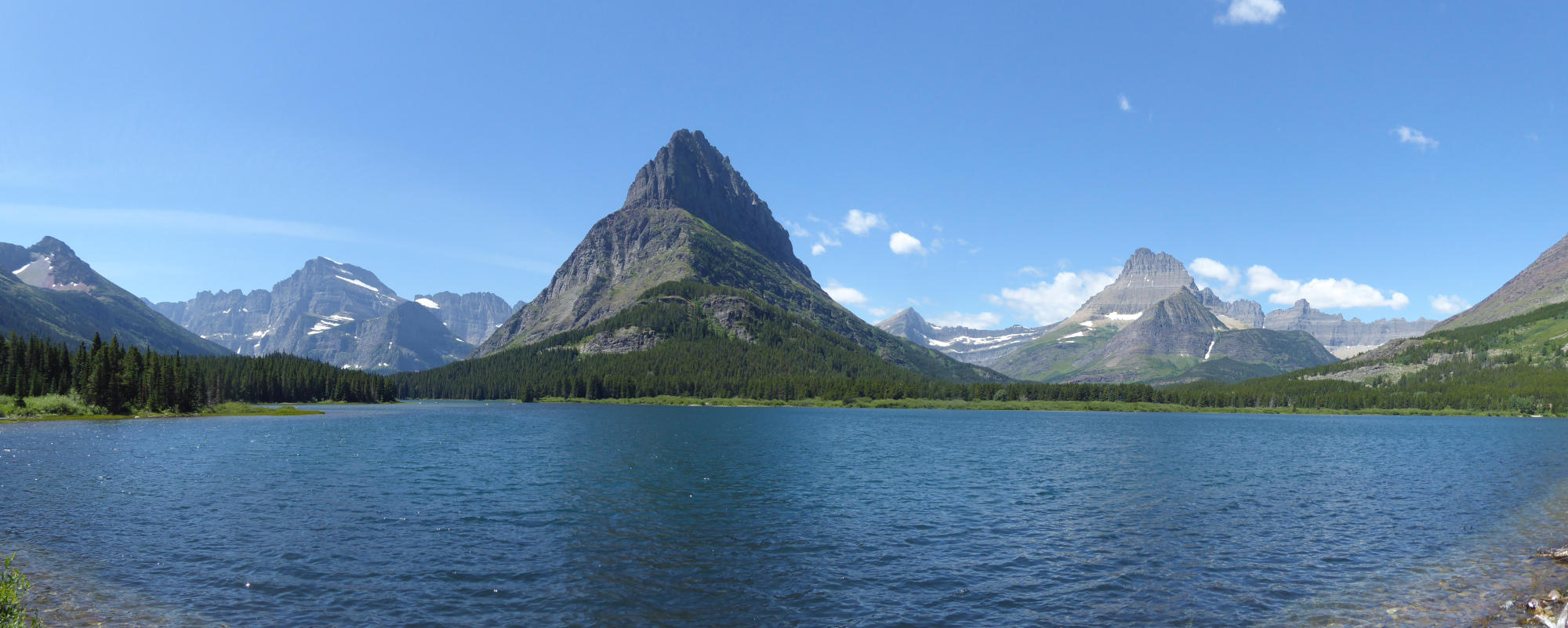
Day five, Swiftcurrent Lake.

This website contains affiliate links, which means The Trek may receive a percentage of any product or service you purchase using the links in the articles or advertisements. The buyer pays the same price as they would otherwise, and your purchase helps to support The Trek's ongoing goal to serve you quality backpacking advice and information. Thanks for your support!
To learn more, please visit the About This Site page.

Comments 2
Hang on, the start of that trail is what we did way back, am I right? Though we stopped at morning star campground. Also very wet as I recall!
I have the same backpack as you now. It’s done me fine (including a 12-day no food stop hike in Peru), still looks as new. I’m sure you’ll put it through its paces. I do find the top strap/pocket weird, useful but weird.
You’re right! It was late August 2010. I seem to remember we scrapped our plans for Triple Divide Peak, and sat in the tent, in the rain, at Morning Star lake.