
 ">
HRP 5: Over Carlit & Canigou to the Mediterranean Sea – El Serrat to Banyuls-sur-Mer
The final stretch of the HRP captures every face of the Pyrenees — alpine summits, long ridgelines, Mediterranean forests, and, at last, the sea. After saying goodbye to Andorra, the route leads over Pic Carlit and the legendary Pic du Canigou, which offer a worthy farewell to the high Pyrenees. From there, the terrain softens and the air grows heavy. Between cork oaks, mosquitoes, and humid heat, we draw closer to the Mediterranean day by day.
HRP Day 28 – Stomach Pain
El Serrat to a small plateau with a pond: 7.3 mi / 4,000 ft elevation gain / 4 h
On the evening of our zero day in La Massana, my stomach starts to ache. That’s not unusual — my stomach tends to complain about something on a regular basis. But this time, the pain doesn’t go away. It lingers into the night. Around 3 am, I wake up nauseous and spend three hours lying awake. After another hour of sleep, I don’t feel much better. I take some medication to calm my stomach, and we head to the hotel breakfast buffet, where I focus on eating as gently as possible. Still, I would rather not stay another day. The weather is perfect, and the thought of spending such a clear day indoors feels wrong. Maybe I can “walk it off.”
We take the bus to Ordino and then on to El Serrat, where we left the trail two days ago. Everything goes surprisingly smoothly, and by noon we’re back on the HRP. Unfortunately, the pain hasn’t subsided. We climb to the Refugi de Sorteny, where we take a break on deckchairs and sip soft drinks. I take another pill and hope for the best before tackling the next climb up to Collada dels Meners (8,900 ft). Slowly, I start to feel better, and that gives me hope.
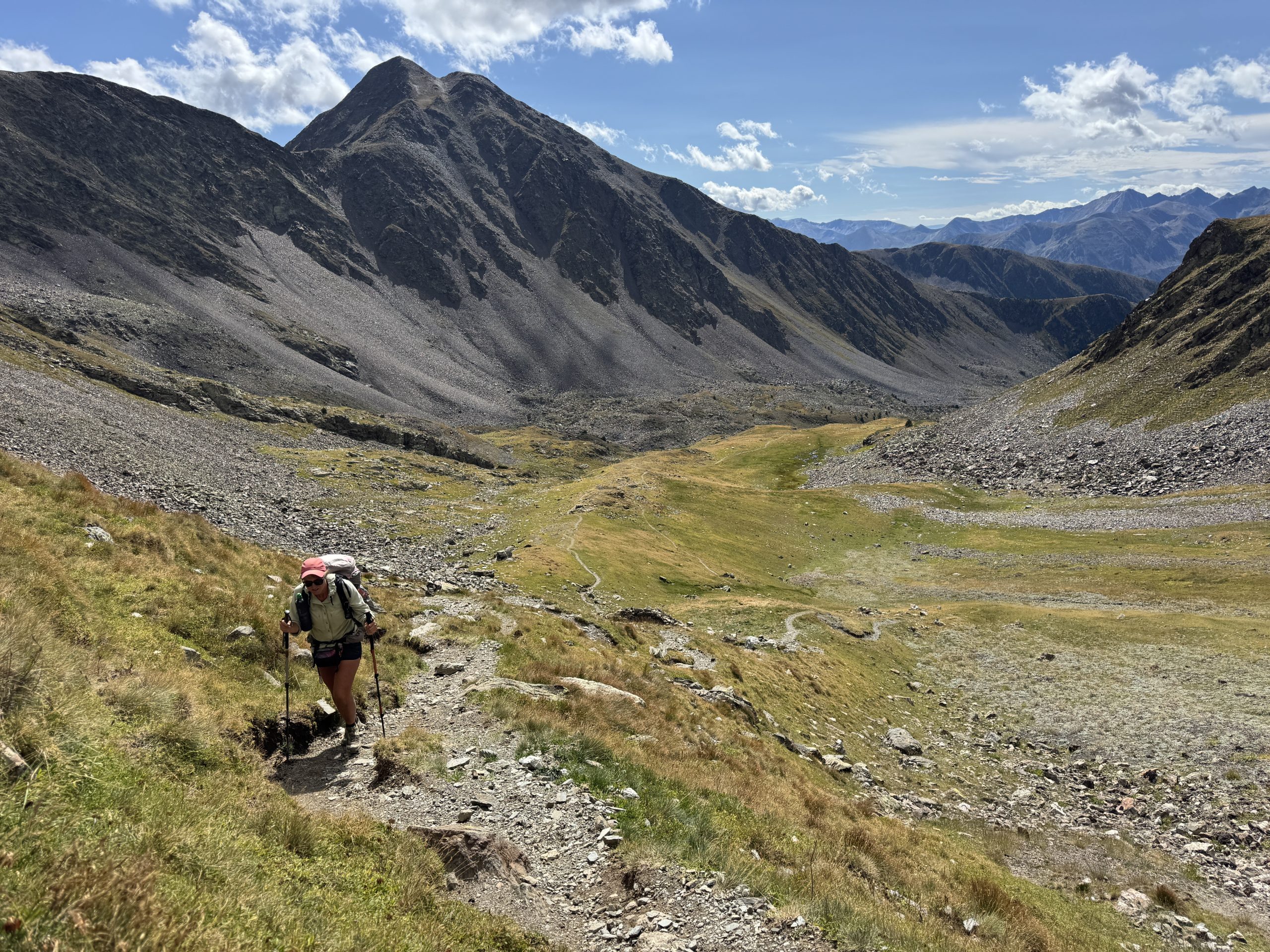
Climb to Collada dels Meners
We stop by a stream to fill our bottles and meet Paradise and Agnes, a Polish couple. Paradise hiked the PCT last year and started the HexaTrek this year, but after an injury, he and Agnes are now exploring the Pyrenees at a more relaxed pace.
From the pass, we have a fantastic view of Andorra’s mountains — colorful slopes, green meadows, and scattered little lakes. I’m in awe. For a moment, I forget the pain and feel light again.
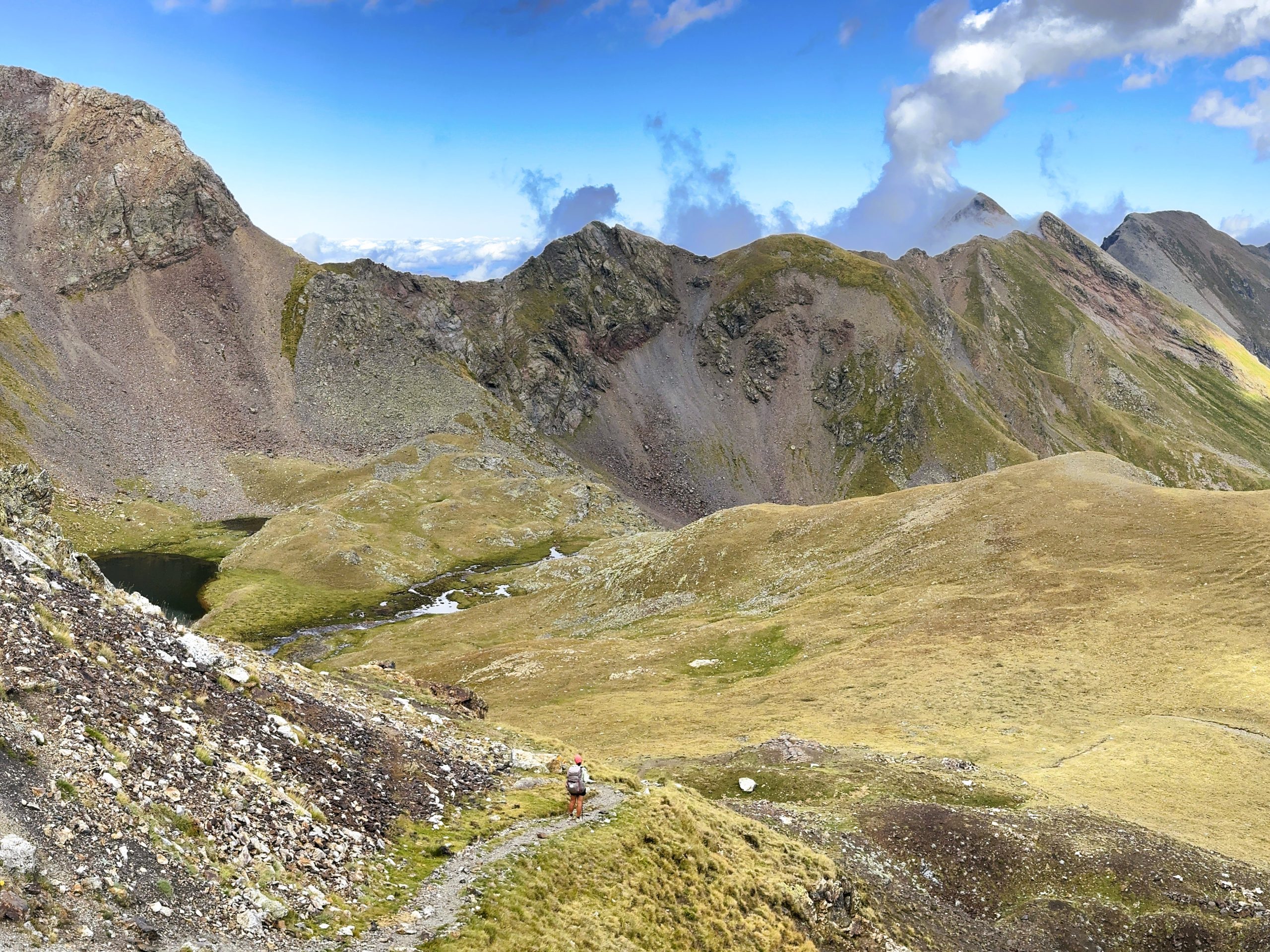
View from Collada dels Meners
But on the descent, hunger hits me hard. I haven’t eaten since breakfast, as I’m too afraid of upsetting my stomach again. Eventually, I can’t take it anymore, drink a protein shake, and eat a few cookies. Big mistake. The pain returns with full force, and I drag myself up the next short climb.
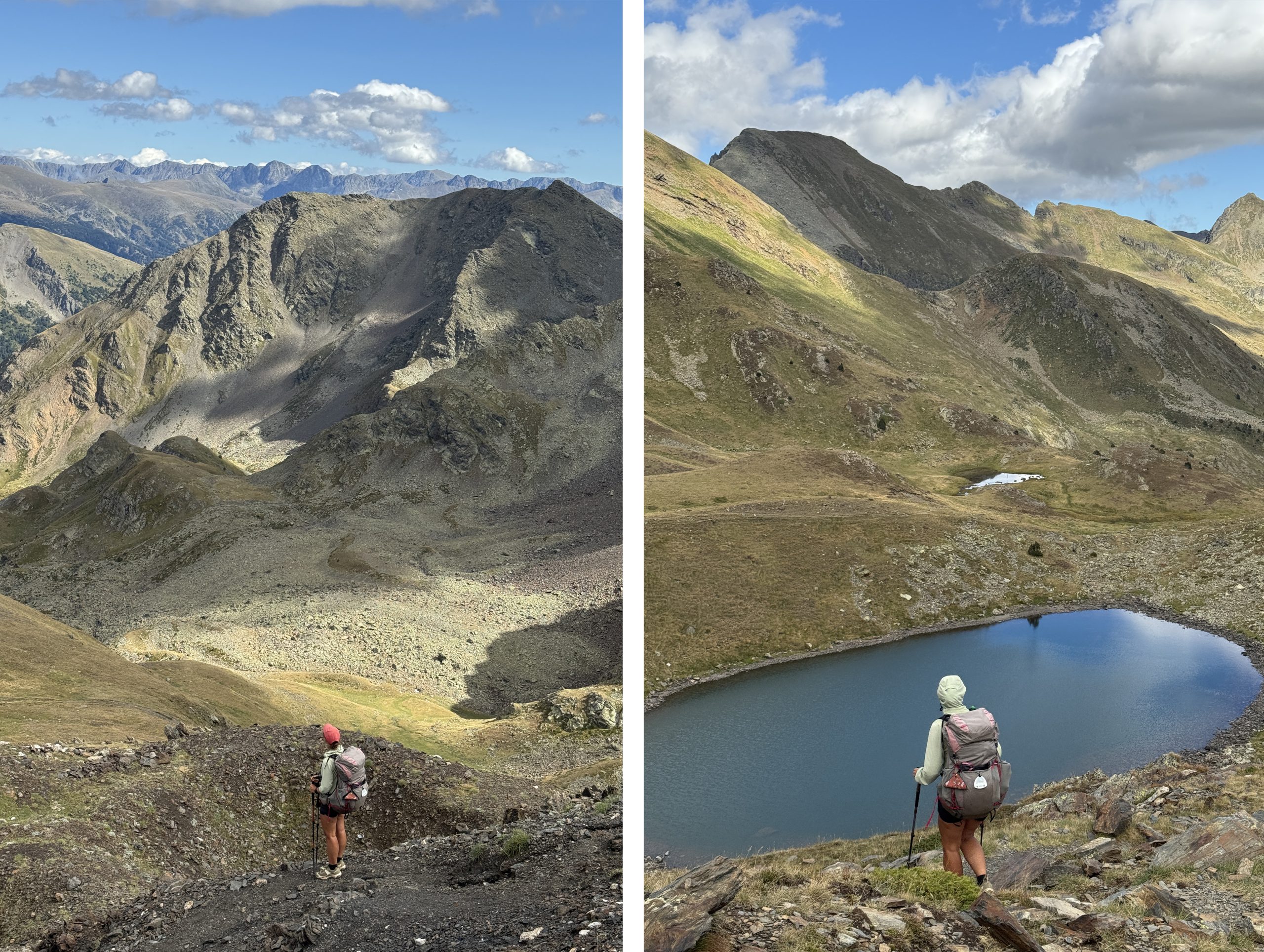
On the way to Cabana Cóms de Jan
We reach the Cabana Cóms de Jan, which is overrun by a loud group of teenagers. Definitely not the place to camp. So we keep going. I wish I could hike farther today, but I have to admit defeat. A quiet spot by a pond will do.
Lying down and ginger tea help. I can only hope I’ll feel better tomorrow and that this won’t turn into another weeks-long stomach saga like last year in the San Juans. The setting sun paints the grass gold, and the cliffs glow in the evening light. Despite everything, it’s beautiful. And that’s what matters.
HRP Day 29 – Farewell to Andorra
Small plateau with pond to L’Hospitalet-près-l’Andorre: 13.6 mi / 4,658 ft elevation gain / 8 h
Clouds roll over the mountains in the morning. My stomach feels much better today, and I’m optimistic. The first climb to the Serra de Cabana Sorda is steep but short from our campsite. The view vanishes into the mist, yet just as we reach the pass, the clouds lift. I climb a little higher along the ridge to look down at the lake below, Estany de Cabana Sorda. A cold wind sweeps across the heights, pushing clouds through the valley at dizzying speed — a hypnotic dance of light and motion.
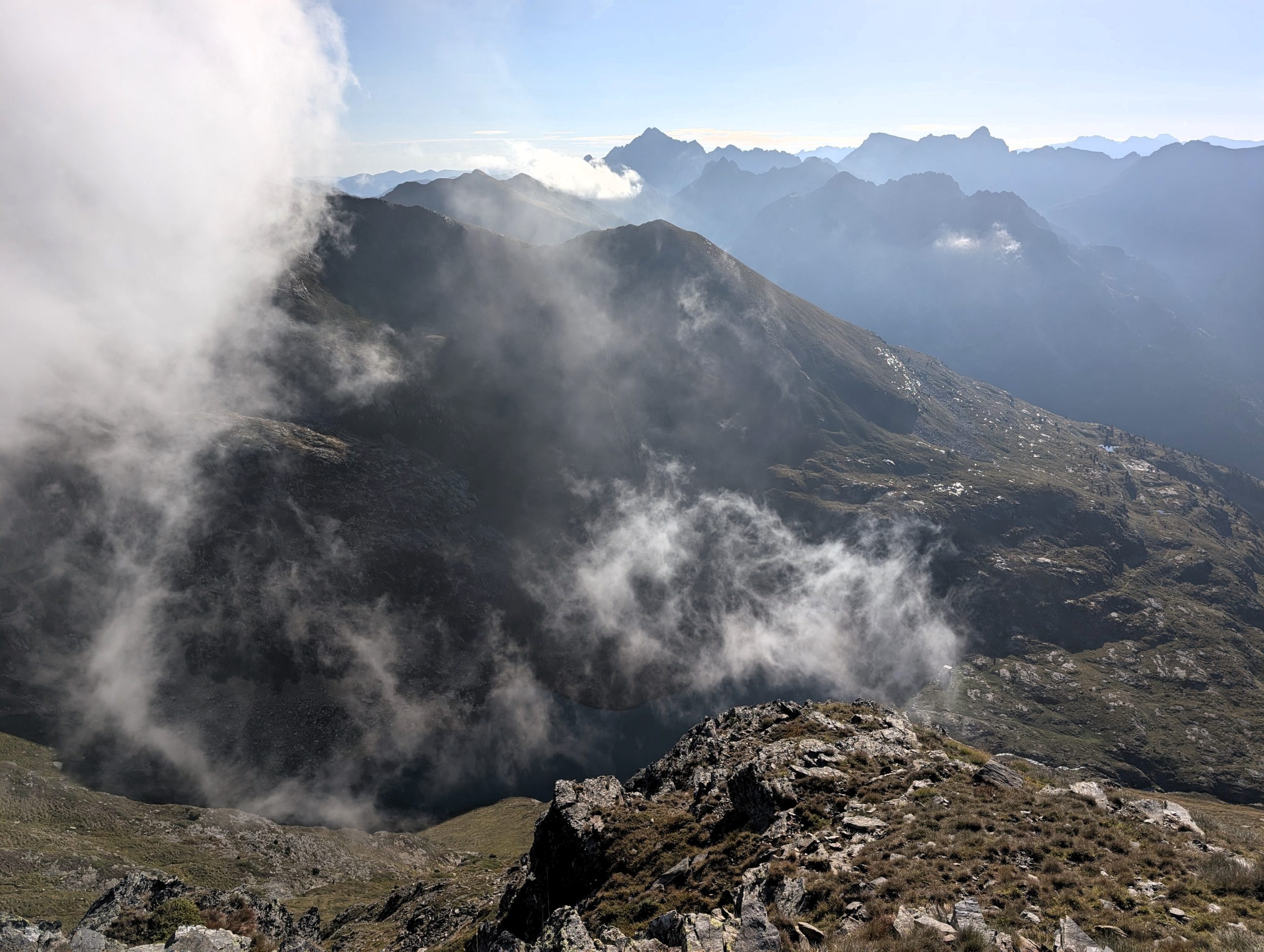
Watching the dancing clouds above Estany de Cabana Sorda from the pass
We descend to the lake I just admired from above. Its color is a deep green now, while from higher up it had seemed blue in the shade. One more climb remains before we reach Refugi de Juclar just in time for lunch. The menu du jour is generous: pasta Bolognese, followed by a kind of goulash with rice, followed by cake. I’m still careful with my stomach and can’t eat much — a situation Ryan is more than happy to help with.
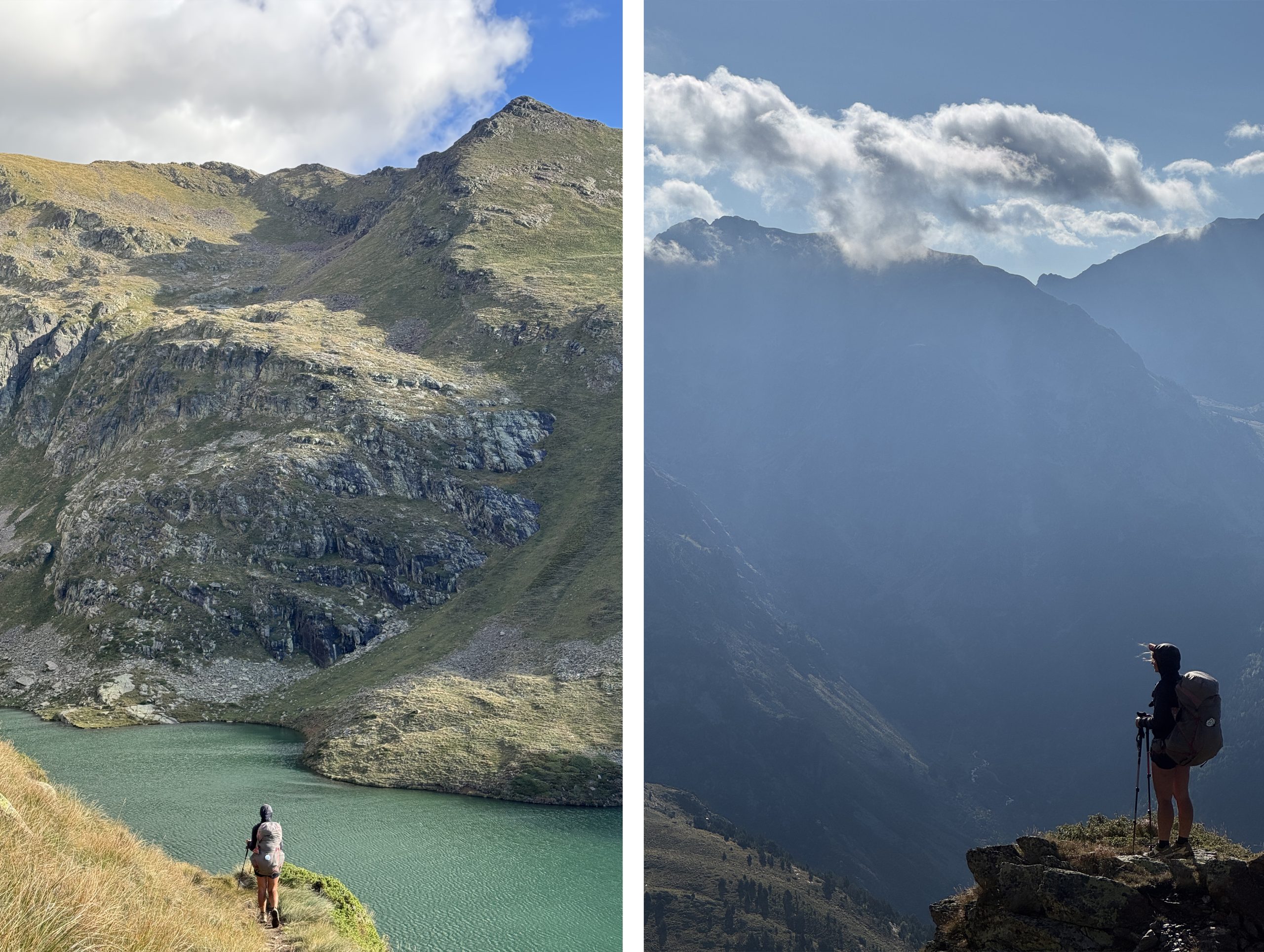
Descent to Estany de Cabana Sorda
We pass the lakes near the refuge and climb to the next pass, enjoying the beautiful view back down to the alpine lakes. At the Col de l’Albe, we bid farewell to Andorra and reenter France. Andorra may look tiny on the map, but it remains one of the highlights of the HRP — compact, wild, and intense.
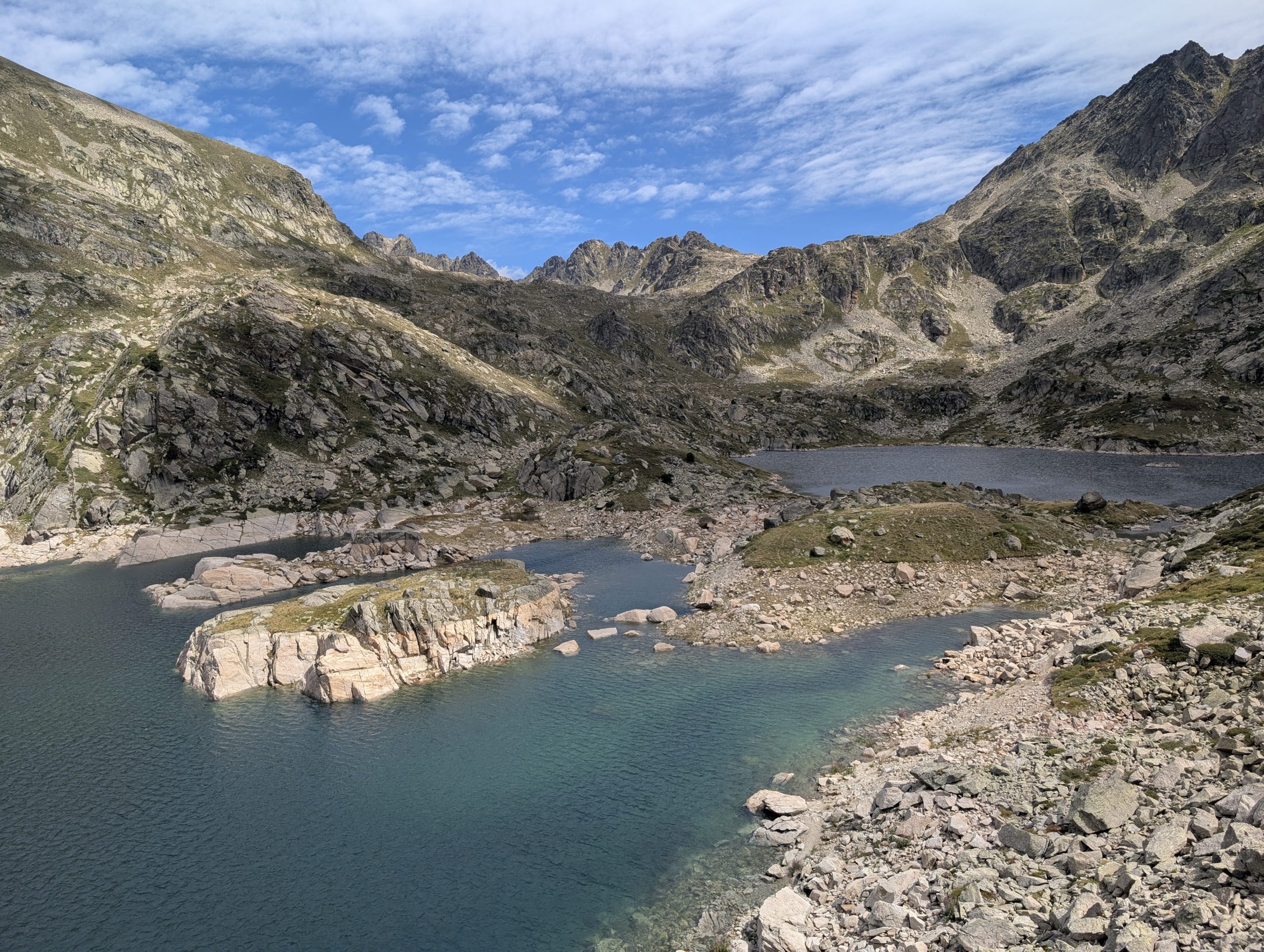
Lacs de Juclar
From here, only six miles remain, mostly downhill, but they drag on. First we navigate another tedious stretch of boulder fields, passing four more lakes along the way. Then progress becomes easier. Soon we can see the road two miles away, and beyond it the clustered houses of L’Hospitalet-près-l’Andorre. A series of switchbacks — repeatedly ducking under a large black pipeline — finally brings us down to the valley. Our plan to reach town on Sunday has worked out after all, despite my stomach troubles yesterday.
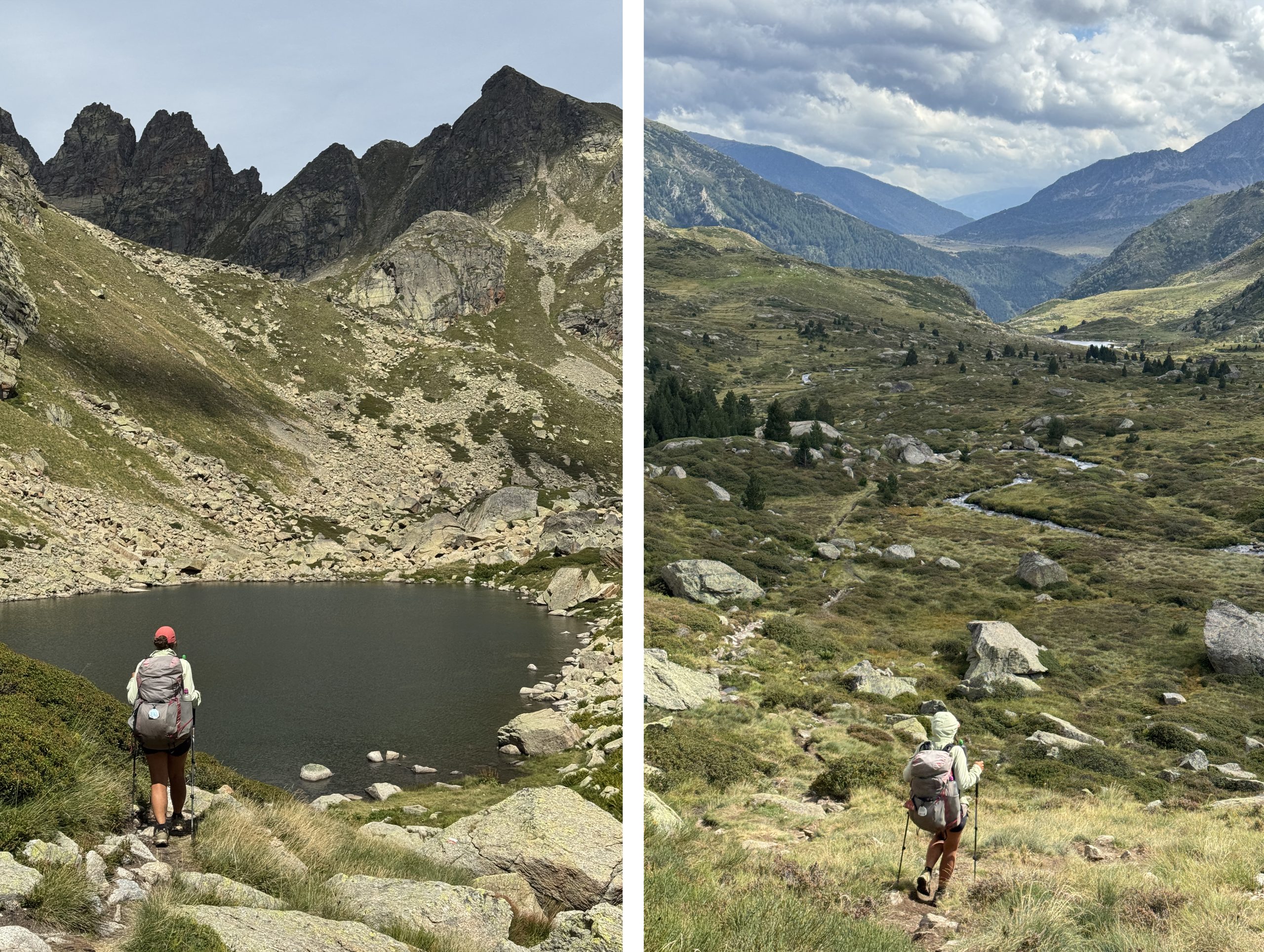
Descent to L’Hospitalet-près-l’Andorre
In the small grocery store of this otherwise unremarkable border town, we stock up on snacks and our beloved Orangina — finally available again now that we’re back in France. We even find a frozen lasagna, which we can heat up in the microwave. And let me tell you: hot frozen lasagna tastes so much better than cold (iykyk).
We walk to the campground a little outside of town and pitch the tent just in time before the evening rain starts. We shower, which feels oddly unnecessary after two days with hardly any sweat. My clothes still smell like detergent. I feel like a dayhiker.
Most of the HRP now lies behind us: only 120 miles to the Mediterranean. I’m in no rush. The HRP is as hard as it is beautiful.
HRP Day 30 – The Miserable Mist
L’Hospitalet-près-l’Andorre to Estany dels Forats: 11.7 mi / 5,118 ft elevation gain / 6 h
The morning begins cold, grey, and rainy. We’re wrapped in thick clouds, and even the thought of leaving the warm sleeping bag feels like an act of sheer willpower.
Eventually, we pull ourselves together and pack up the tent, still soaked from the night’s rain. To make matters worse, I realize one of my shoes hadn’t been fully under the tent and is now drenched. There’s even a small puddle inside it. My backpack is damp too, where it must have brushed against the wet tent wall. I’m not exactly in the best mood.
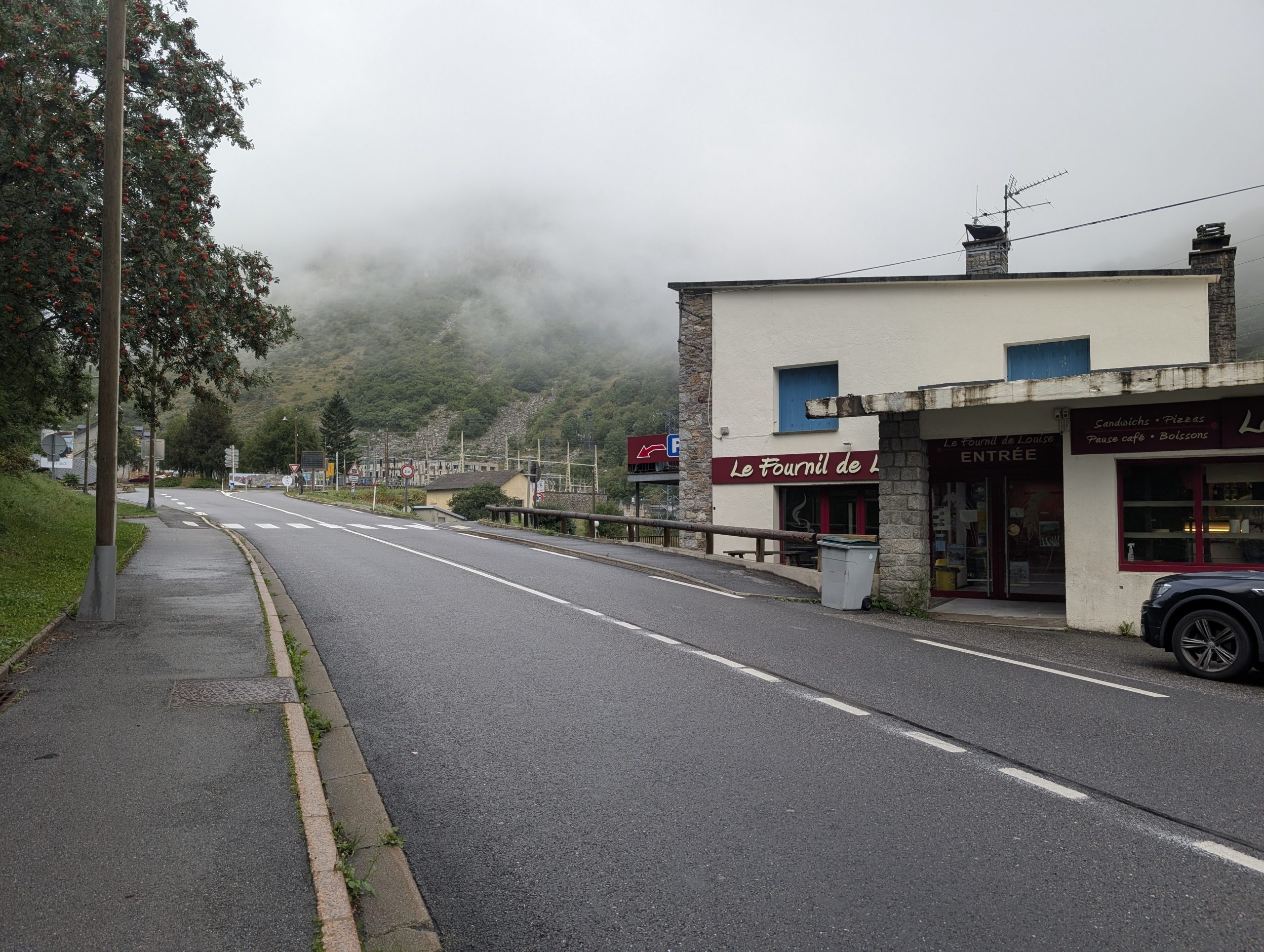
The cold, rainy morning in L’Hospitalet-près-l’Andorre is best spent in the local bakery
We head to the bakery, where we devour sandwiches, apricot tart, and blueberry turnovers with thick hot chocolate. Outside, a patch of blue sky appears, and we decide that this must be the turning point — the moment everything gets better — and set off.
Apart from a short, steep section at the beginning, the climb is pleasant. Gentle switchbacks lead us through misty forest up to Étang des Bésines and on to Refuge des Bésines. The sun refuses to show, but at least it’s not raining. And as long as we keep moving, we stay warm enough.
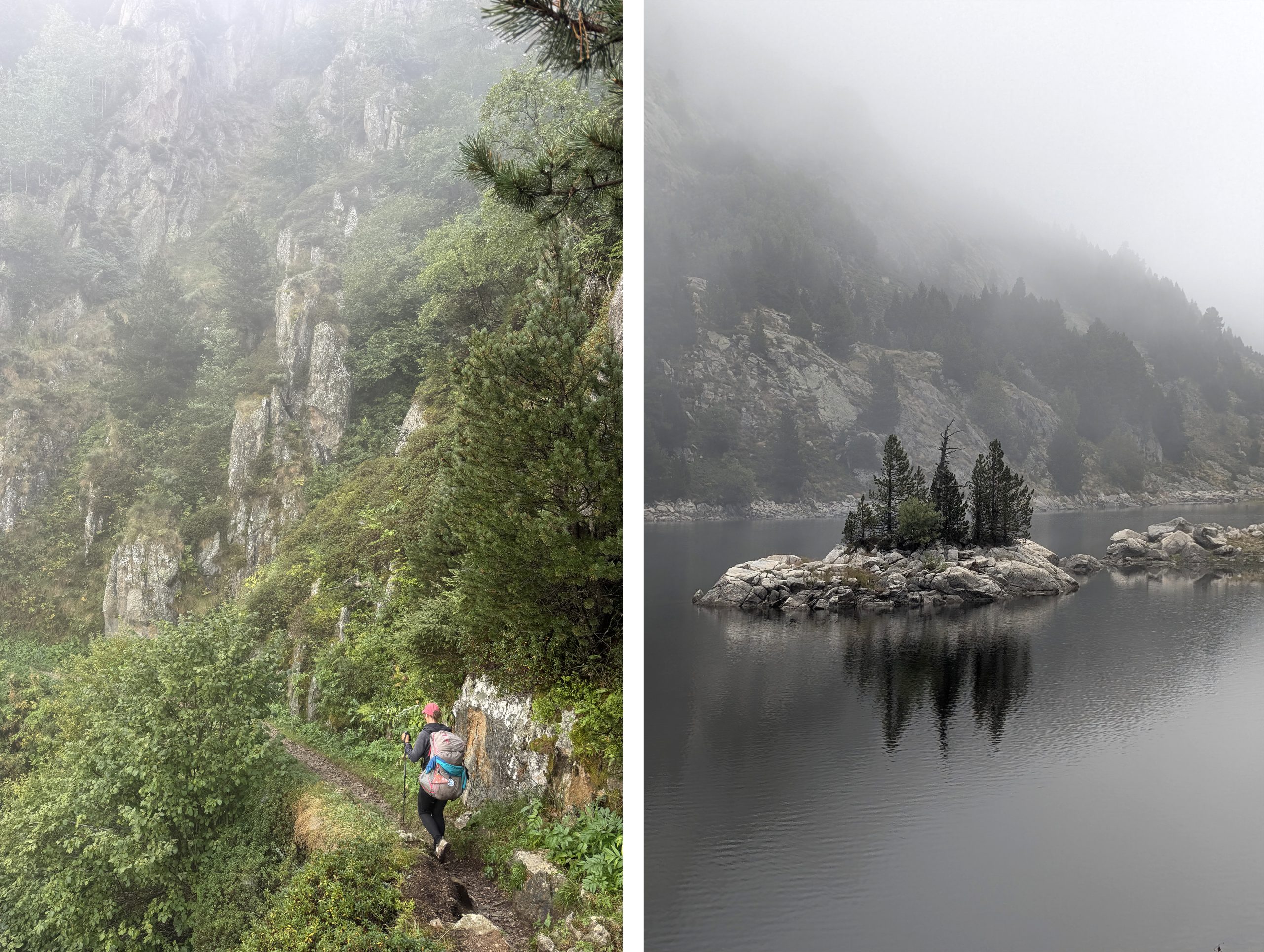
Climb from L’Hospitalet-près-l’Andorre
At the refuge, we order cheese omelettes and Orangina. Sitting by the warm stove, I think: I never want to leave this place. But eventually, we head back out into the weather. At first, it’s freezing, but movement brings warmth back to our bodies. A fine drizzle follows us up the trail. The world is nothing but fog — no visibility, just grey silence, as cold wind lashes our faces.
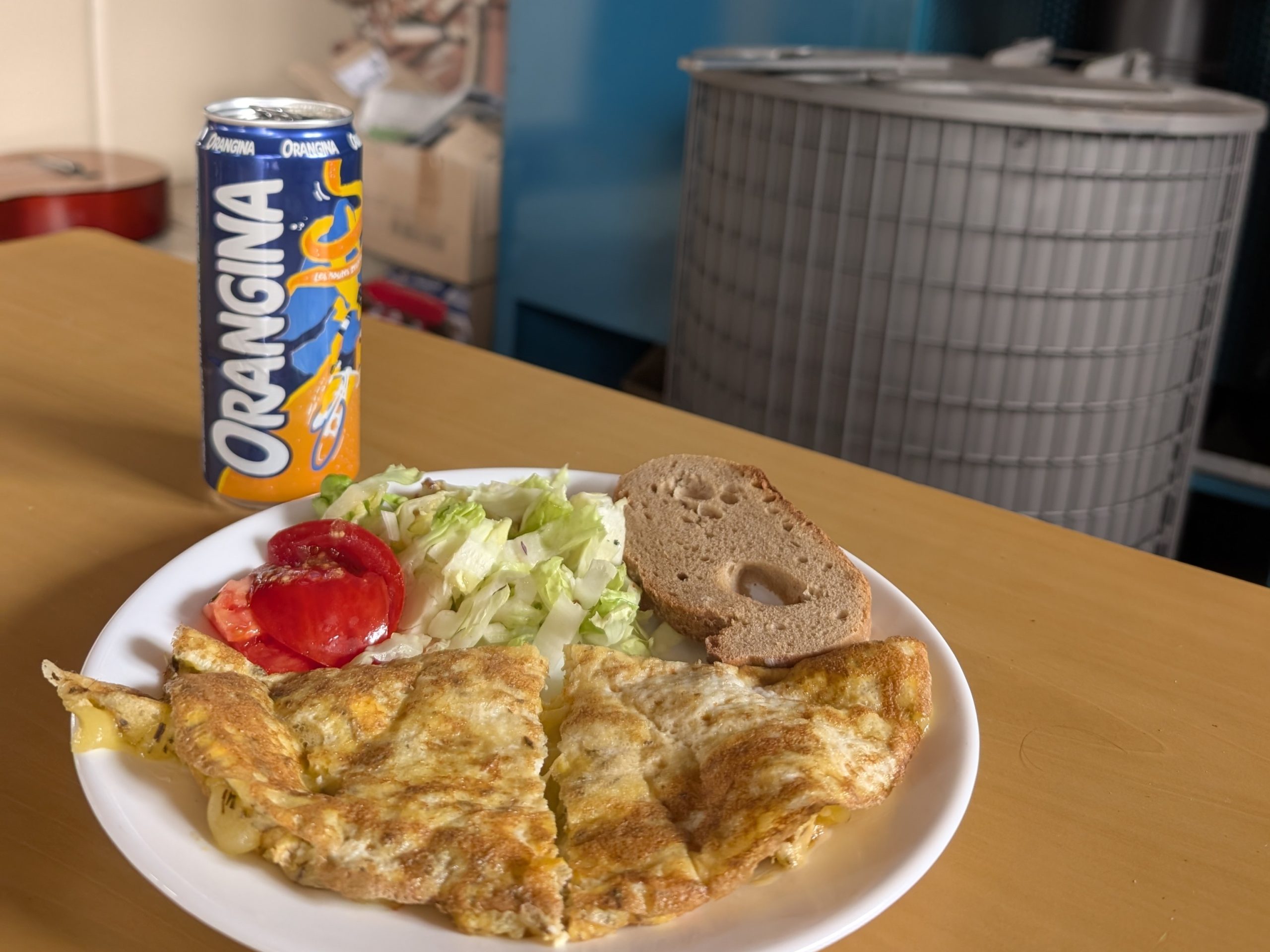
Omelette and Orangina at Refuge des Bésines
For a brief moment, the sun seems to win: the slopes above Lac de Lanoux glow faintly in the diffuse light. But it never reaches us. We continue climbing through the clouds until we reach Estany dels Forats, where a large herd of mountain goats greets us.
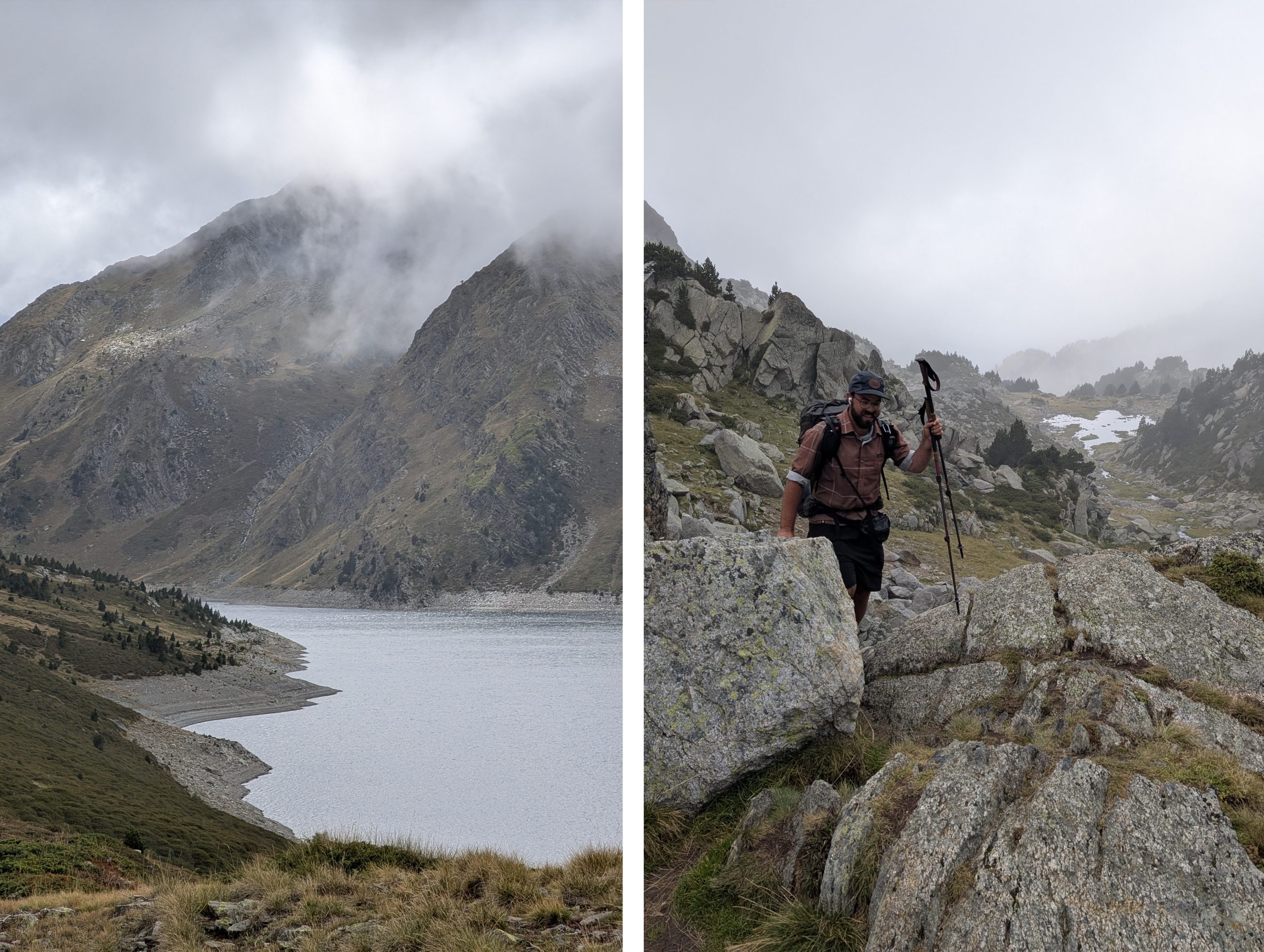
Hiking through the misty weather to Lac de Lanoux
I’m proud of us. Despite rain, wind, and fog, we made it exactly as far as we’d planned. Tomorrow, we’ll climb Pic Carlit — hopefully under a clearer sky.
HRP Day 31 – Cloudy with a Chance of Meatballs
Estany dels Forats to La Perche via Bolquère: 13.9 mi / 2,263 ft elevation gain / 6.5 h
The morning starts out freezing cold. A thin layer of ice covers the tent, and it takes a while before I can bring myself to crawl out of the warm sleeping bag. It was the coldest night so far.
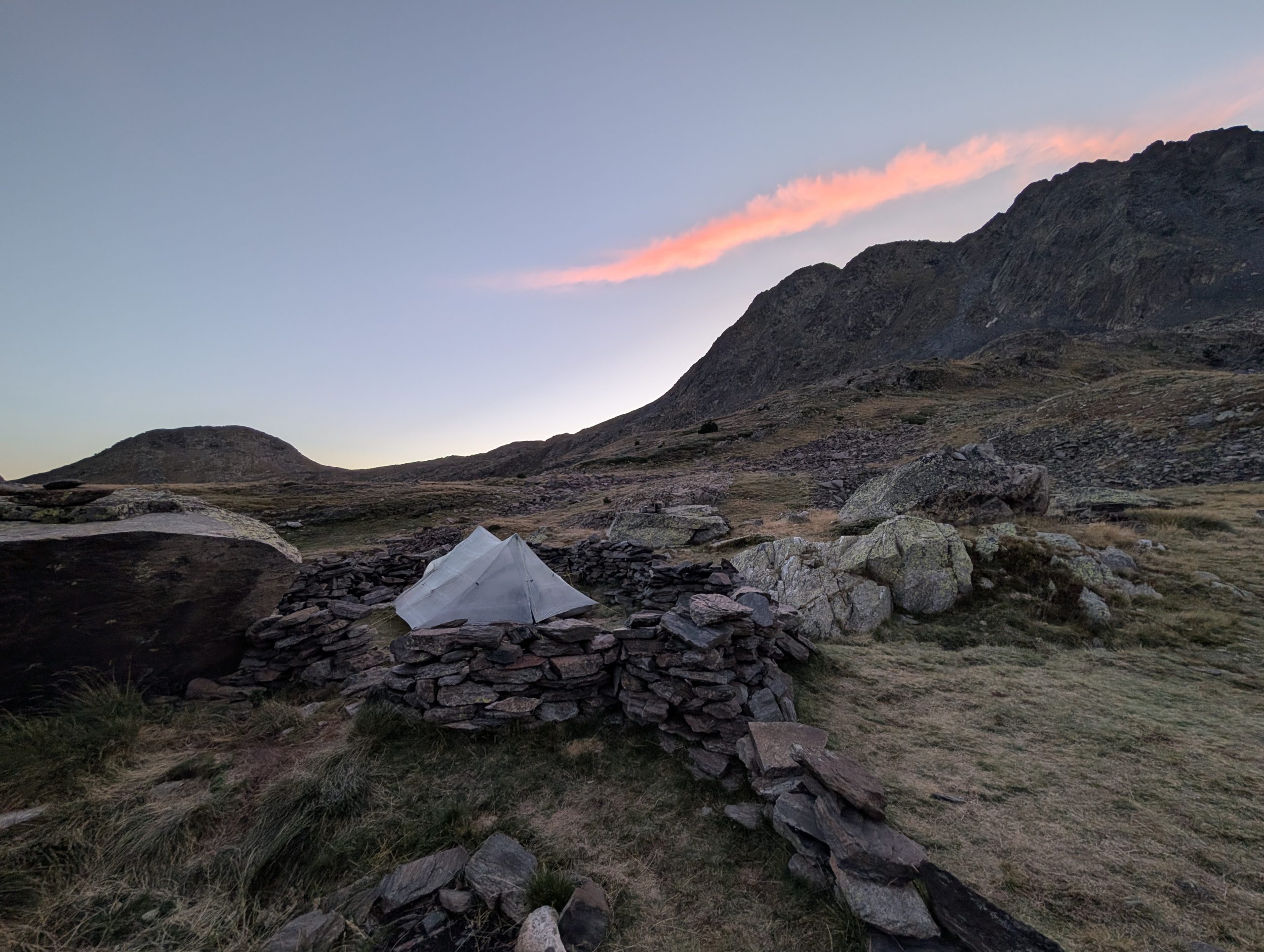
Waking up after the coldest night on the HRP
The climb up Pic Carlit (9,583 ft) is steep and runs along the shaded northern slope. I’m wearing my down jacket, leggings, and gloves, and my fingers are still trembling. The rocks are slick with frost, so I place each step carefully. At least the scree is frozen solid, making it more stable underfoot. As often when the climb feels hard, I start counting my steps as a little mental trick to keep busy and motivate myself. The gaps between numbers grow longer than usual. Normally it’s 1, 2, 3, 4 — now it’s more like 1… 2… 3… 4.
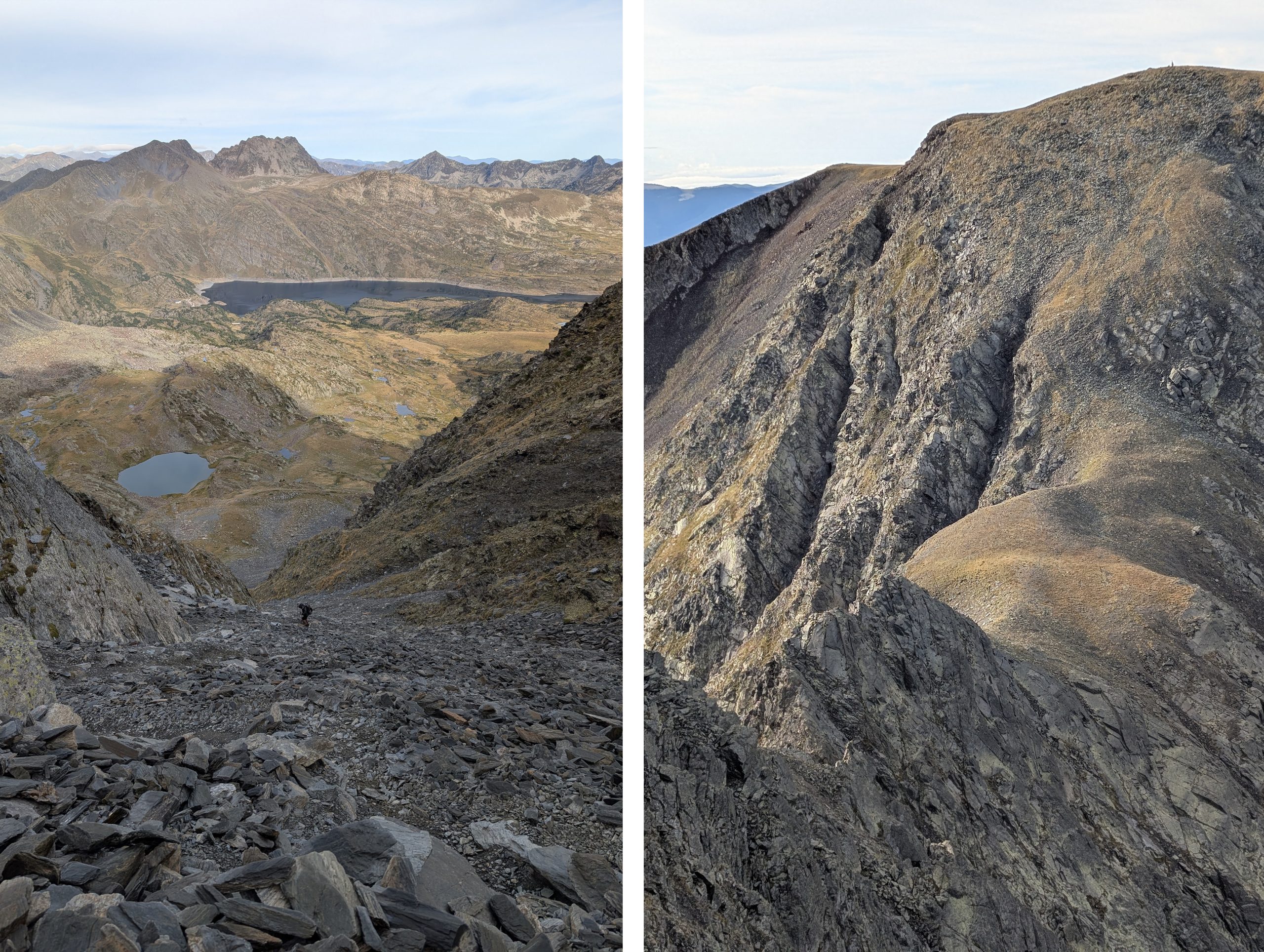
Climb to Pic Carlit
At the summit, the sun greets us with one of the best views on the HRP. To the east, a mosaic of lakes; to the west, jagged peaks. The Mediterranean remains hidden beneath a blanket of clouds, but I imagine it shimmering somewhere beyond the horizon. Many day hikers are out — clearly, Carlit is a popular peak.
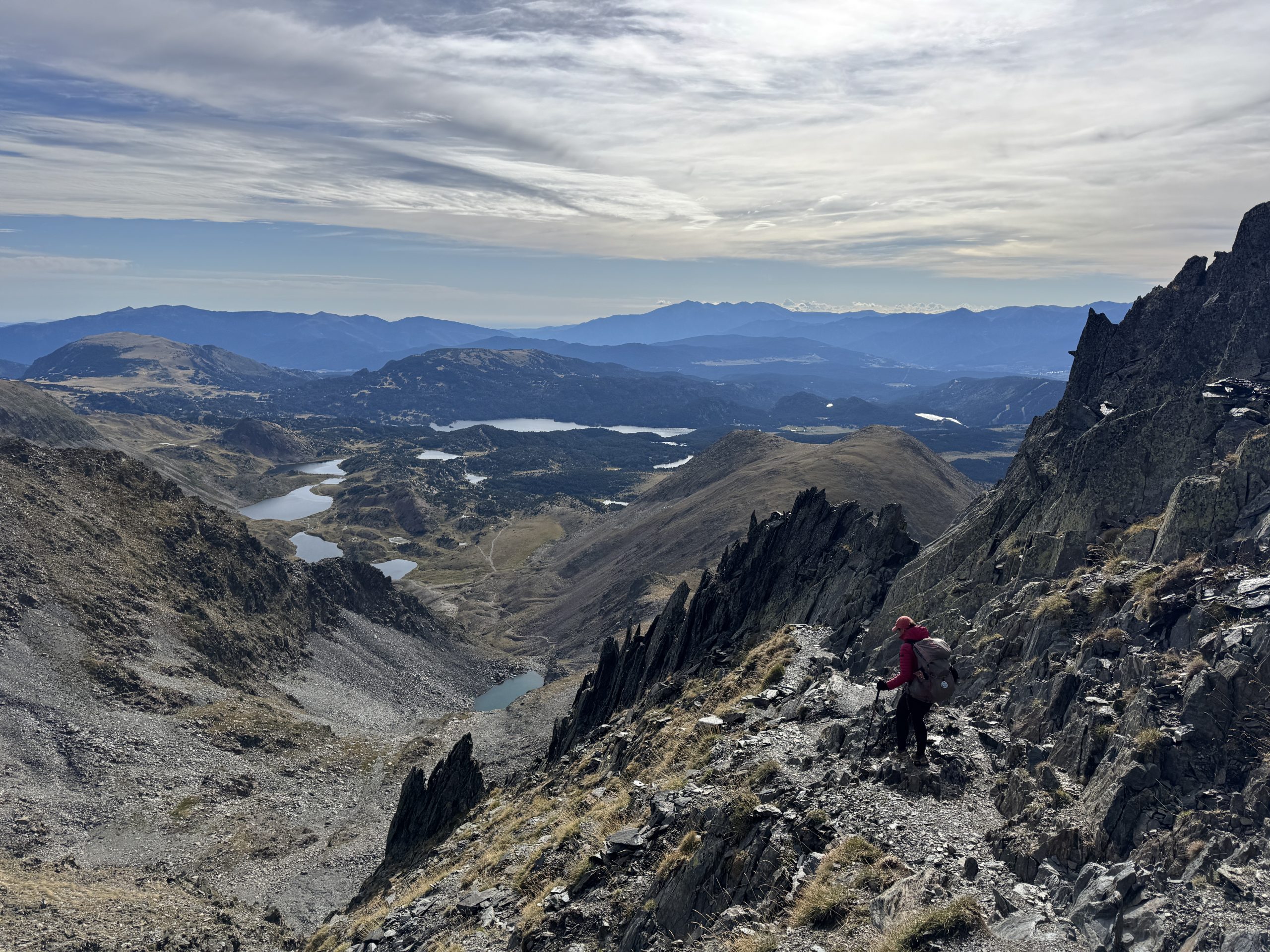
Descent from Pic Carlit
The descent leads us to a large parking area with not one but three restaurants. We choose the Auberge du Carlit and order Boles de Picolat — Catalan meatballs in a rich tomato and olive sauce. I’m in love.
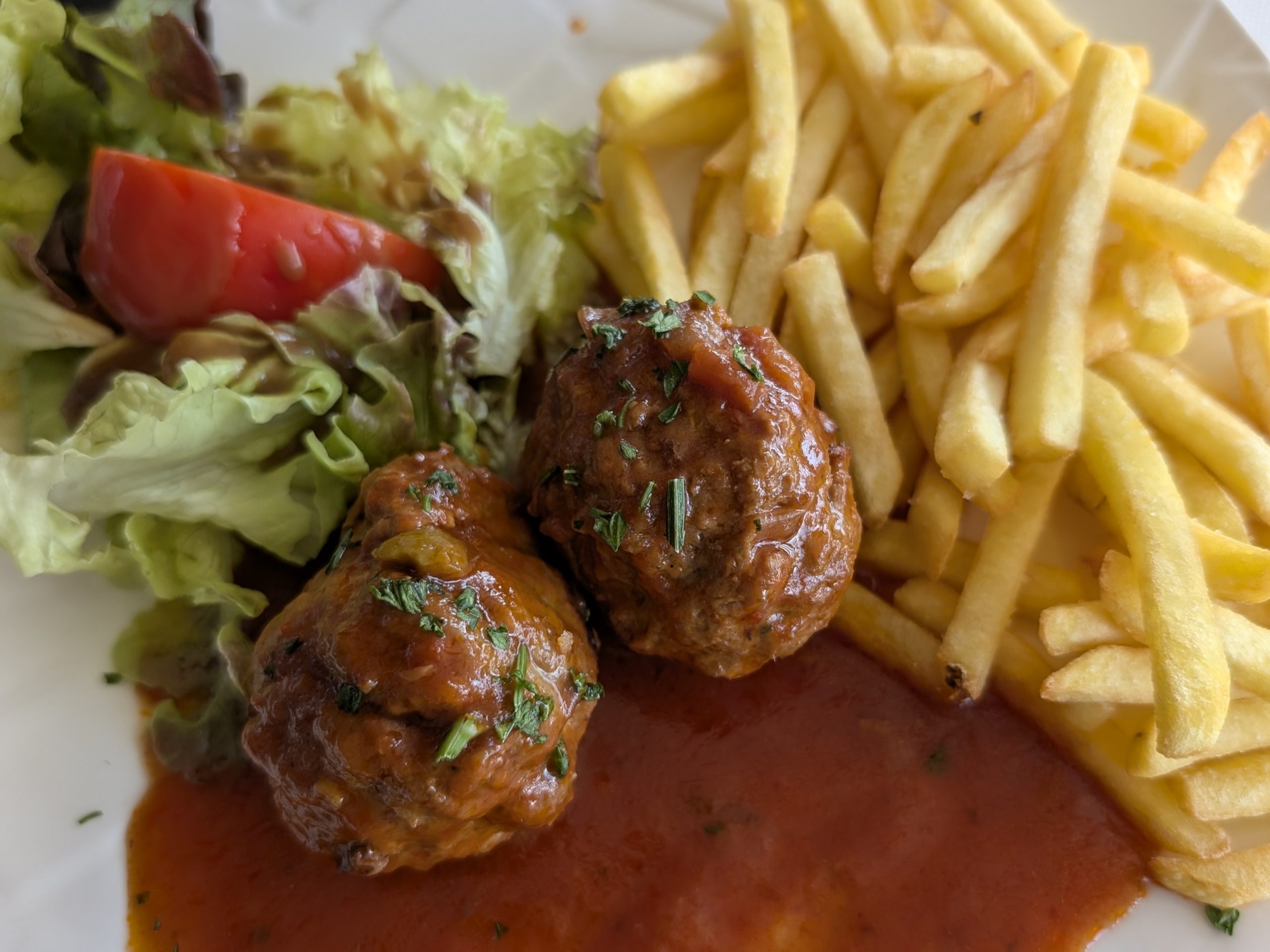
Boles de Picolat — Catalan meatballs in a rich tomato and olive sauce
After lunch, we continue past a chain of lakes. I find myself a little annoyed that we didn’t stick to the GR 10 here. The HRP takes a more convoluted route on rough, rooty trails, and the path is crowded with day hikers obliviously blocking the way.
Once we rejoin the GR 10, the walking becomes easier — wide forest roads that flow smoothly beneath our feet. A short road walk brings us to Bolquère, where we restock. The small grocery store surprises us with its excellent selection: our favorite caramelized-onion chips and even the Knorr Thai soup mix we used to make the best trail noodles ever after Gavarnie. I’ve been hunting these ever since. They have a great selection of local cheeses, and since none of us share a common language, the lovely lady behind the counter starts mooing and bleating to show which animal each cheese comes from — the most entertaining way to order cheese!
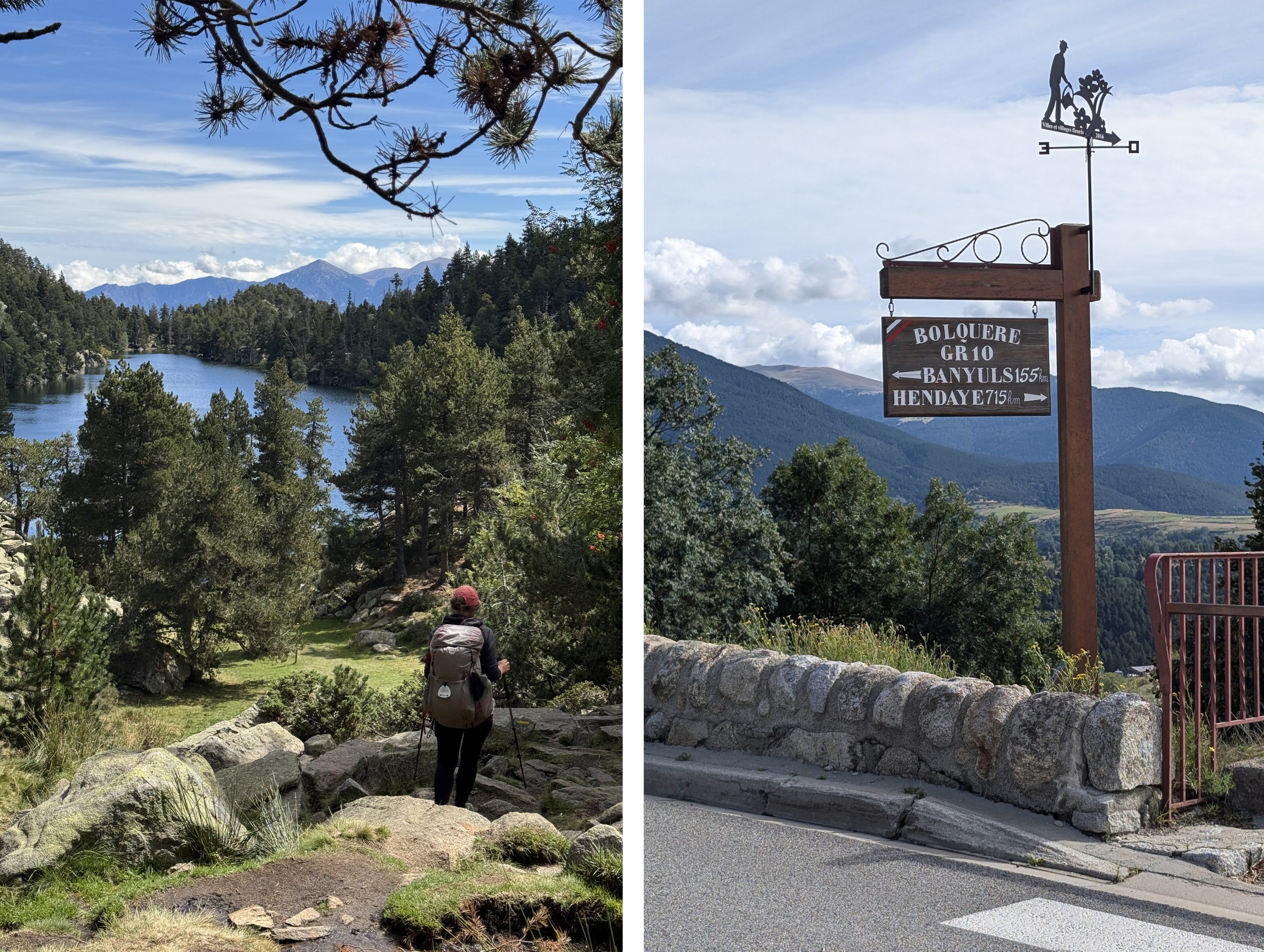
Descent to Bolquere for our last resupply
We only have one mile of road walking to La Perche left — unfortunately, without a shoulder and with far too much traffic. I’ve reserved a room at the local hotel since wild camping here is only allowed above 6,500 feet, and we’re not about to climb that high anymore. When we arrive, the door is locked, but a quick phone call in a mix of French and English gets us inside.
After last night’s frost, our still-damp tent, and the promise of a delicious three-course dinner, I regret nothing. The Boles de Picolat were so good that we order them again.
HRP Day 32 – A Long Ridge Walk
La Perche to river plateau before Refugi d’Ull de Ter: 14.5 mi / 5,710 ft elevation gain / 7 h
After the cold, wet days before, today is one of those rare, perfect days. It’s not too hot, not too cold, bright blue skies, and a long ridge walk ahead.
First, though, we have to march two miles along the road to Eyne, which isn’t the most pleasant start. We keep switching from one side of the road to the other, depending on the curve of the turns or to make space for passing tractors.
From Eyne, the trail climbs gently through the idyllic Vallée d’Eyne, following a river. Marmots sit by the path, purple flowers line the water, and the stream occasionally tumbles down in small waterfalls. It’s paradise. At the last spring, we fill our bottles as there won’t be any water on the ridge.
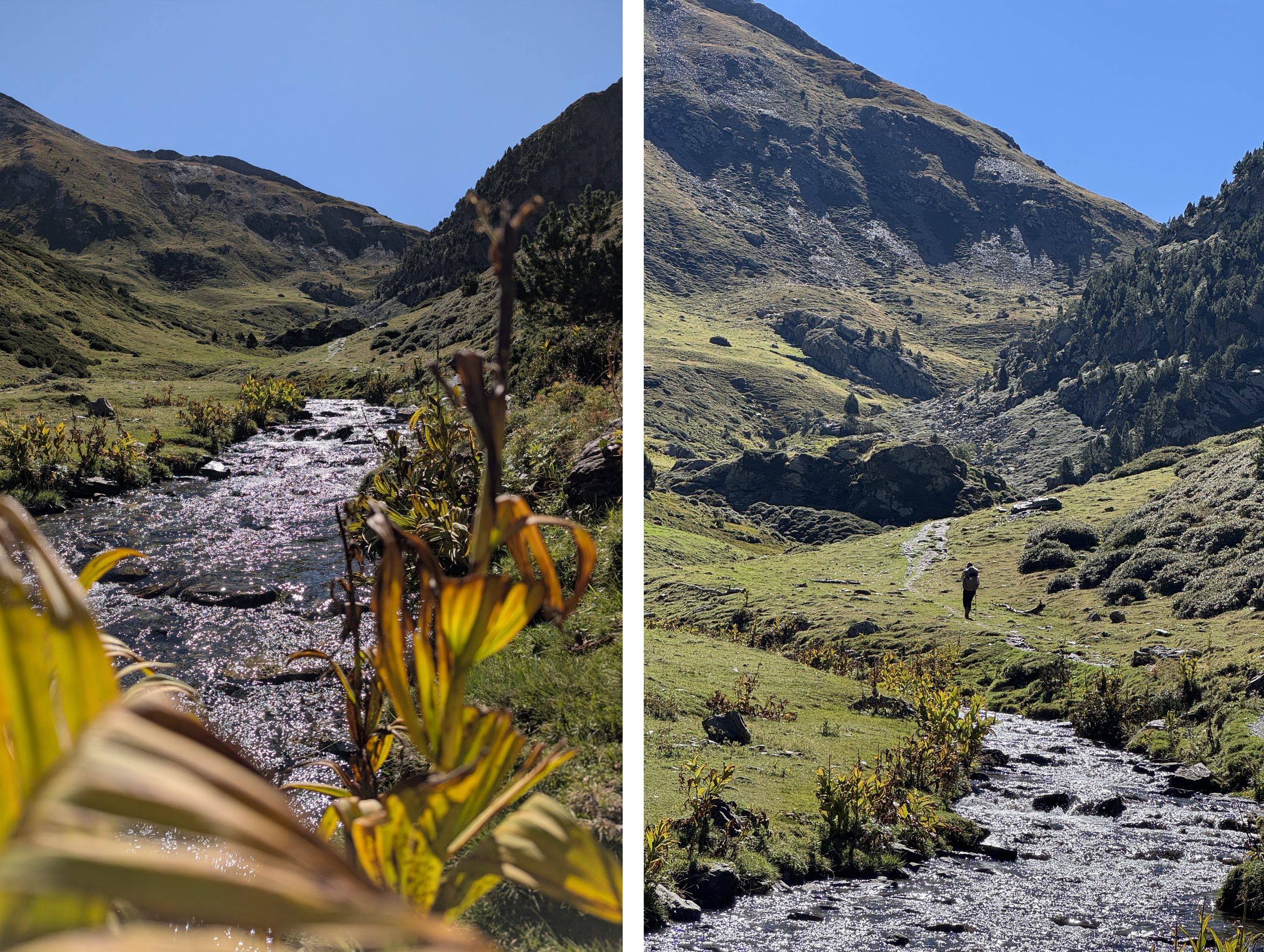
Climbing through Vallée d’Eyne
After 3,600 feet of ascent in 3.5 hours, we reach the Col d’Eyne, right alongside a group of young trail runners. None of them is actually running, but with their sleek vests and fashionable gear, they look like they’ve stepped straight out of an outdoor catalog. I feel pretty good about keeping up with them, considering my comparatively heavy pack.
From here, we follow the ridge, straddling the border between France and Spain. It creates a funny mix of greetings — someone calls out “¡Buen provecho!” and I reply with “Merci!” I’ve long since given up trying to switch languages; on the HRP they change too quickly to keep up.
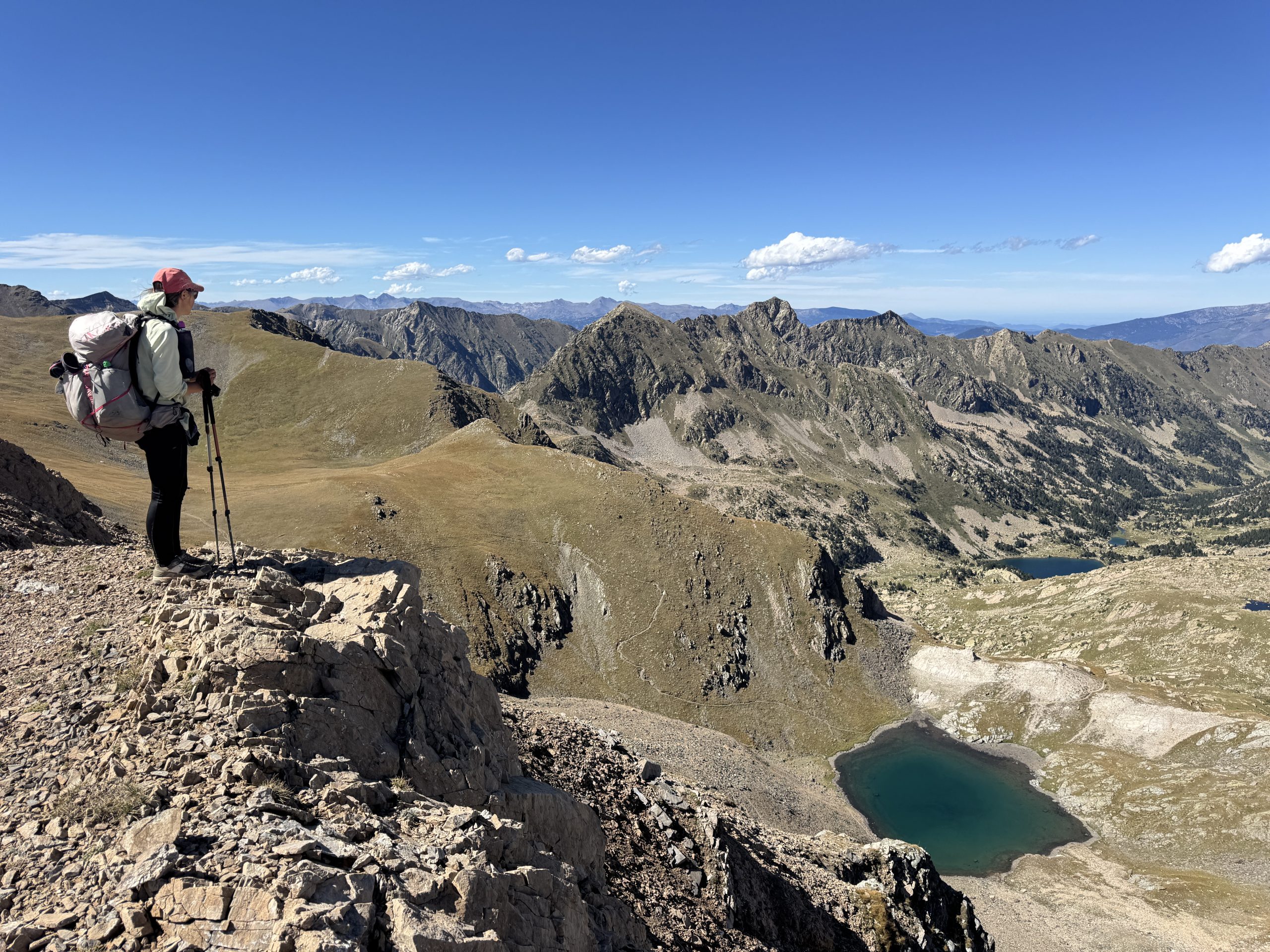
Ridge walk between Col d’Eyne and Col de Tirapitz
The trail is clear and surprisingly smooth. Despite the many climbs, we make good progress. And the views! On both sides, valleys open up with alpine lakes and endless mountain ranges. We pass one summit and saddle after another, including the Col de Nou Creus, where nine small crosses commemorate nine people dying in a blizzard.
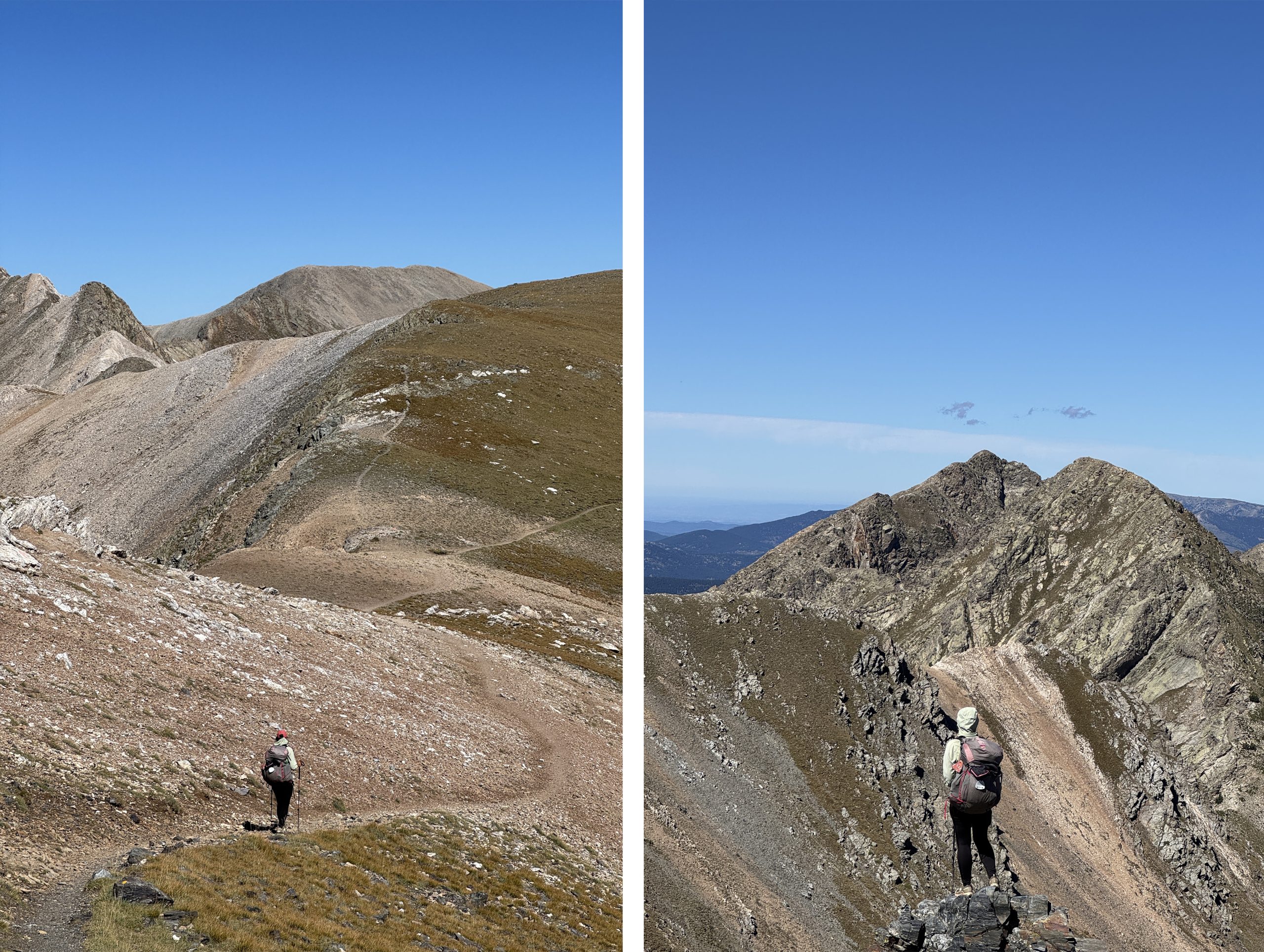
Ridge walk between Col d’Eyne and Col de Tirapitz
Eventually, the ridge ends and we descend — right through a herd of mountain goats that barely notice us. Usually they’re skittish, but these just glance up, then go back to grazing. Marmots dart between the rocks, and the sun hangs warm in the sky. At the first river, we stop to fill our bottles and meet Shawn, a Canadian HexaTrek hiker with long hair and a beard — the kind you can spot as a thru-hiker from a mile away. He’s from Québec, which gives him a big advantage here: he actually speaks French.
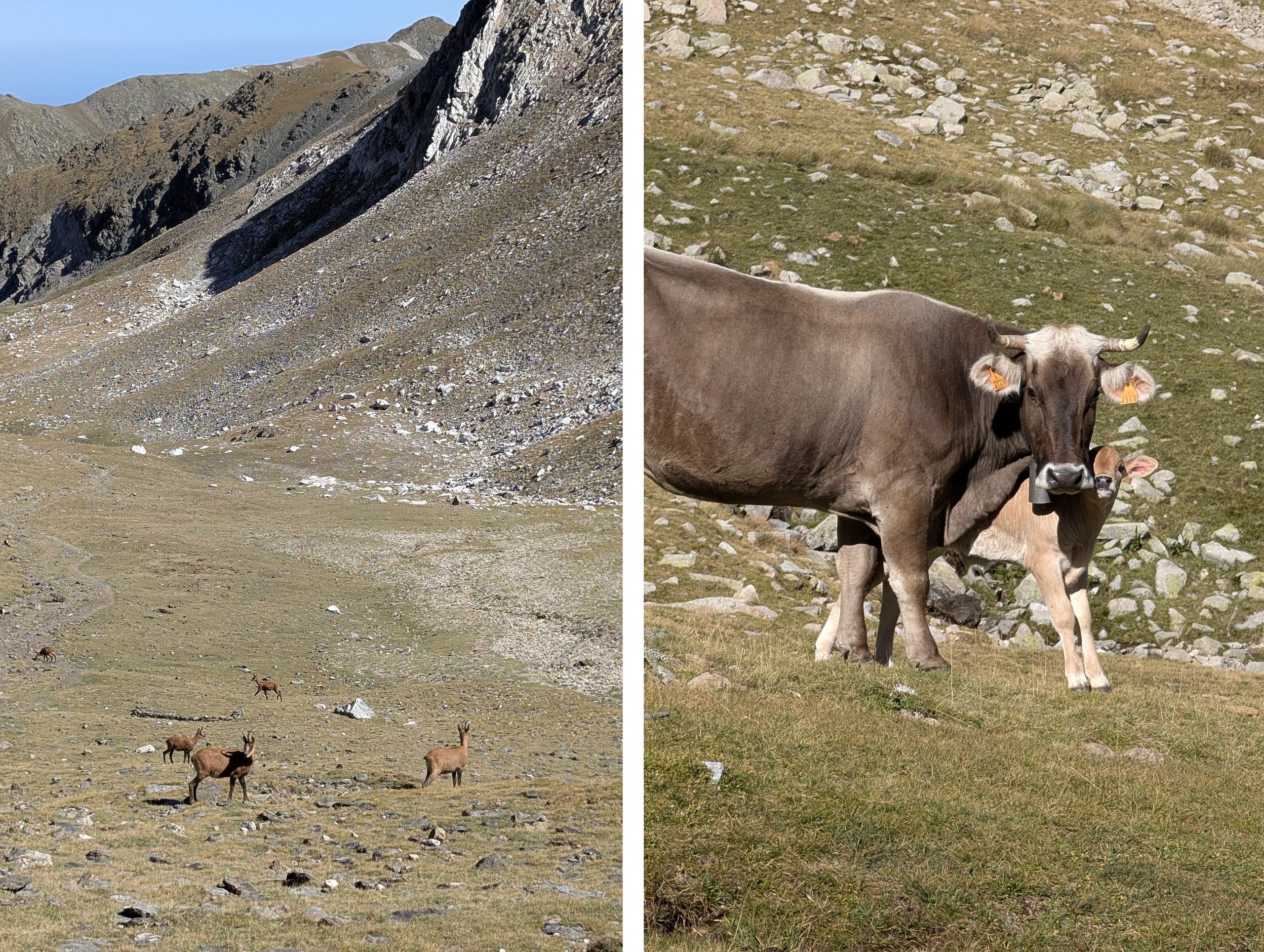
Meeting mountain goats and cows on the way to Refugi d’Ull de Ter
We trade trail intel — he warns us about limited water after Refugi d’Ull de Ter, and we warn him about the dry ridge. We also tell him about our experiences on the high passes ahead as he’s thinking of switching from the HexaTrek to the HRP for a while. A typical thru-hiker chat.
Just before the Refugi d’Ull de Ter, we find the perfect campsite by the river: a small grassy plateau, soft ground, flowing water — everything you could want. No need to haul water, no wind, no stress. The evening sun is so warm that, for the first time in what feels like forever, we enjoy eating outside. After all the changeable days, this is one of those evenings when everything feels effortless — perfectly in balance.
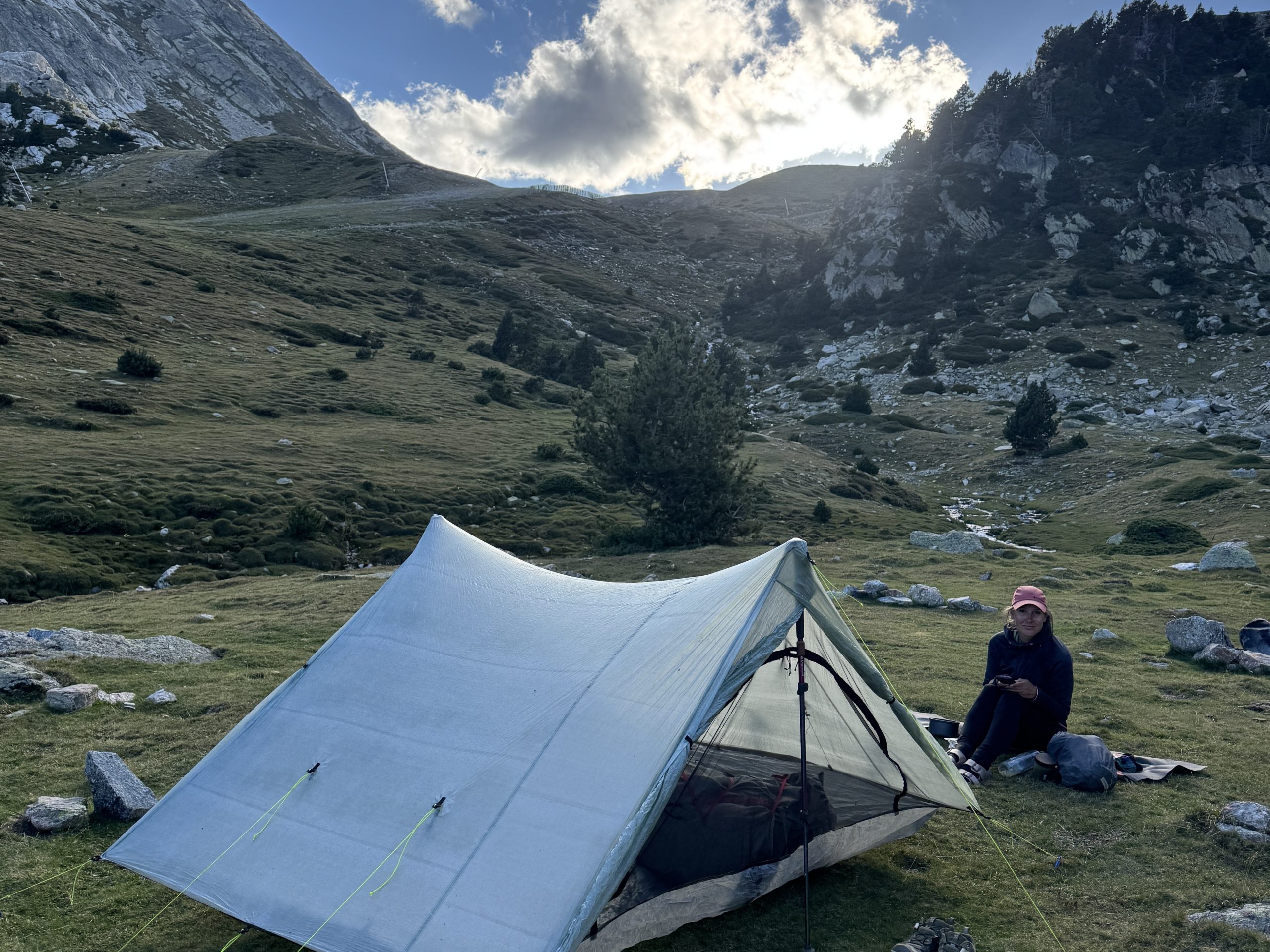
Perfect campsite near Refugi d’Ull de Ter
HRP Day 33 – Much Ado About Nothing
River plateau before Refugi d’Ull de Ter to Pla de Cady: 14.5 mi / 4,170 ft elevation gain / 7.5 h
A sunrise like a painting: clouds above us glow deep orange and red, while below, a solid sea of fog fills the valley.
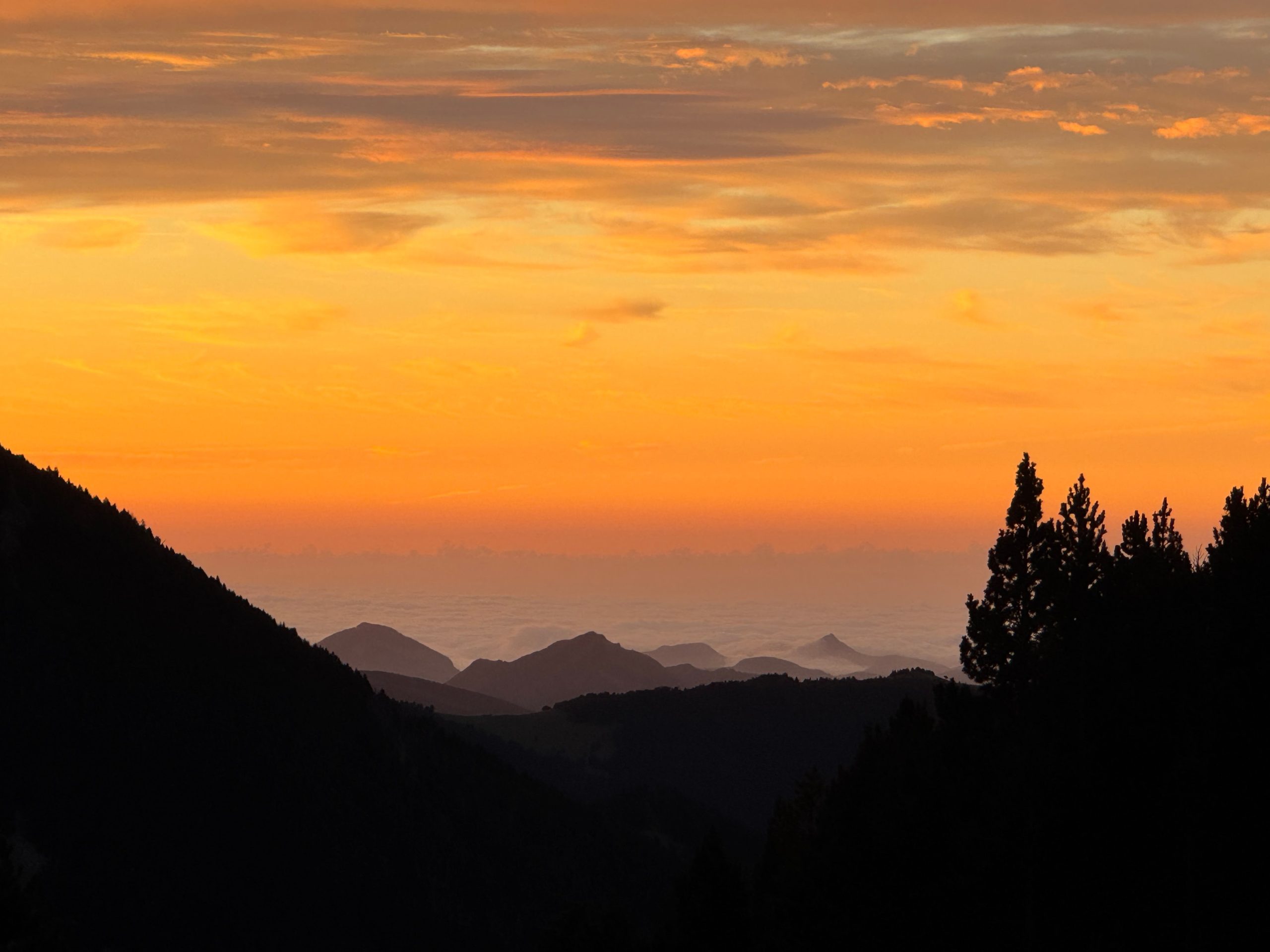
Morning on the HRP
We first descend into a ski area, past silent chairlifts and vast parking lots waiting patiently for winter. Then comes a short, steep climb, where we encounter a group of hunters with a dachshund that keeps turning around to look at me. I can’t tell if he’s just being watchful or sizing me up as potential prey. Either way, I don’t trust him. Eventually, we pass the group and continue on, unobserved.
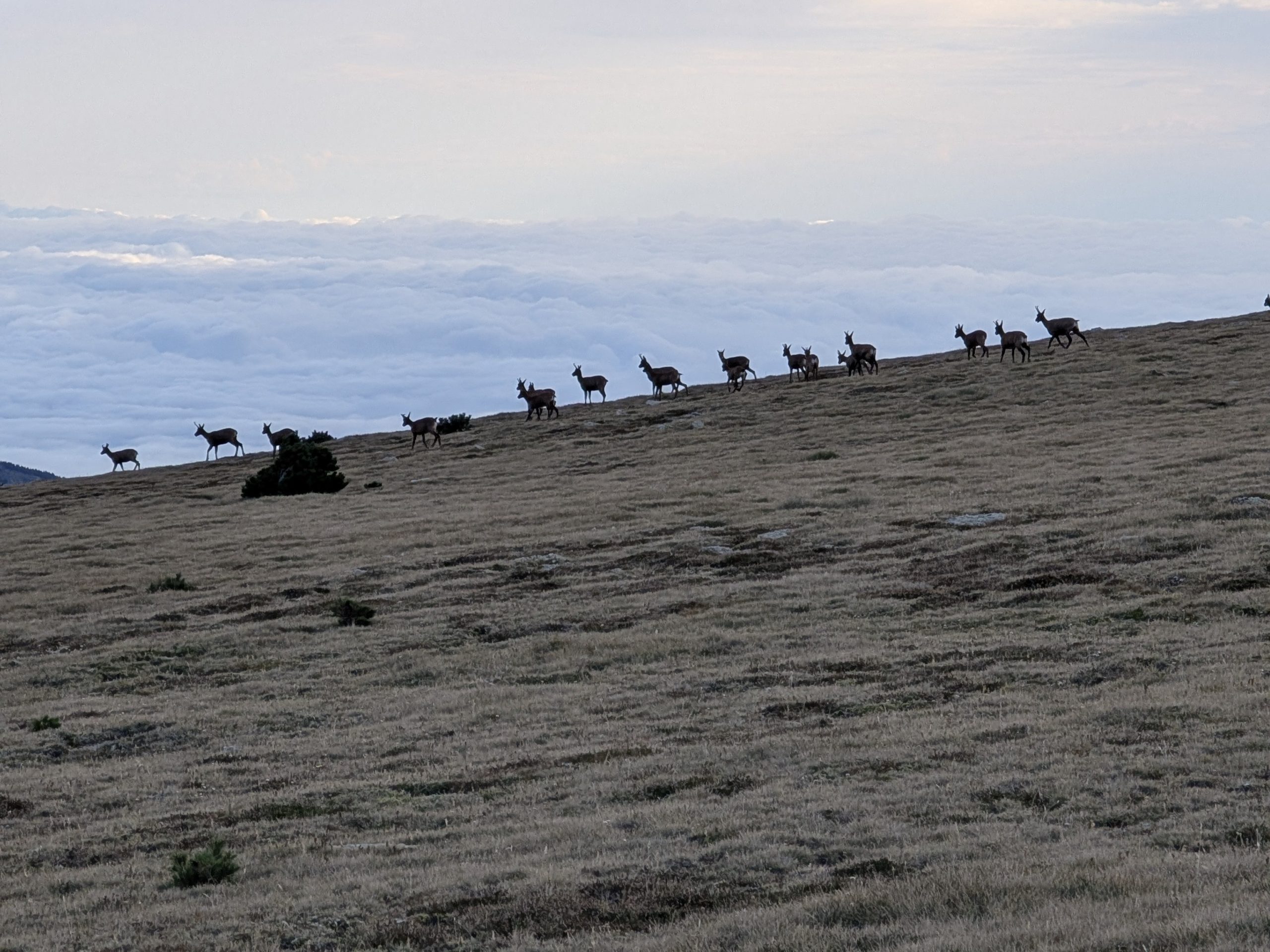
Mountain goats on the plateau
Today’s route crosses several high plateaus, staying above 6,500 feet for most of the day, so the elevation gain feels gentler. The trail is smooth and easy to follow, and by early afternoon we’ve already covered the 13 miles to Refuge de Mariailles, where we walk straight into the clouds.
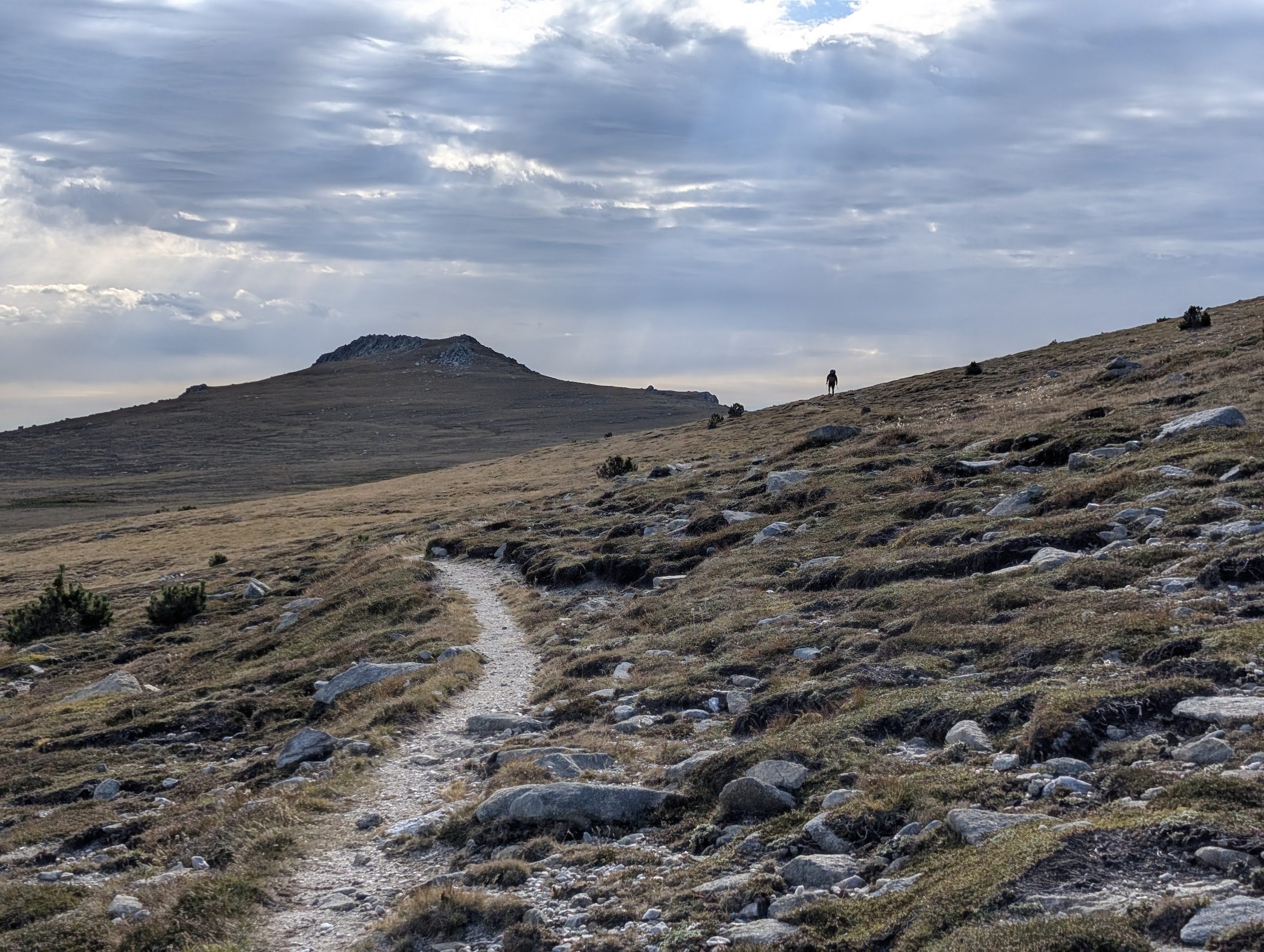
Walking over high plateaus
I’m hungry and ask for the plat du jour. The woman behind the counter rattles off something in French that I don’t understand a word of. I decide not to risk it and stick to safe ground: Coke and Orangina. Also, it’s loud in the refuge as a big group fills the room, their voices echoing off the walls. It’s immediately too much for me, so we escape back outside.
The sky darkens, distant rumbling hints at a coming storm, and the air grows heavy. The forecast says it should hit around 6 pm. A tanned man with flowing hair, shirtless — he looks like a French Tarzan — comes striding toward us, eyes wide, warning: “You should turn back!” We just smile. This isn’t our first rodeo, my friend. Besides, we know there’s a small cabane higher up if things get serious.
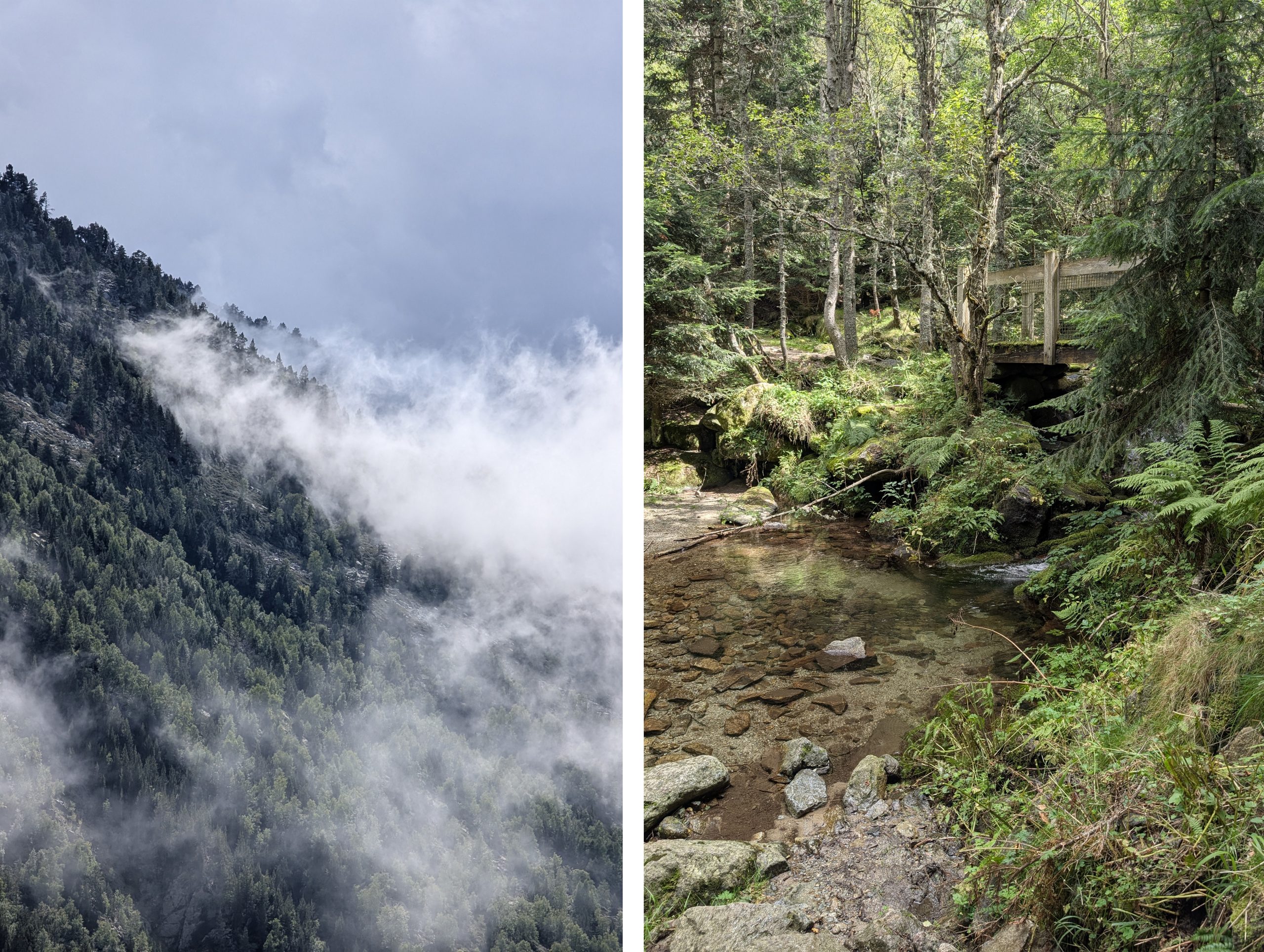
Climb towards Pic du Canigou
When we reach it, three people are already inside, and the weather no longer looks threatening. So we continue on until we find a spot on a broad plateau. Ahead of us rises Pic du Canigou (9,133 ft), the last major peak before the Mediterranean. With the storm looming, though, summiting today is off the table.
We camp in a small basin that shelters us from the wind. Dramatic clouds pile up overhead, but then… nothing. No thunder, no rain. Only the clinking of cowbells as curious cows wander by. Much ado about nothing. But better that way than the other.
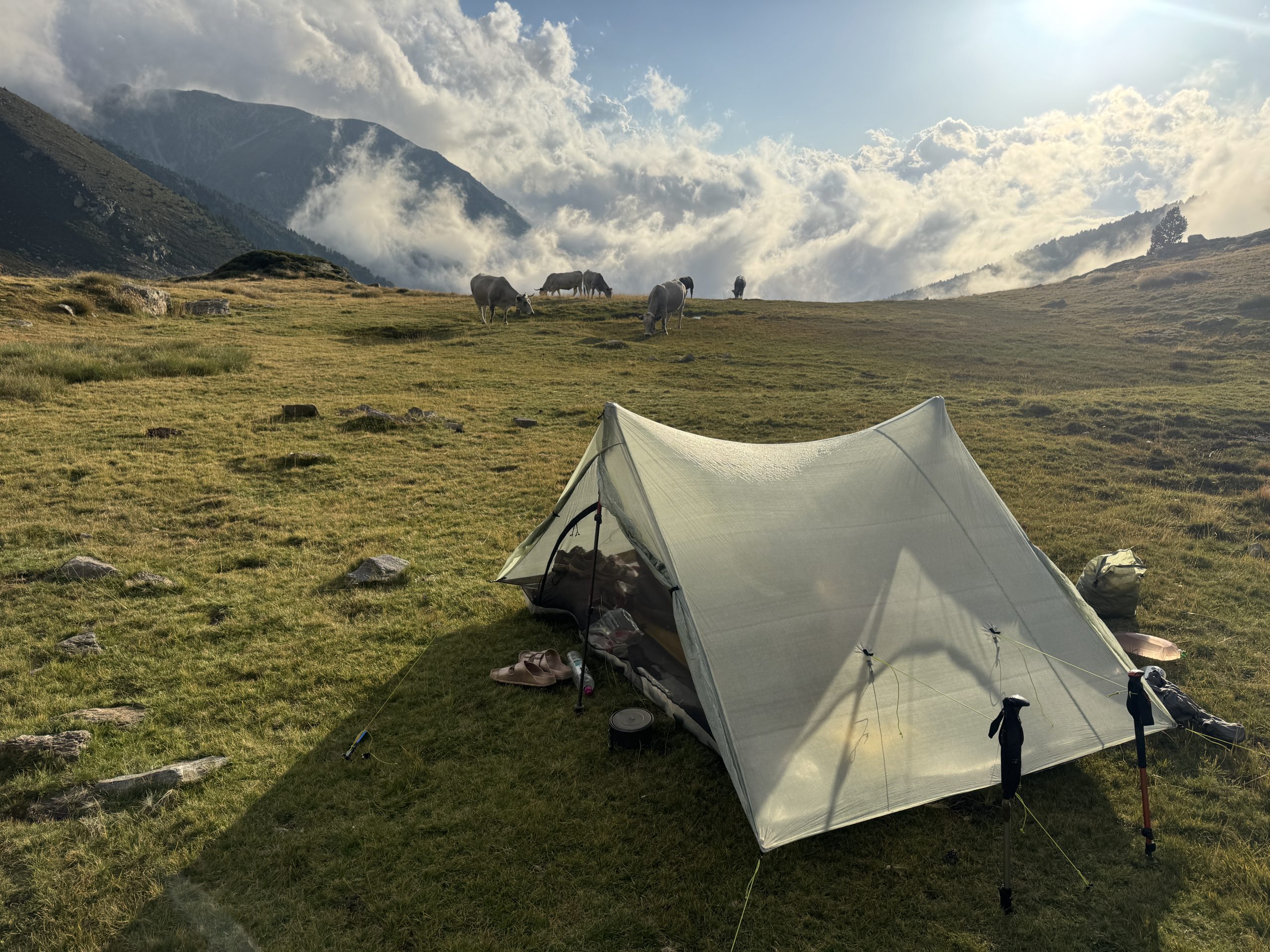
Campsite on Pla de Cady, just below Pic du Canigou
HRP Day 34 – Farewell to the High Pyrenees on Pic du Canigou
Pla de Cady to Arles-sur-Tech: 18.5 mi / 2,919 ft elevation gain / 9 h
Since we camped beneath Pic du Canigou, it isn’t far to the summit this morning. The trail winds pleasantly upward in switchbacks through rocky terrain, and we overtake a group of three young day hikers. One of them blocks the path at a junction and nearly knocks me off the trail with his backpack as he turns. Annoyed, I keep going, determined to stay ahead of them.
Just before the summit, we scramble up a chimney that offers the perfect amount of challenge without being frightening. The rock is solid and grippy, though small stones occasionally break loose. We’re glad no one is climbing above us. At the top, the wind is icy, prayer flags flap against my face, and clouds swirl across the ridges. The silhouettes of hikers appear along the opposite crest in between the clouds, and far below, villages dot the valleys. The Mediterranean remains hidden behind a thick blanket of clouds, but we know it’s there, waiting in the east.
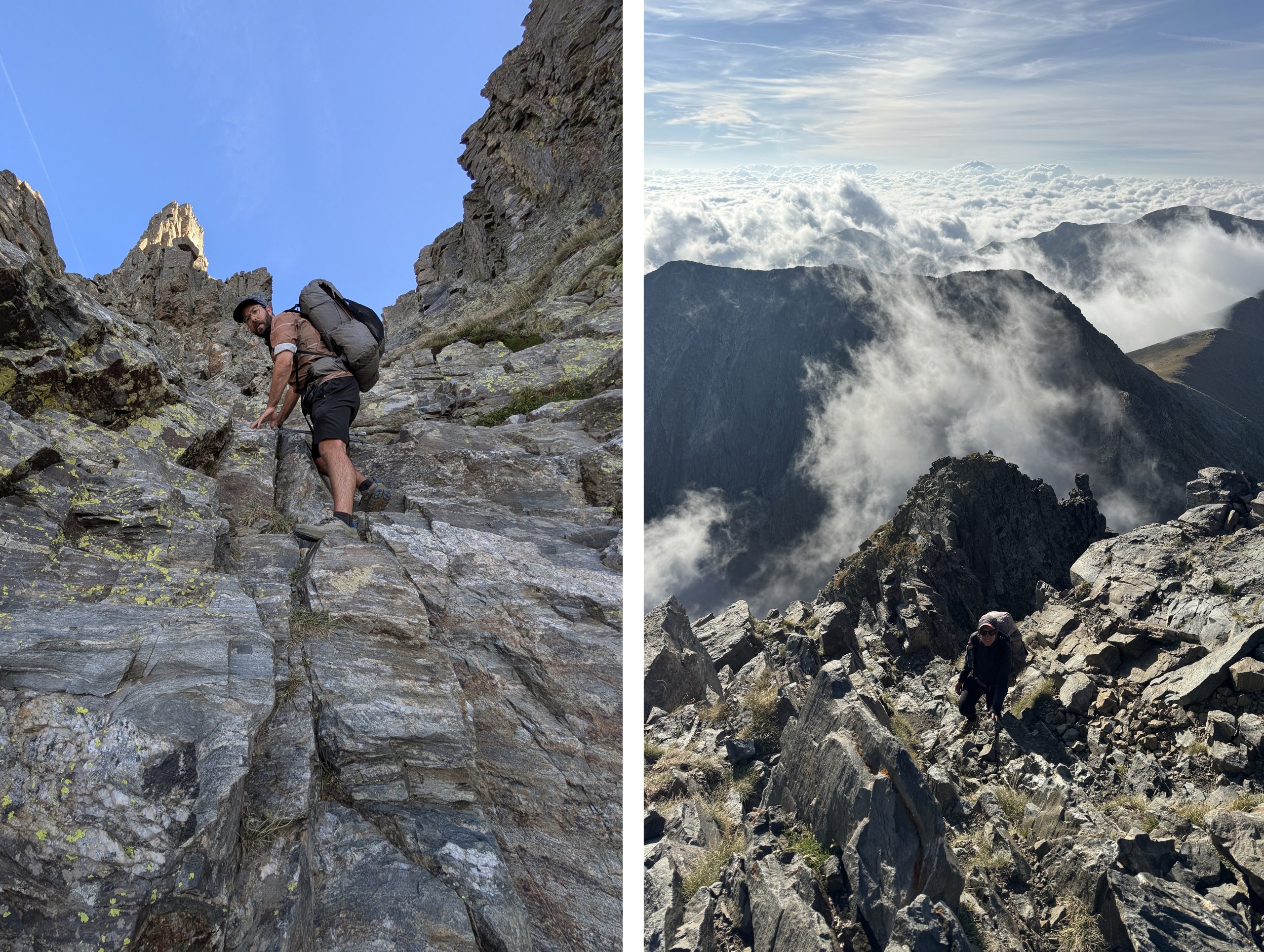
Climb to Pic du Canigou
The three hikers from earlier catch up, and we take summit photos for each other. The woman wears the same Decathlon fleece as I do — only hers still looks brand new. The pink is still pink, not faded to washed-out rose, and there are no holes. Mine, on the other hand, has survived two full thru-hikes and looks like it. Decathlon stopped making this model, and I can’t help feeling a little jealous of her pristine version.
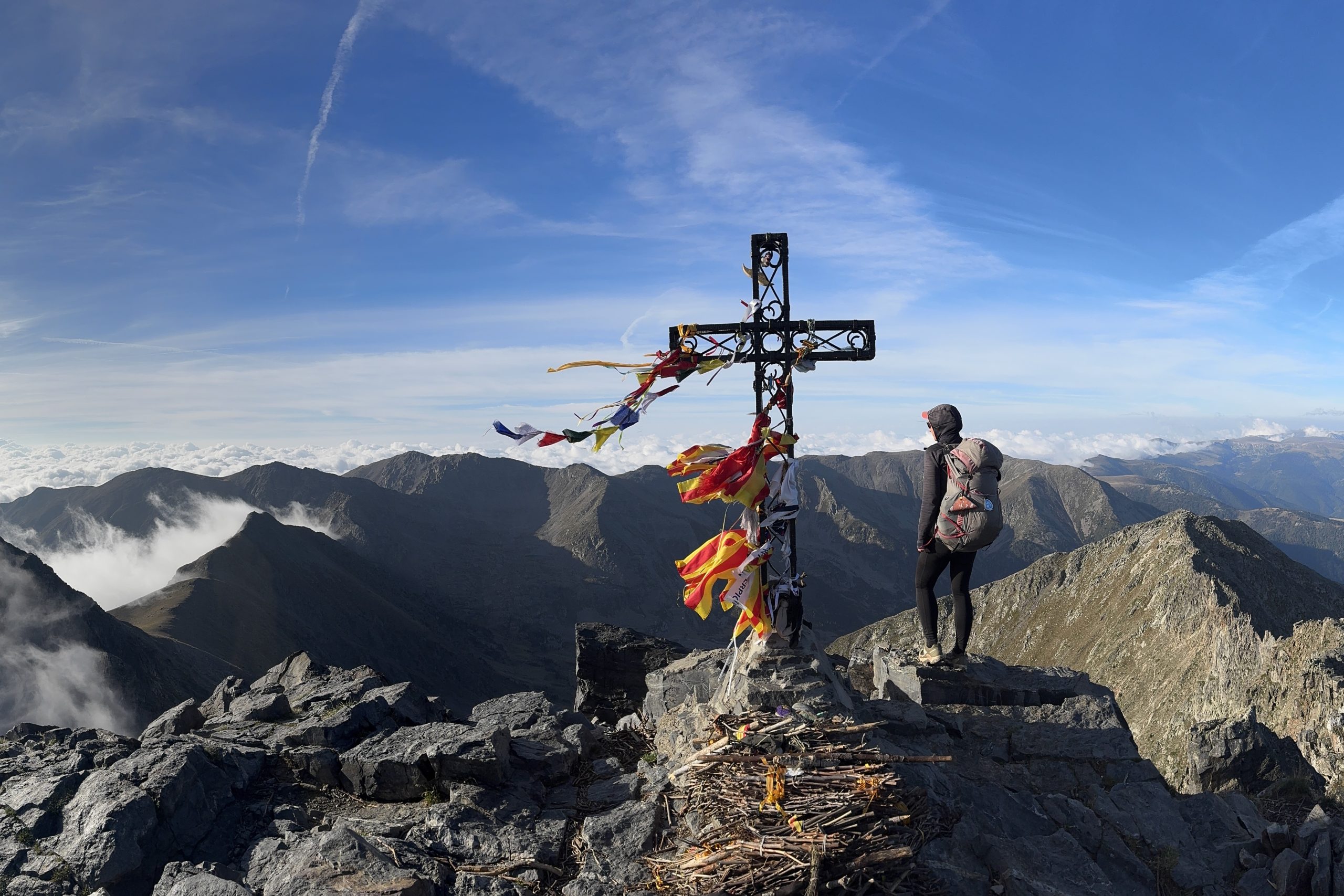
Summit of Pic du Canigou
It’s getting freezing at the top. I pull on my rain jacket and two pairs of gloves, and we start descending the much easier trail on the other side where we pass lots of hikers coming up. The path lies in deep shade, and I can’t warm up. My hands refuse to thaw, and I can’t wait to feel the sun again. I’m colder this morning than on any other day of the HRP. But the high peaks are behind us now — from here on, we’ll rarely climb above 3,000 feet. Canigou feels like a fitting farewell to the high Pyrenees.
At Refuge des Cortalets, I treat myself to a hot chocolate that warms me from the inside. The rest of the day is quieter, through forest and along a balcony trail tracing the Canigou massif, but clouds swallow any view. Cows provide entertainment instead. Two cows with calves block the path, more interested in licking the salt off the rocks than letting anyone pass. A rock wall on one side, a steep slope on the other — no way around. A German couple stands helplessly on the far side. When one cow finally moves, the man tries to slip past, but the cow swings her head, knocks him off balance, and off the trail into thorn bushes. He’s scratched but otherwise fine.
Ryan manages to get by, and when I follow, the cow flicks her head again, and I land in the dust. She’s just swatting flies, completely uninterested in us. Eventually the cows shuffle aside, and we slip through. We didn’t expect this kind of obstacle on what was supposed to be an easy trail. Crazy: we’ve survived storms, lightning, and exposed scrambles, only to nearly be taken out by a cow.
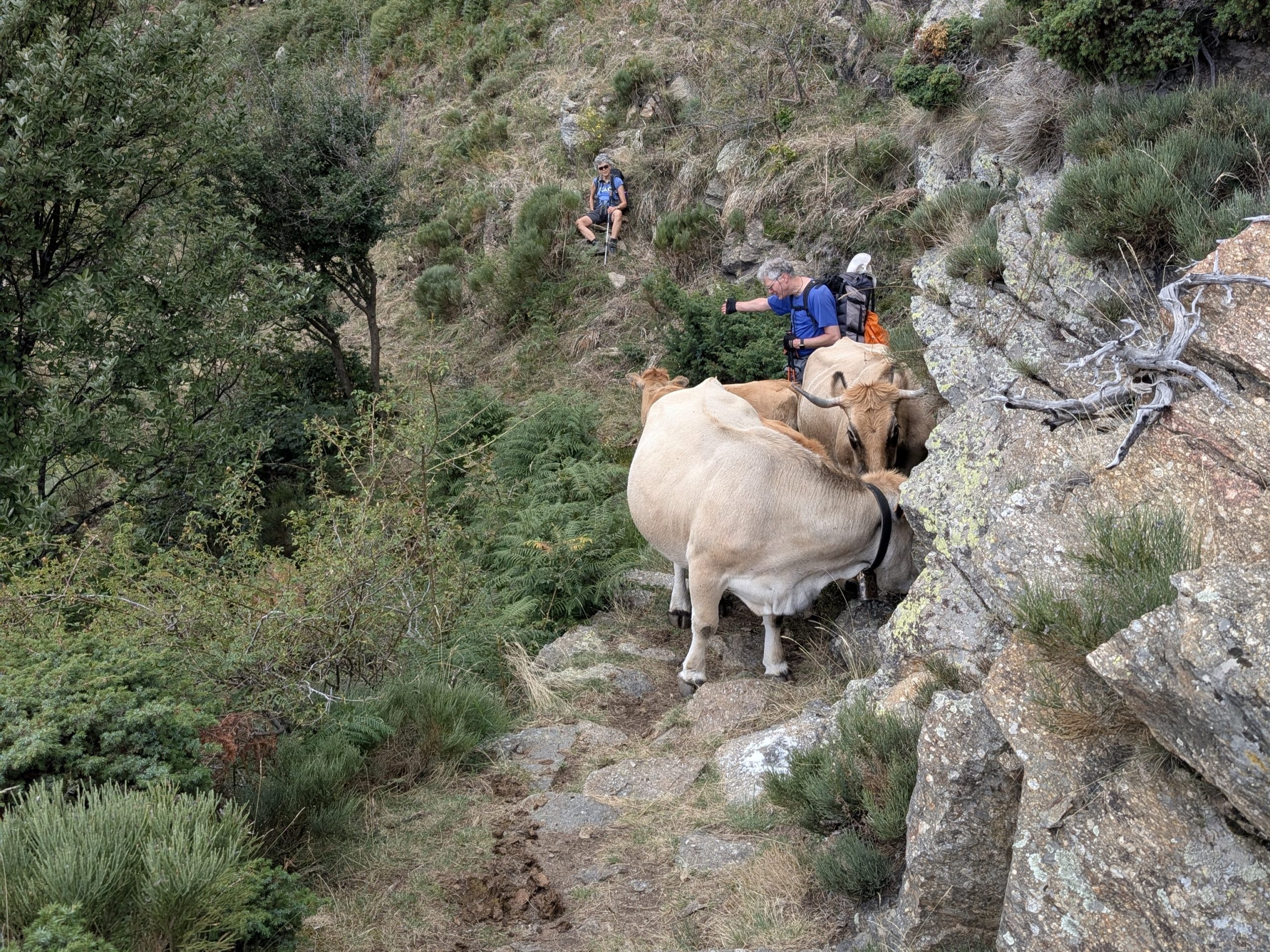
Cows are blocking the trail
Twice more the path is blocked by cattle, but this time we can scramble around along the slope. The trail then winds for a long time through the forest before descending to Refuge de Batère. Unfortunately, we’re too late for lunch, so Orangina will have to do. There we meet Nikita, who’s hiking the GR 10. She tells us that all her trail friends have quit or fallen behind, and she’s been walking alone for days — something she clearly dislikes. It’s her first long-distance hike, and she’s loving it. We suggest the PCT as her next adventure. But I’m eager to move on — I’m getting cold when I sit still, it’s already 4 pm, and we still have some ground to cover.
From here it’s another seven miles downhill to Arles-sur-Tech, at just 925 feet elevation. It’s been ages since we’ve been below 1,000. We’ve entered the foothills now — the final stretch. The HRP follows the GR 10 all the way to Banyuls from here.
The path alternates between dirt roads and narrow woodland trails, eventually turning Mediterranean: dry pines, dusty gravel tracks. We pass through a strange “ecological camp” filled with trailers. Two campers ignore our “Bonjour,” but at least two adorable cats greet us instead. The lower we go, the hotter and muggier it gets. Tiny flies swarm around our faces, and we wave our trekking poles wildly to keep them away. I already miss the cool mountain air.
At last, after 20 miles — our longest day on the HRP — we reach Arles-sur-Tech. On other trails this would have been routine, but here it feels monumental.
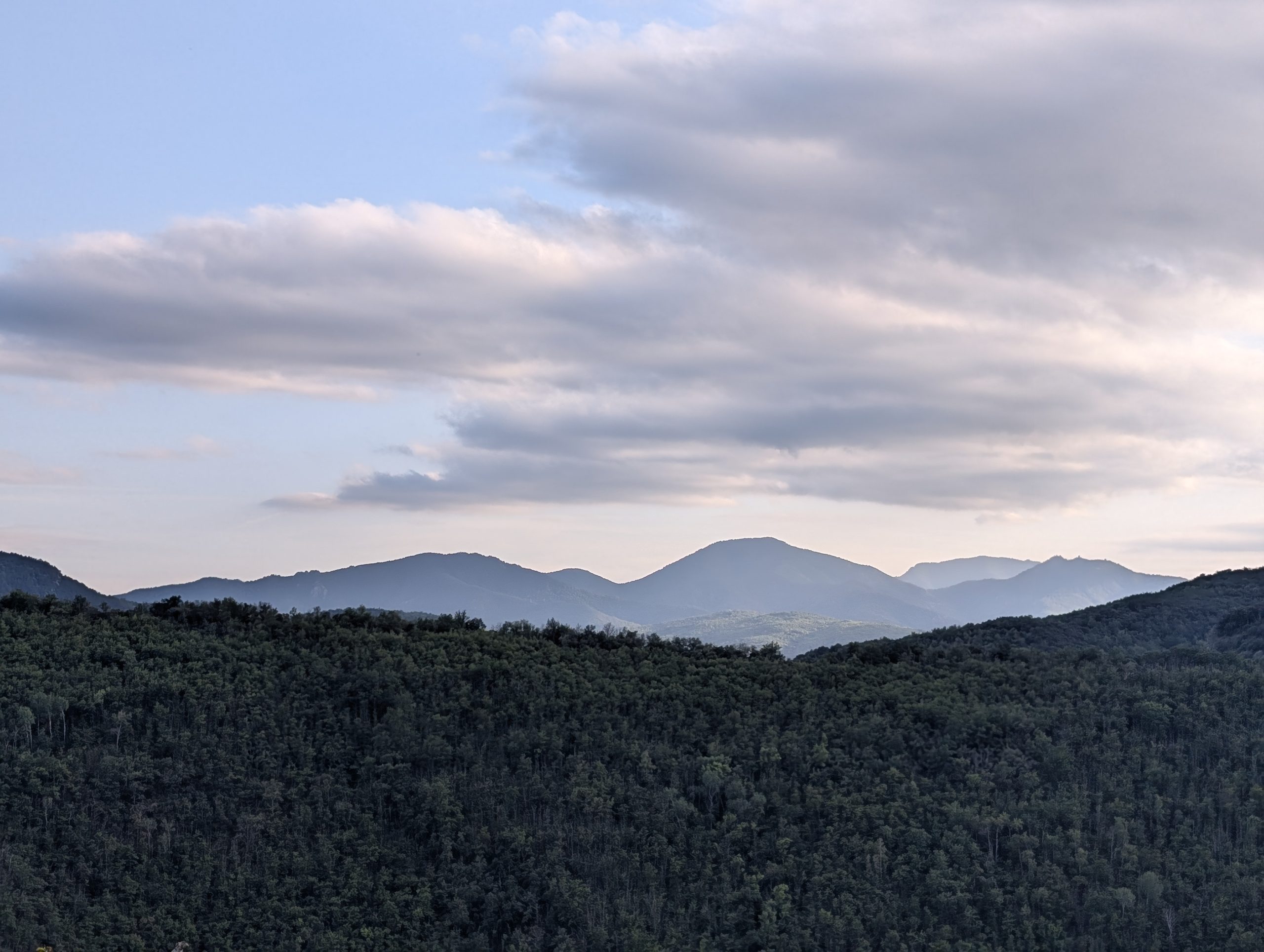
A last view back into the mountains
At the campground, the reception is empty. A note lists a phone number, but no one answers. Unsure what to do, we walk next door to the restaurant for food and maybe some information, but there’s nothing happening there either. Apparently a concert is happening tonight; people keep showing up, but no one seems to be serving.
Then we run into Sanne from the Netherlands, who had been hiking with Cordelia recently. Cordelia has already moved on, but Sanne injured her foot and is resting here. She tells us we can just set up our tent and pay tomorrow. Relief. It’s nearly 8 pm, and we just want to shower, eat, and rest.
We spend the evening cooking dinner and talking to Sanne about our HRP experiences while swatting mosquitoes. She tells us that the morning after the frosty night, she and Cordelia met a hiker who had gotten lost and spent the night outside wearing only shorts and a thin jacket. Apparently she was fine — which sounds almost impossible — but what can you do when someone insists they’re okay?
HRP Day 35 – From Meltdown to Mediterranean Views
Arles-sur-Tech to Refugi de les Salines: 11 mi / 5,675 ft elevation gain / 6 h
A rare sight this morning: not a single drop of condensation on the tent. The campground owner rolls by in his golf cart, and we pay for the night — accidentally for two. A translation error on my part, but at 23 euros total, I let it slide.
We do our resupply at the Spar and stroll through the pretty alleys of Arles-sur-Tech. I’m especially looking forward to breakfast: fromage blanc — my favourite French yogurt — with cherry compote. Only problem: I’ve been out of lactase pills for days. That’s supposed to change today, since there’s a pharmacy in town. The plan: get the pills, then enjoy breakfast.
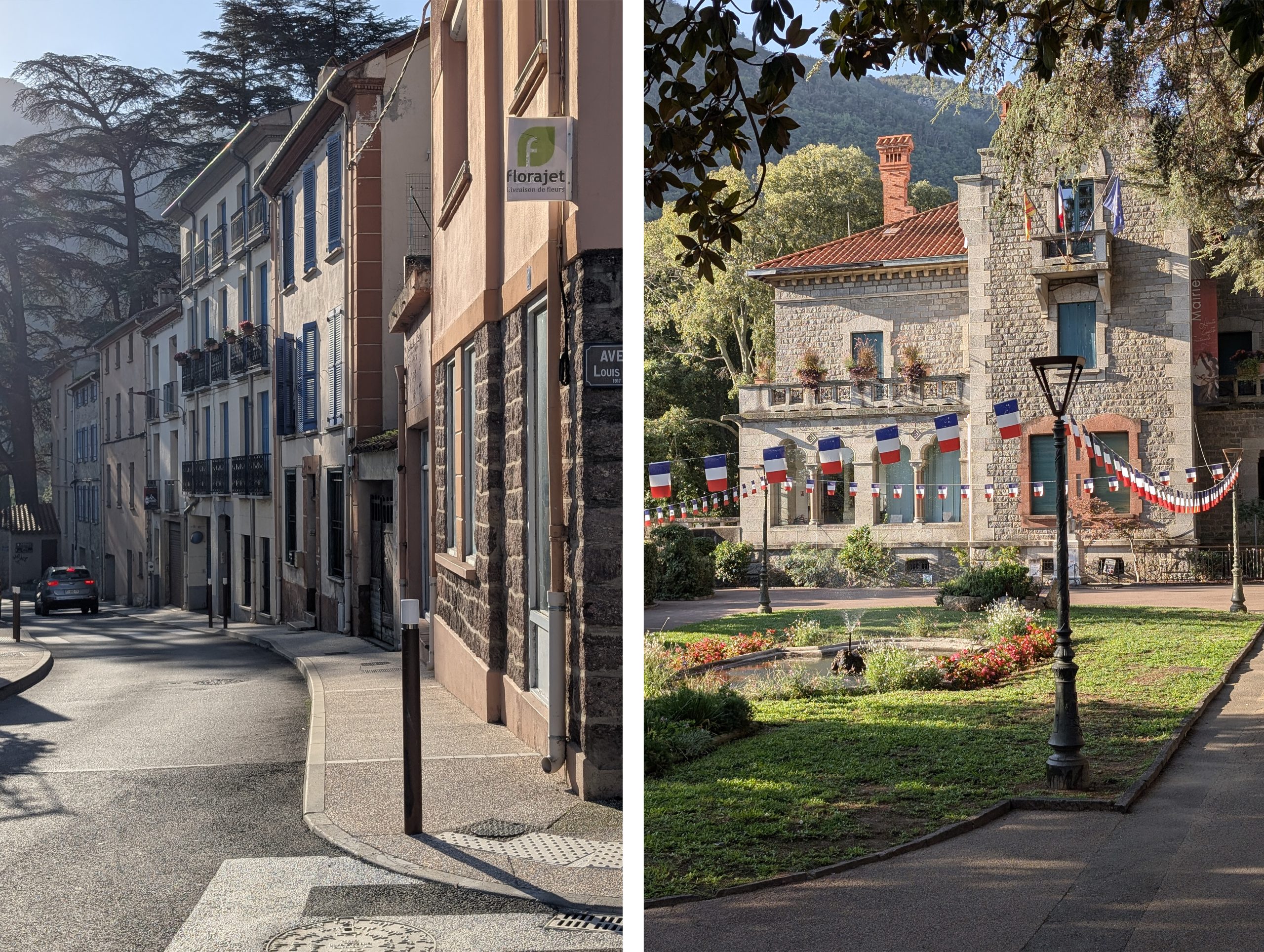
Arles-sur-Tech
The pharmacy visit turns out to be more challenging than expected. I wander the aisles, trying to avoid talking to anyone, but find nothing. A piercing bell rings every time a customer enters, making me flinch each time. Finally, I gather my courage and ask — in broken French — for lactase pills. The pharmacist looks completely baffled. I try again, explaining they’re for lactose intolerance. After several awkward exchanges, we establish they don’t have any in stock but could order some. I thank her and leave.
And then it all crashes. Too loud, too hot, too many cars, too many stimuli. The plan has failed, my head is buzzing, and my body is overwhelmed. I can’t keep track of what’s next. Refill the Orangina? Take out the trash? Eat breakfast? It’s all too much. I put in my Loops, take a few deep breaths, and decide: I just need to get out of here — back into nature, where I can think straight again.
The climb through the forest is steep and humid. Sweat runs down my face, and we stop every few hundred feet to rest. I wipe my face with a towel and gulp Orangina like a magic potion. There’s no view to reward us, just trees and heat. It feels like the HRP gifted us a chapter of the Appalachian Trail. At the pass, I finally eat my fromage blanc with cherries — lactose be damned. A risk I’m willing to take.
The descent leads to La Fargassa, an eco-hotel and campground for hikers. On the lawn, a kitten greets us, purring as it winds around my legs. A brief, peaceful moment.
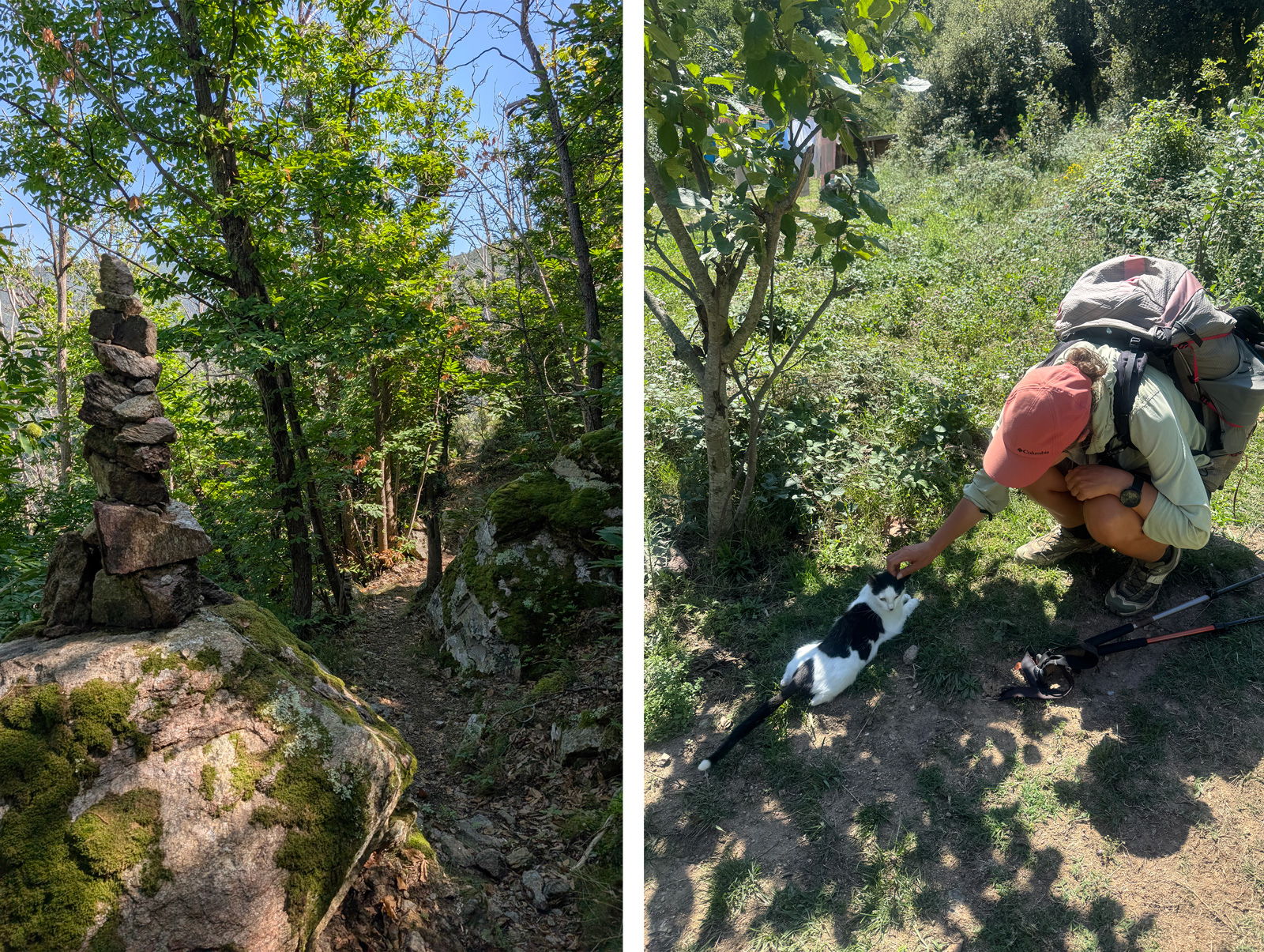
Muggy climb from Arles-sur-Tech
Then begins the HRP’s final major climb: over 3,200 feet of elevation gain through dense, airless forest. We take a break by the fountain at Montalba d’Amélie, eating sandwiches and washing them down with Orangina. Praise be the Orangina, my lifeline through this sweaty, suffocating day. Then we climb again, steep in parts, relentless throughout.
The HRP isn’t done testing us. Instead of following the gentler GR 10, it veers off on its own route up to Roc de Frausa (4,757 ft) — a faint, scratchy path buried in thorny brush. But when we finally reach the top, a cool breeze greets us, drying our sweat, and for the first time, we can see the Mediterranean Sea. From one ocean to another. The thought fills me with awe. Just a few more days, and this thru-hike will be another memory. We joke about turning around and walking back to the Atlantic.
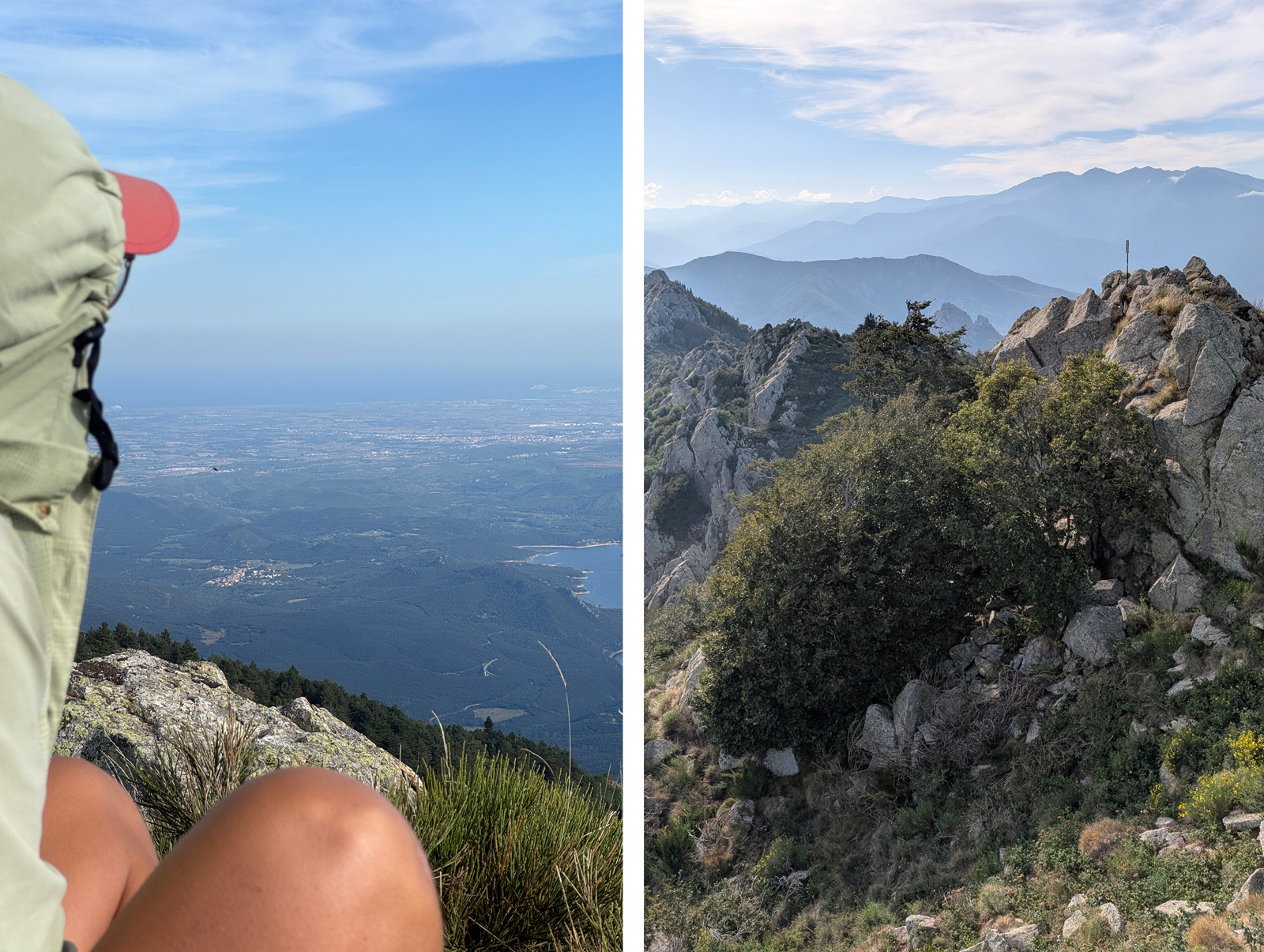
First view of the Mediterranean from Roc de Frausa
The descent through the bushes is confusing, but soon we reconnect with the GR 10. One mile later, we find a closed refugi with a cold-water fountain beside it and a flat meadow just behind, perfect to pitch our tent.
We meet two young engineering students from Toulouse. They often spend weekends hiking in the Pyrenees, they tell us, and this time they’re on a three-day trip. They plan to continue three more miles to Las Illas, where there’s a campground with showers. Showers? Sweet summer children. Tomorrow’s sweat will erase any effort. Up here, it’s cooler anyway, though the mosquitoes disagree.
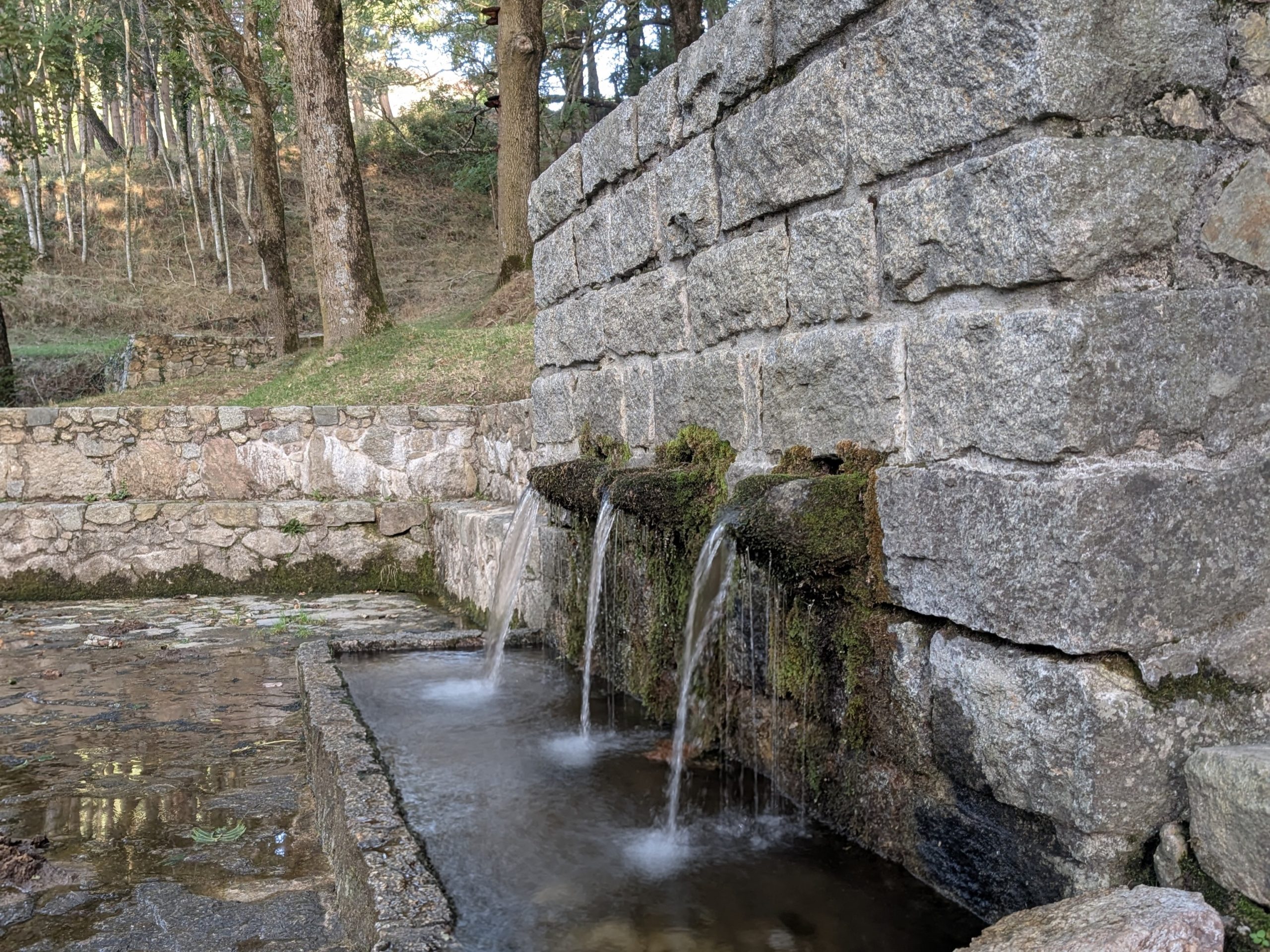
Campsite by the fountain of the closed Ermita de las Salinas
I’m rather tempted by the idea of food down there, but peaceful quiet wins. We cook our usual dinner: pasta with salami and Knorr Thai soup. It tastes a little different every night, depending on the combination of ingredients. Only two nights left on the HRP. I’m glad to spend them out here — between the sound of cicadas and the murmur of the spring. Civilization will have us back soon enough.
HRP Day 36 – Of Fanta, Flies, and Friendship
Refugi de les Salines to Col de l’Ouillat via Le Perthus: 17.7 mi / 3,379 ft elevation gain / 6.5 h
The day begins muggy and overcast, but the few climbs in the morning are gentle and the roads wide. We follow mostly uneventful forest tracks.
After three miles of descent, we reach Las Illas, where several cats greet us. On the climb out, we follow the paved road for a while, passing houses — until a barking, growling dog appears, teeth bared. I swear I can see murder in his eyes. Did you know dogs cause about 30,000 deaths a year? Admittedly, most from rabies. Still, I’m glad I’m not alone. Only once we’re past his house does he stop chasing us.
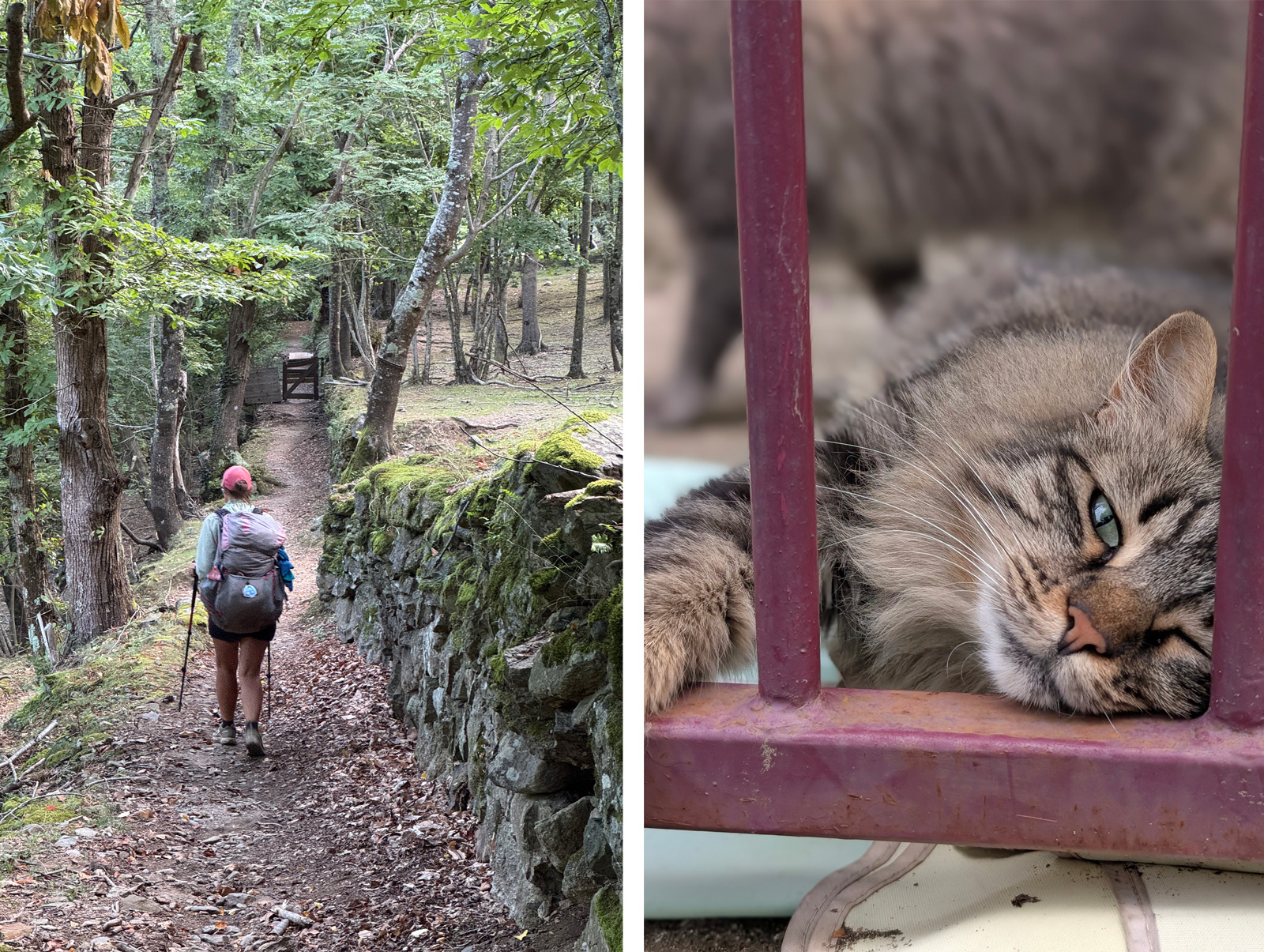
Descent to Las Illas
We march the 11 miles to Le Perthus in silence — I’m in a kind of trance, focused on my audiobook, one foot in front of the other, mostly on forest roads. At least the miles go by fast. Cork oaks line the path; the air is heavy and sticky. We pass the French engineering students from yesterday again; I’m not in the mood for conversation, but Ryan, ever the social one, takes over. They tell us they also love windsurfing.
The guidebook had warned about Le Perthus, and rightly so. A grim border town choked with traffic and people, lined with supermarkets specializing in booze and cigarettes. A place of transit, not of rest. It’s hot, grimy, and reeks of exhaust fumes. Ryan volunteers to dash into the supermarket for baguettes while I guard our packs outside. No Orangina to be found, so Fanta will have to do for the next climb. We grab some fast food in the next best restaurant, then escape.
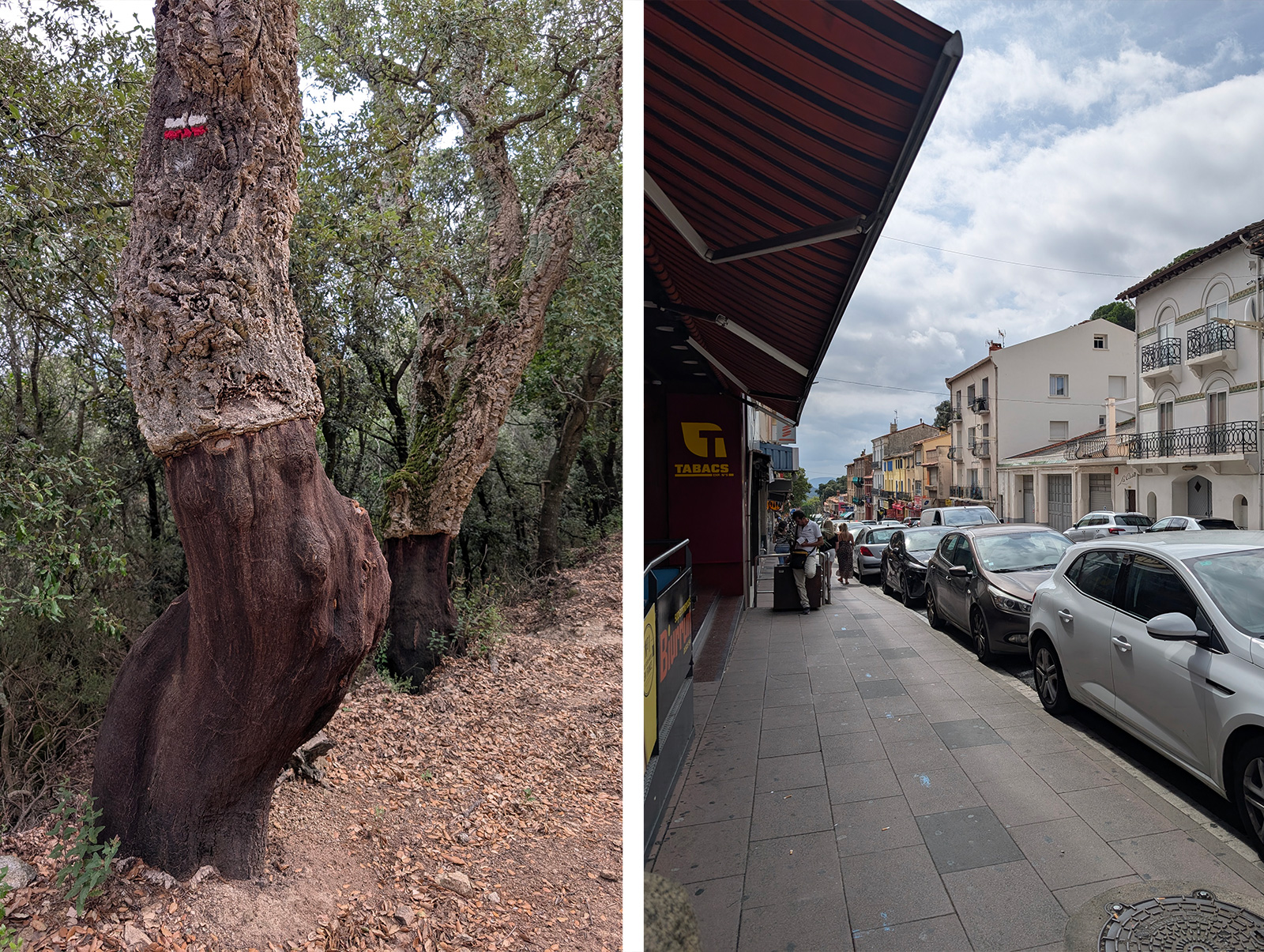
Cork Oaks lining the path today until we reach busy Le Perthus
Ahead lie 2,300 sticky feet of elevation gain. The forest road is only briefly steep, but the air is suffocating, and sweat pours down. We’d forgotten to refill our water in Le Perthus, and everything here is bone-dry. When we finally reach a spring, we can hear the water flowing, but it’s piped into a closed tank with no spout. Ryan gets creative: he climbs on top, opens the lid, and scoops out just enough to fill our bottles.
Flies torment us, landing on our faces and arms. Then, on a narrow, overgrown stretch thick with brambles, my already holey shirt snags — and a grasshopper jumps straight down my shirt. I scream, drop my pack, and fling it out. My patience snaps. Not the high passes, not the thunderstorms, not the cold — this is what breaks me. The HRP ends as it began: hot, muggy and merciless. At least that makes saying goodbye easier.
At last we reach the Chalet de l’Albère, sweaty, sticky, and reeking. Salvation: Orangina and crêpes. There is supposed to be a great view, but it’s nowhere to be seen — we’re enveloped in thick fog. An orange cat balances along the railing, and a friendly golden retriever wanders over for attention. No murderous intent here — he’s a good boy.
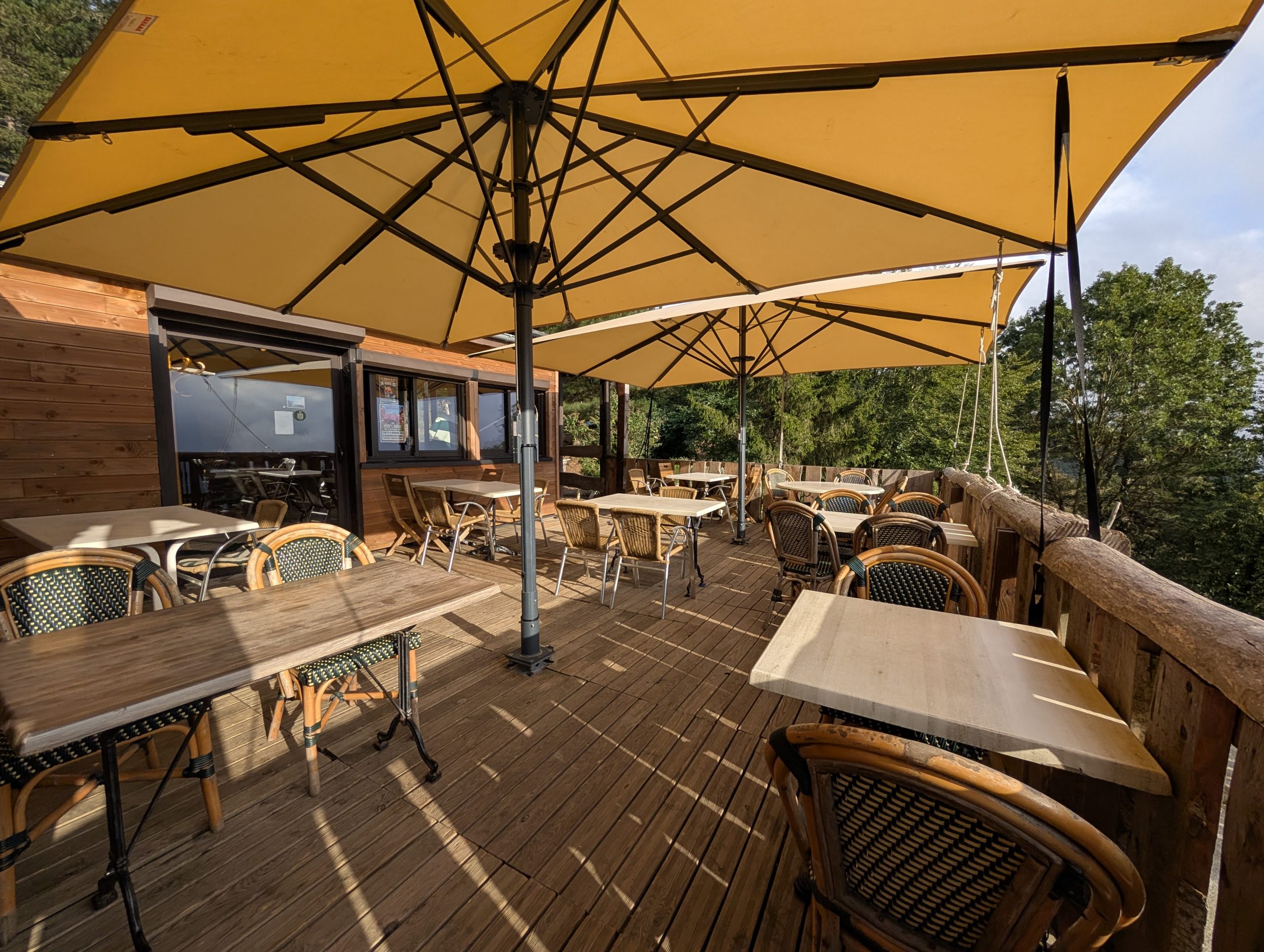
Chalet de l’Albère
And then we see Cordelia again! We haven’t met since Gavarnie but have kept in touch, and it’s wonderful to reunite. We also meet Ben and Hugo, two French GR 10 hikers. The evening turns into a lovely mix of laughter and shared memories. Only one person is missing: Sanne. Her ankle injury forced her to take the bus — just three days short of the finish. Painful, but honestly, she’s not missing much. Joy has given way to endurance. We’re only walking now to complete our continuous footpath between the Atlantic and the Mediterranean. Tomorrow it will be done. And soon enough, we’ll miss it. A bad day on trail beats a good day at the office, as the saying goes.
We pitch our tent behind the chalet. We’ve been warned about a mischievous fox that steals food from tents at night, so the owners kindly let us store our food inside. A gesture we’re deeply grateful for. It would be tragic if a fox chewed through the tent on our last night. After all, we’ve heard the stories — Iiro fought off one in the middle of the night, and Sanne’s fox even punctured her sleeping pad and stole all her food.
Dinner feels like a feast: bread with tomato spread and ham, salad, pasta with mushrooms, baked brie, and for dessert, stracciatella yogurt. I still have no lactase pills, but Ryan will just have to live with the nighttime orchestra of consequences. Fair revenge for his snoring.
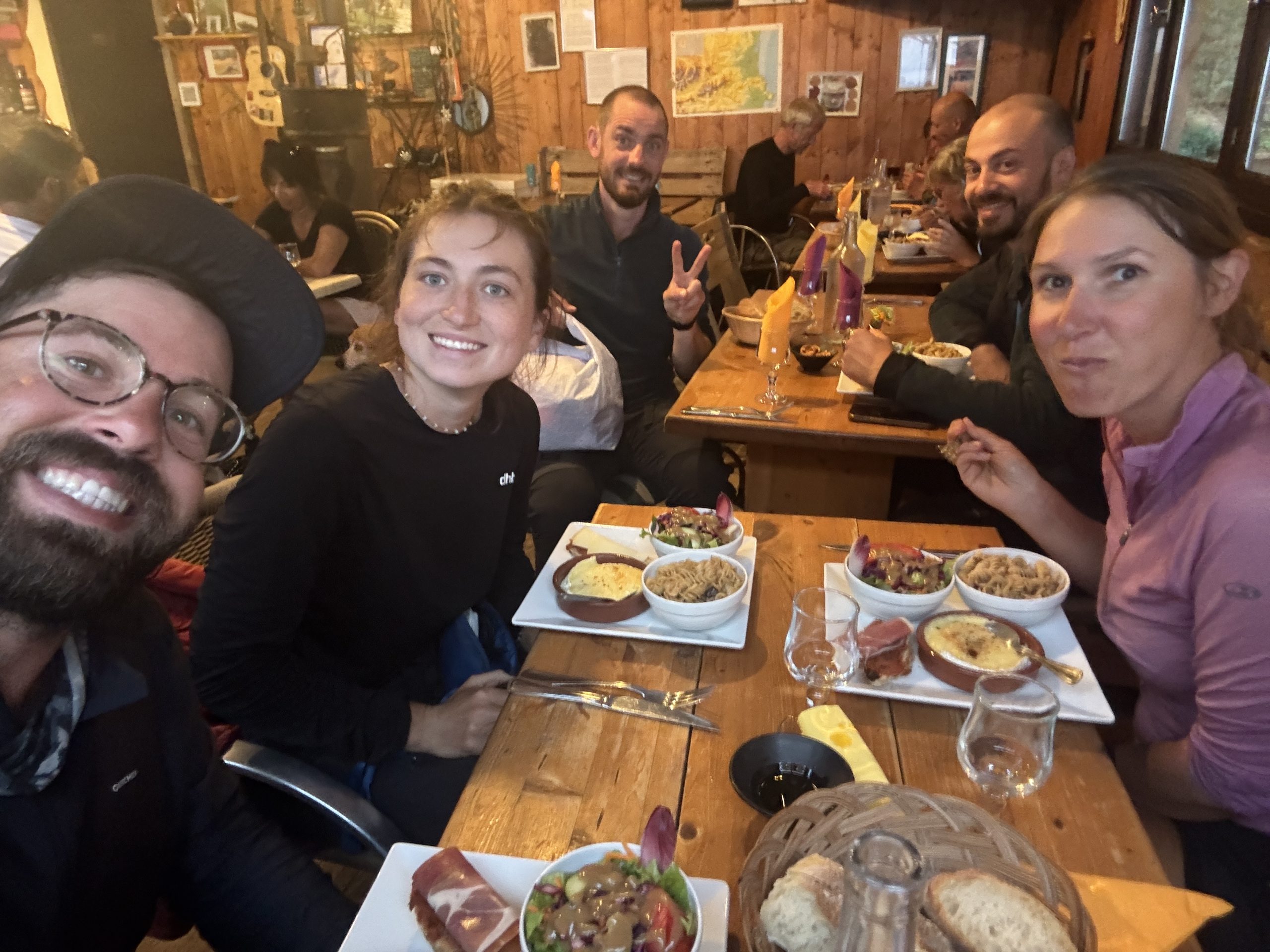
A feast for our last dinner on the HRP and reunion with Cordelia
Fog creeps up the slopes as night falls. When the terrace door is open, it even drifts inside. Later, stepping out, we can barely find our tent. The mist is so thick it feels straight out of Stephen King’s The Mist, but thankfully, the only monsters we encounter are mosquitoes.
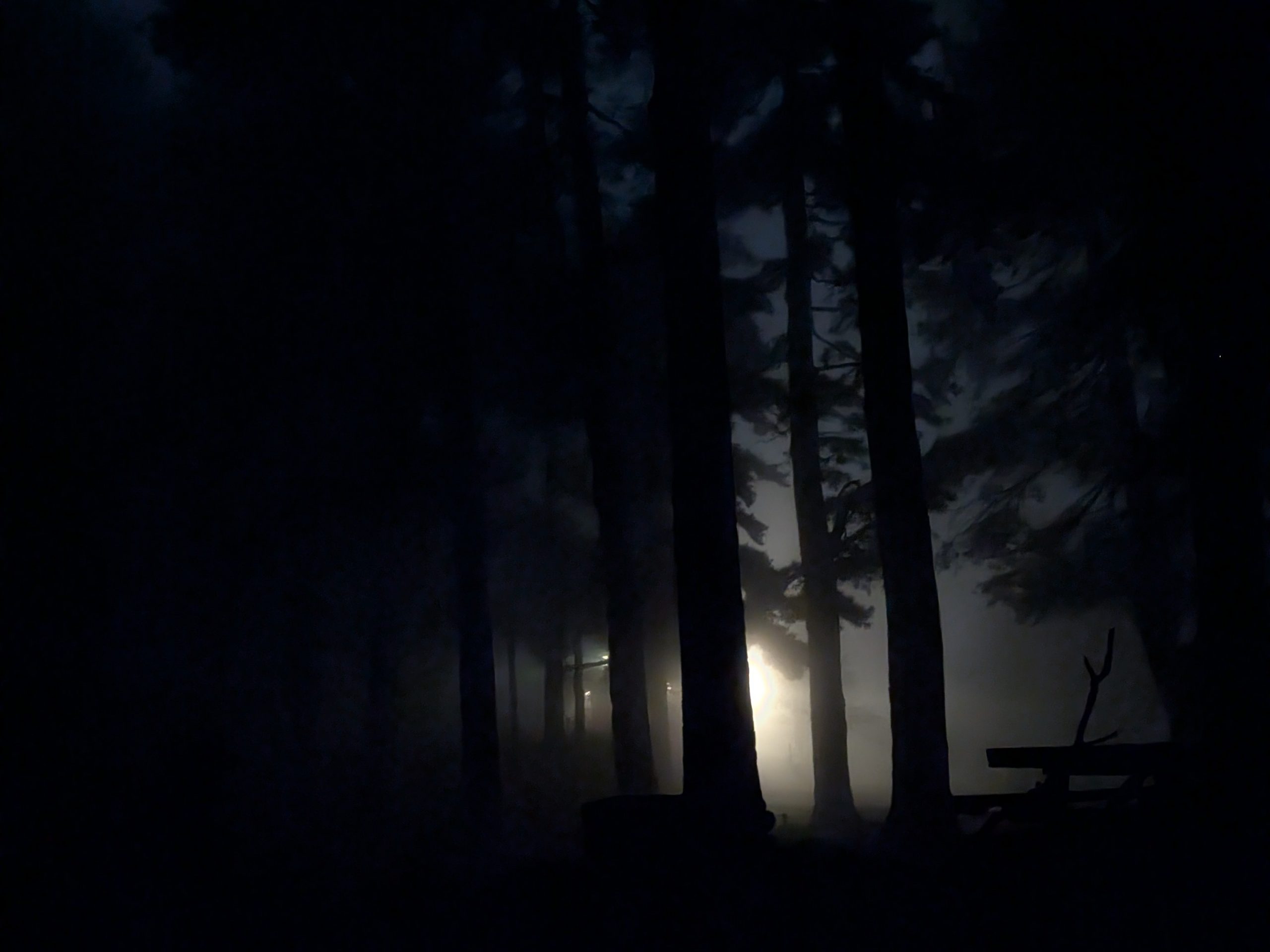
We feel like we stumbled into Stephen King’s “The Mist”, but the only monsters we encounter are mosquitoes.
HRP Day 37 – Arrival at the Mediterranean
Col de l’Ouillat to Banyuls-sur-Mer: 14.5 mi / 2,821 ft elevation gain / 6 h
The final day on the HRP begins foggy and rainy. So, we take our time. Cordelia and Ben are already gone by the time we crawl out of our wet tent. The descent toward the Mediterranean includes a long ridge walk with views toward the coast. Soon, the clouds lift, revealing rolling hills that gradually flatten out. It’s still hazy, but at least it’s not hot — a cool breeze keeps us dry and comfortable.
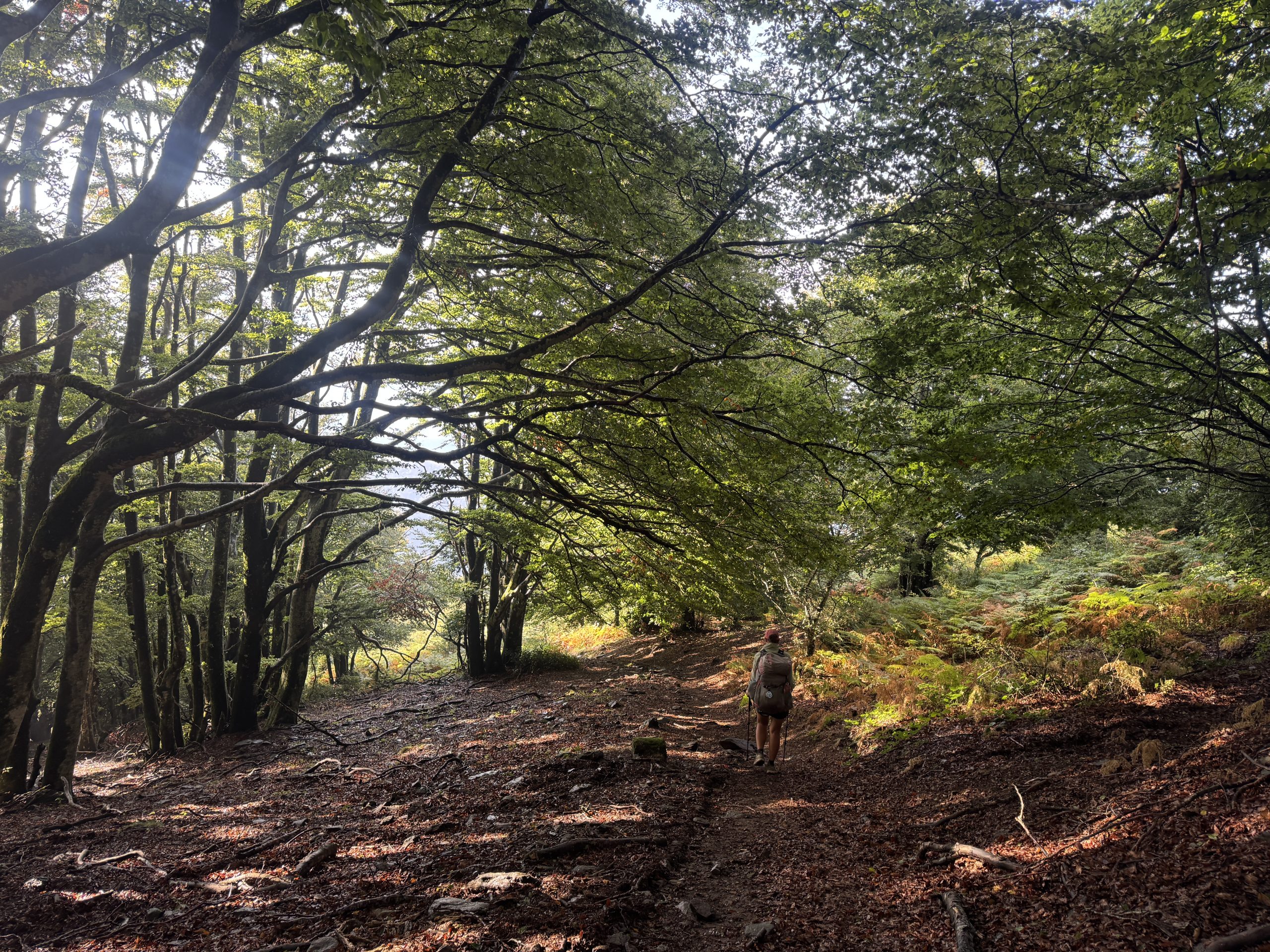
The last morning on the HRP
At Pic Neulos (4,120 ft) we pause to take in the vast views before the trail continues along the undulating ridge. In the distance, the Mediterranean glimmers through the haze, as if waving us closer. We stop for lunch near Pic de Sailfort and discover mold on our cheese. We cut off the bad parts and eat it anyway — a little stubbornness is part of every thru-hike.
While we sit between the rocks, eating our last sandwich with salami and questionable cheese, a trail runner appears, sprints up to the summit cross below us, and suddenly pulls down his shorts to take selfies. Mid-sentence, I stop talking to Ryan. It’s… a surprising distraction. Either he hasn’t seen us or he simply doesn’t care. Either way, kudos for the confidence. Then he pulls his shorts back up and runs off as if nothing happened. Welcome back to civilization.
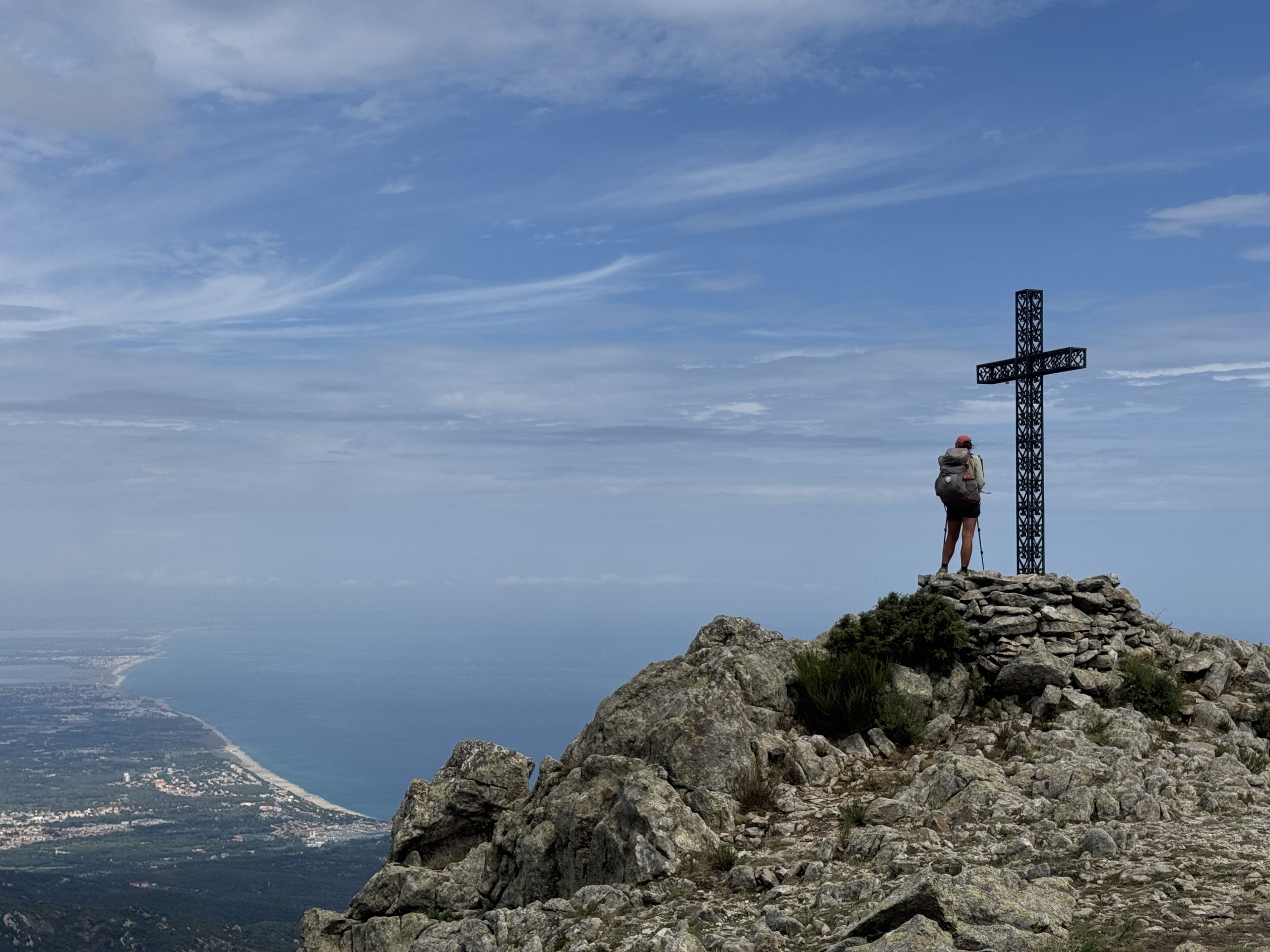
View of the Mediterranean from Pic de Sailfort
Dark clouds build up behind us, and we know what that means. The rain catches up long before we reach the sea. We take shelter under some trees, sitting on a bench by a water source, waiting for it to pass. Instead, it settles in for good. Grumbling, we pull on our rain jackets, turn up the music, and hike the final hour through steady rain.
I had imagined our arrival at the Mediterranean differently. We reach Banyuls-sur-Mer around 4:30 pm, standing soaked among palm trees on a pebbly beach. We take a quick selfie, then head straight for the hotel. It’s done.
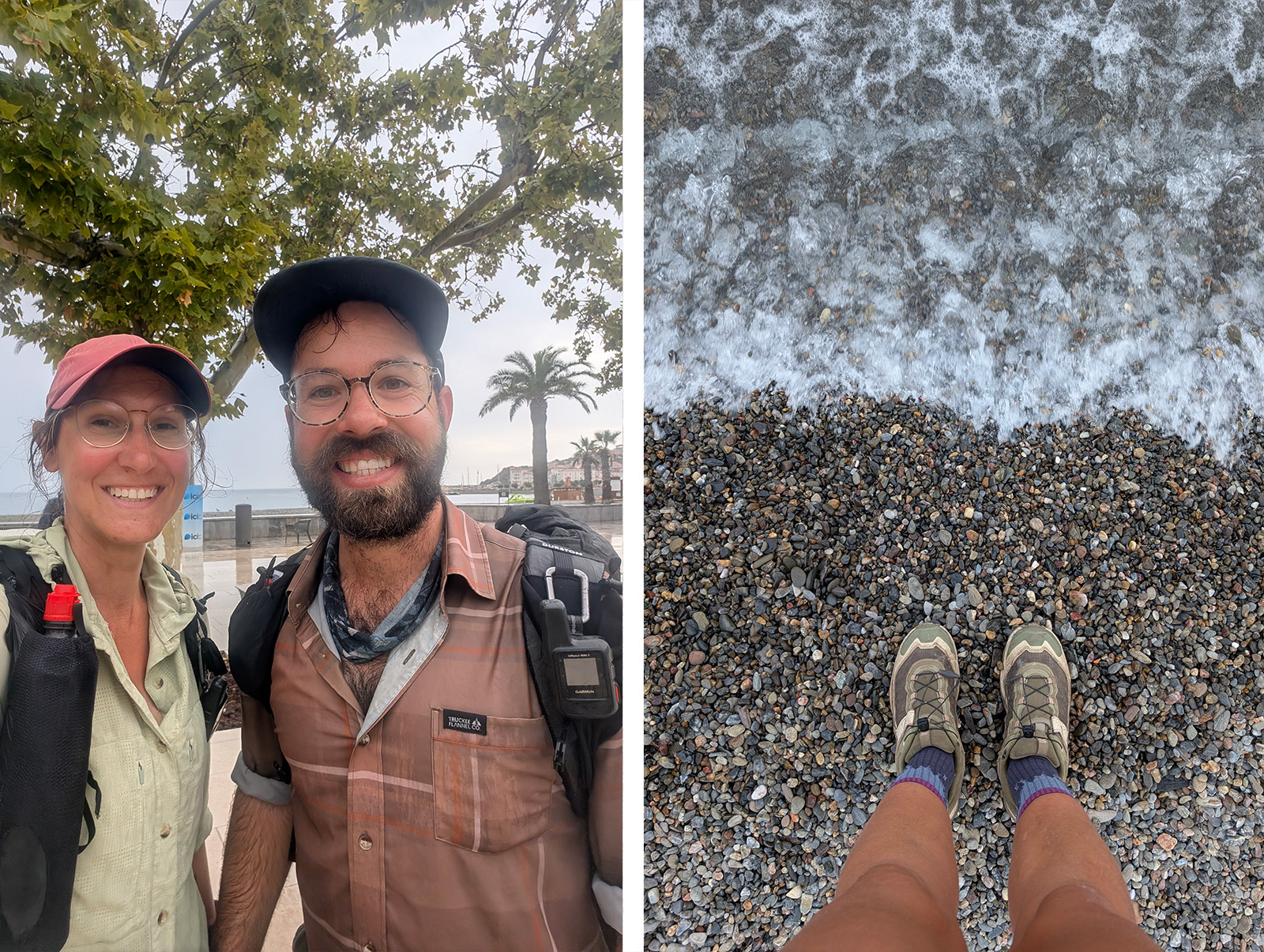
Reaching the Mediterranean, the end of the HRP, in Banyuls-sur-Mer after 479 miles
We feel disgusting — sticky from days of sweat and now drenched in rain. A shower is our priority; laundry, too.
At the hotel, we meet the others: Cordelia, Ben, Hugo and even Sanne. We exchange quick congratulations before rushing off to wash off the grime. It’s amazing how filthy you can feel after just three days, while six dry days can somehow seem less bad. We wash our most essential clothes in the sink and quarantine the rest. There are downsides to having only one set of clothing.
In the evening, we all sit together at a seaside tapas restaurant. We raise our glasses — to 479 miles, 37 days, 156,594 feet of elevation gain, storms, sun, fog, exhaustion, and friendship. And to the moment we reached the sea.
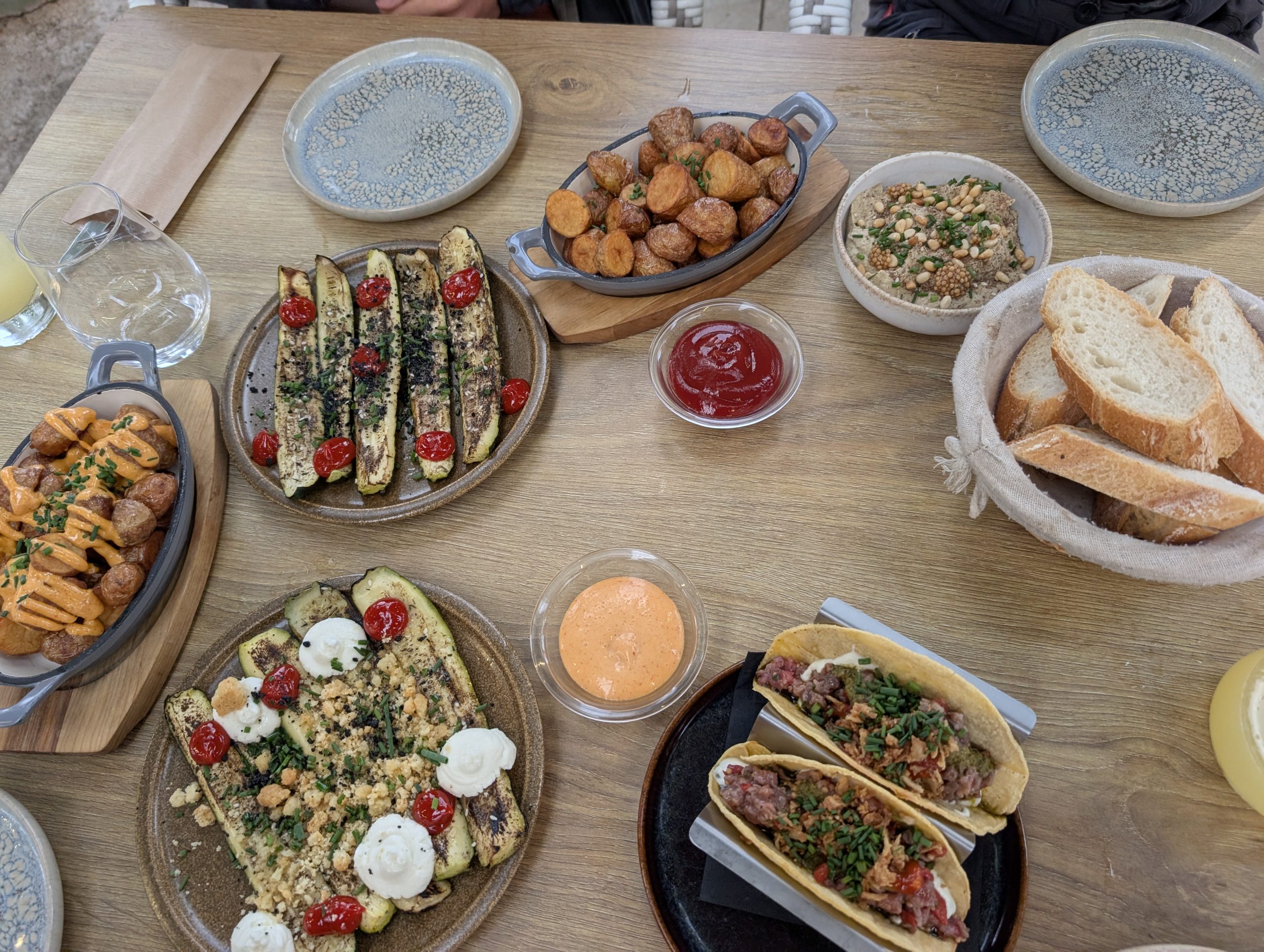
Celebrating the Completion of the HRP with tapas
The night is short and restless. A single mosquito drives us mad. We can’t find it, so it stings us over and over. It’s too hot to cover up completely, so we alternate between sweating, scratching, and cursing. Eventually, the open window and the fan on full blast keep it at bay.
The next morning, we stroll through the streets of Banyuls, buy one last French baguette and some salted butter, and head toward Barcelona, which turns out to be an adventure of its own. Trains were canceled in the morning (Sanne missed her connection because of it), so we opt for the bus to Perpignan. It stops at 21 places along the way, and the constant flow of beach tourists causes a long delay. We sprint for our FlixBus to Barcelona just as the driver is closing the door. After a bit of pleading, he grumbles and lets us in, muttering about punctuality.
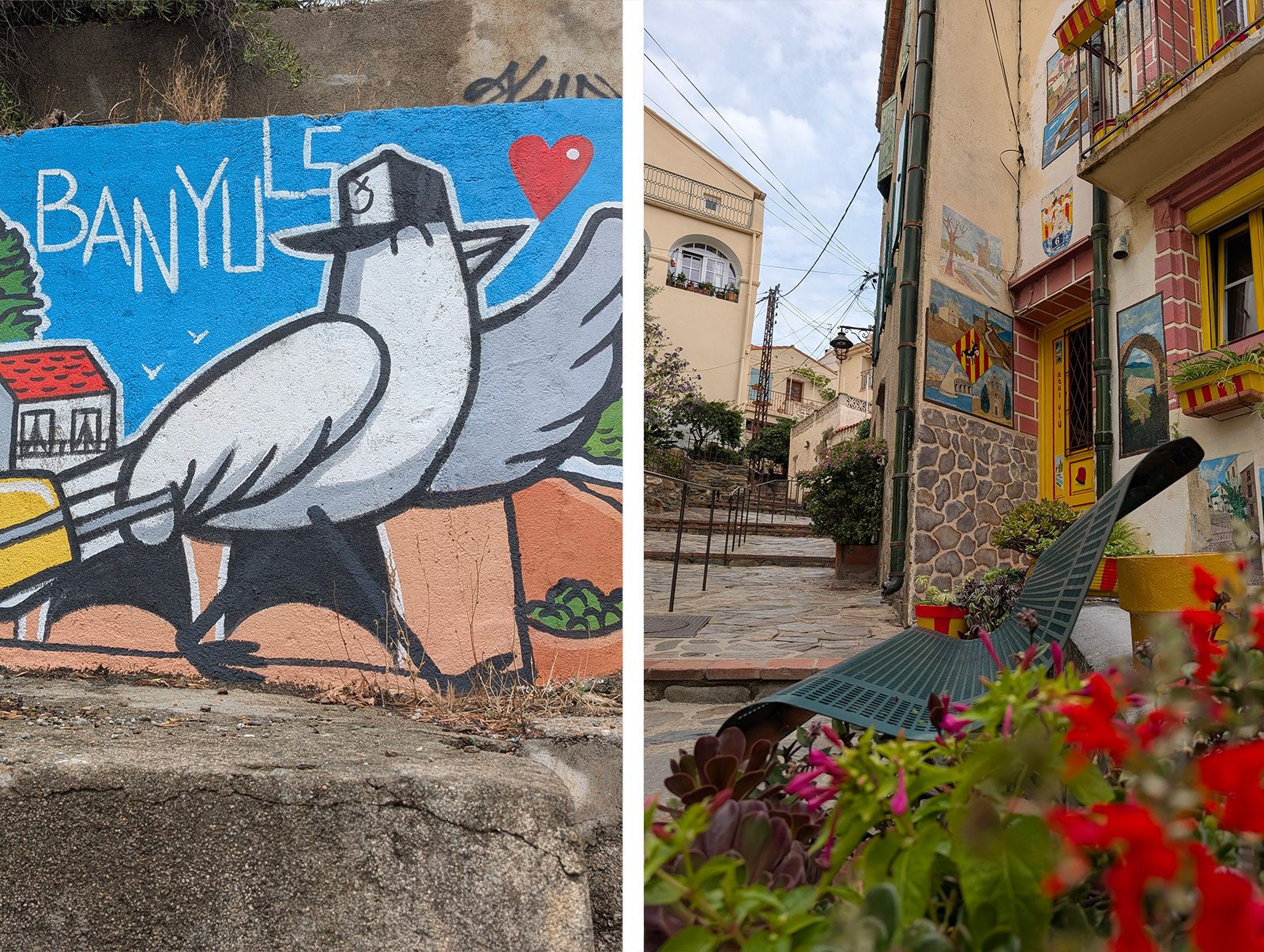
Banyuls-sur-Mer, end of HRP and GR 10
Forty-five minutes before reaching Barcelona, the bus breaks down, leaving us stranded at a highway rest stop in the middle of nowhere. For a while, nothing happens, and no one seems to know when or how we’ll continue. Some passengers start hitching rides. I check the map and find a train station half an hour’s walk away. We’re hikers, after all. We grab our packs and start walking. Along the way, I spot yellow Camino arrows. We’re on the Via Augusta. Somehow, it feels like the perfect ending to this journey.
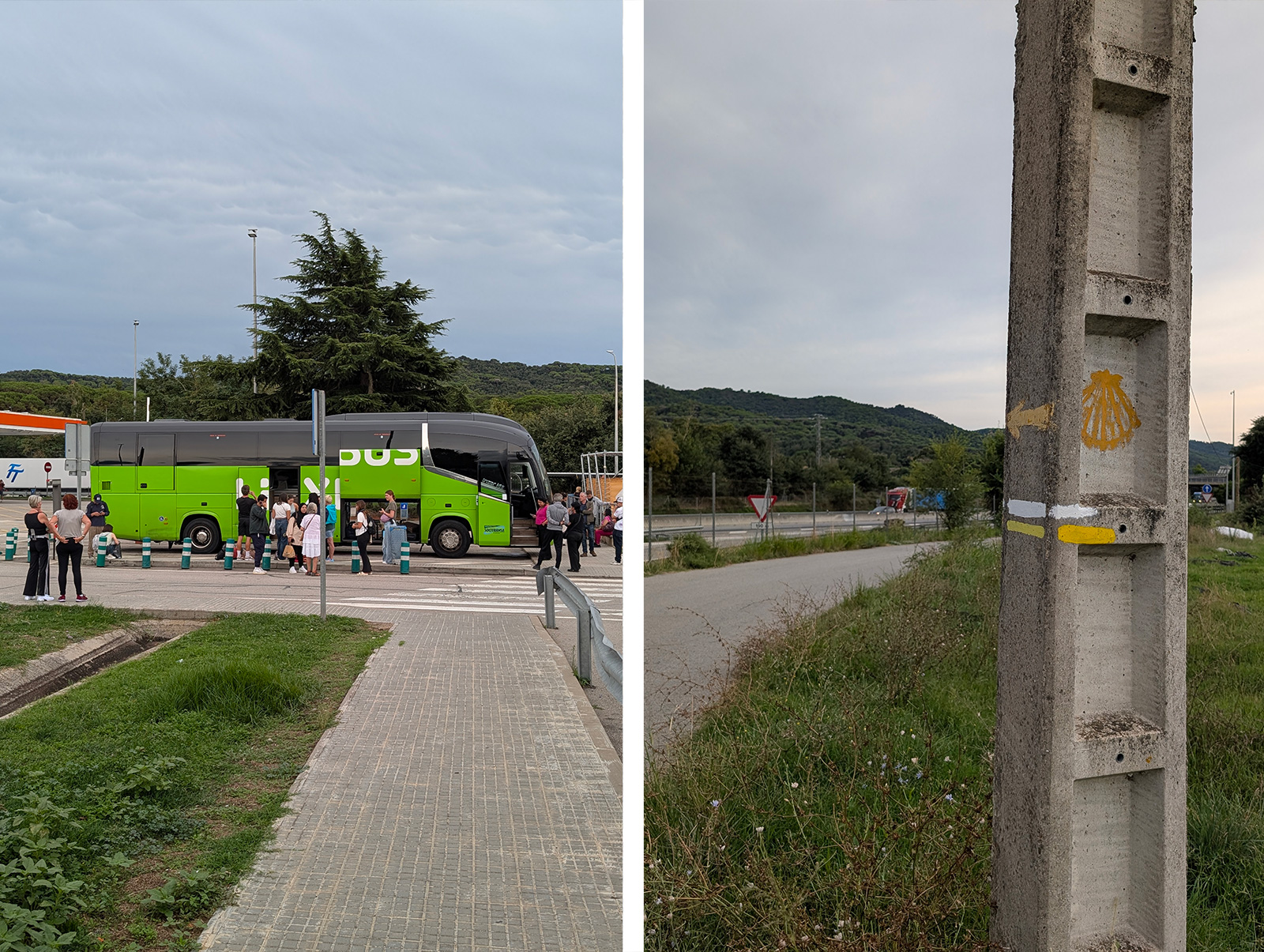
A Flixbus breakdown before Barcelona brings us on the Via Augusta
Reflection – Between Oceans
From the Atlantic to the Mediterranean — two oceans, one mountain range, and between them a world of rock, wind, sun, rain, silence, and endurance. The Haute Randonnée Pyrénéenne isn’t a trail you simply decide to hike. It demands patience, trust, and a sensitivity for everything that unfolds beyond your comfort zone. It’s rewarding, but never without asking for something in return.
I remember days when the sun burned mercilessly and we longed for shade. Others when the cold crept into every fiber, hands numb, tent caked in frost. Moments when I thought I couldn’t take another step and moments when the light, the stillness, or the sound of a river reminded me why I was here.
It’s that strange blend of pain and peace that makes thru-hiking so unique: physically exhausted, yet inwardly calm. Reduced to the essentials: walking, eating, sleeping, and breathing. Barely any signal, no obligations, only the present moment.
The HRP was a journey through extremes — from storms and scree fields to crystal-clear lakes and sunny ridgelines, then down to humid forests buzzing with mosquitoes. A constant oscillation between overwhelm and fulfillment. At times I wanted nothing more than to arrive somewhere. And yet, the moment I did, I wanted to set off again.
Perhaps that’s the real magic of walking: that you never truly arrive but keep growing with every step, every ache, every moment of awe.
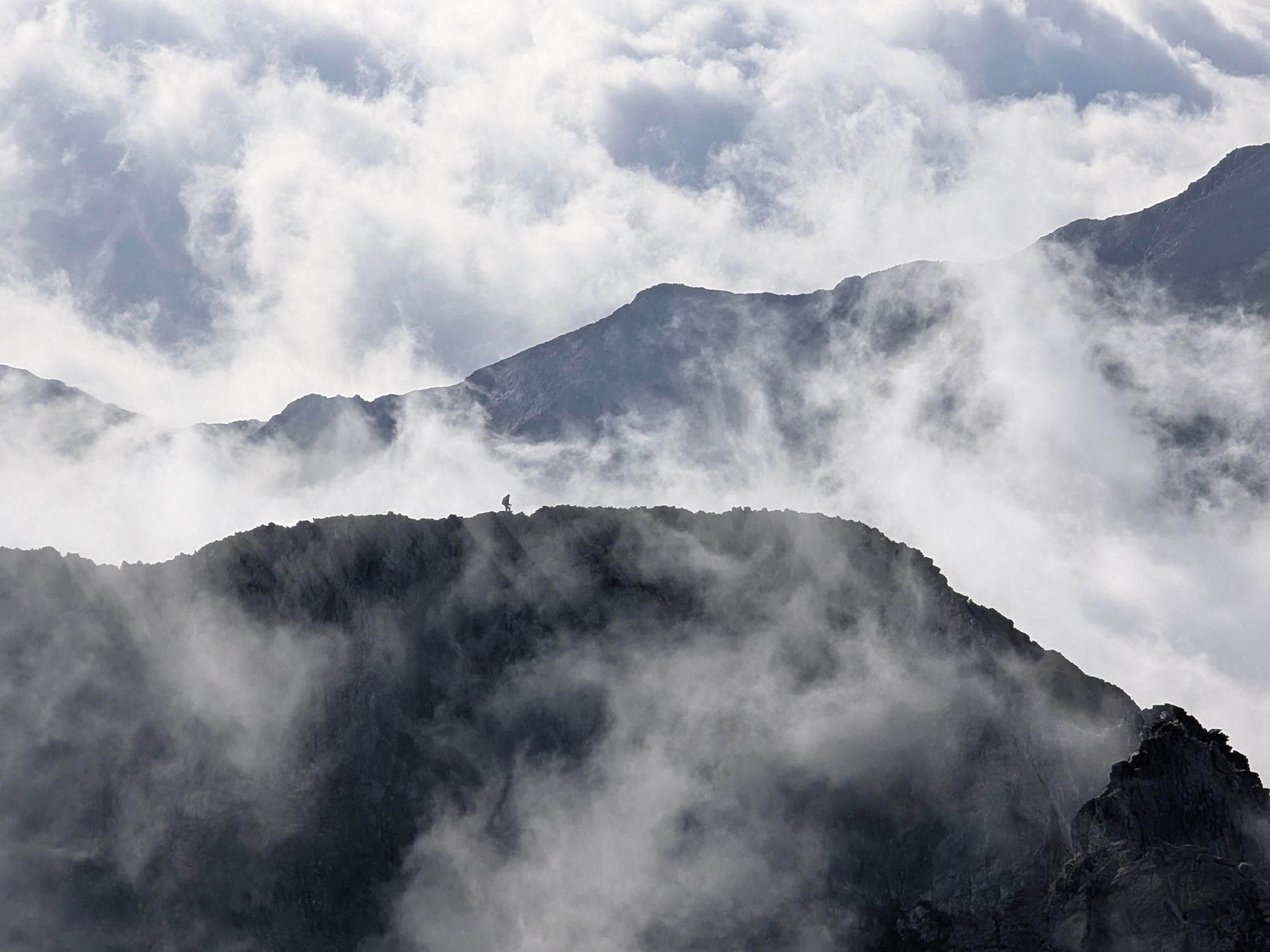
Wanderer in the clouds as seen from Pic du Canigou

This website contains affiliate links, which means The Trek may receive a percentage of any product or service you purchase using the links in the articles or advertisements. The buyer pays the same price as they would otherwise, and your purchase helps to support The Trek's ongoing goal to serve you quality backpacking advice and information. Thanks for your support!
To learn more, please visit the About This Site page.
