
 ">
John Muir Trail NOBO, Week 2: High Passes and Hard, Joyful Work (August 12-18, 2025)
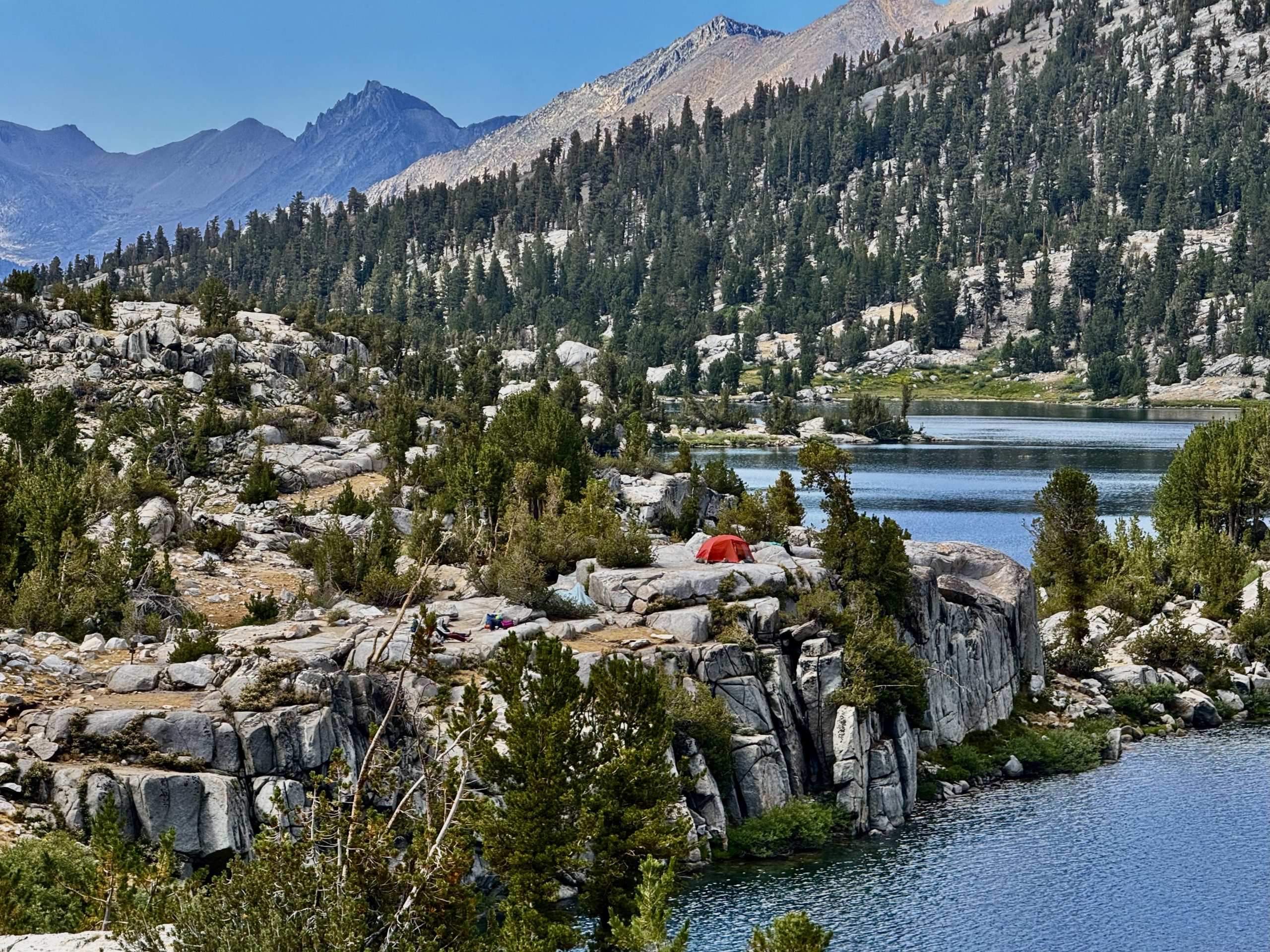
Rae Lakes
If my week one northbound on the John Muir Trail was about easing in, week two was the Sierras saying, “Alright, let’s see what you’ve got.”
This was the week of the rest of the biggest passes —Pinchot, Mather, Muir—and it was the week I discovered just how much hiking in your 60s is equal parts stubbornness and gratitude.
Racing Storms Over Pinchot
By the time my new trail buddy Lara and I hit Pinchot Pass, the sky finally decided to break its long stretch of perfection. The climb up Pinchot from the south was relentless: eight miles of steady ascent in exposed terrain. As thunderheads gathered, Lara and I kept up a constant assessment: are we still safe? not safe? how fast can we move?
We pushed over Pinchot Pass just as the wind picked up. Lara was pale and exhausted, fighting nausea, and I was trying not to show all my anxiety. When we finally dropped down into the trees near Marjorie Lake, just as it was beginning to rain, the only available campsite was near a man backpacking with his two teenage sons, and he clearly didn’t appreciate neighbors. As we set up our tent at an established site about 30 feet from his own, with big boulders separating our two campsites, he walked over and said: “Hey, I hate to be an asshole, but my sons and I were expecting more of a wilderness experience. Can you move on?”
I looked at my companion Lara, who by this time was emotionally exhausted, as was I. I also looked at my already fully-pitched tent. I could appreciate the dad’s desires, but I told him: “Look: We’re exhausted, rain is about to hit us, and we’re at an established site. I’m sorry, but we’re staying.” He turned around without a word and we kept setting up our camp. Under normal circumstances I might’ve walked farther, but when the sky starts to crackle, propriety loses to survival.
Later, after we’d gotten set up and ready for the night, I noticed that the man and his sons had quietly packed up and moved on. I can’t say as I blame them, although we were quiet and soon fast asleep.
That night I ate cold-soaked food in the rain, listening to the thunder’s distant rumble. My meal actually tasted fine … I think I might try more cold-soaking on future trips.

I can’t even remember which beautiful lake this was. Can someone tell us in the comments?
Crossing the Hundred-Mile Threshold
In the morning, I met a solo hiker named Jan: she was 68 years old, incredibly tough, and hiking strong. We crossed paths several more times until she messaged me that her foot had started to develop severe plantar fasciitis. Seeing older hikers out here always gives me a jolt of motivation. We swap stories not just about miles, but about joints, sleep systems, and the quiet pride of still being able to do hard things.
Later that day I crossed the 100-mile mark. It wasn’t marked, but I felt it. My legs had become more reliable than ever. My one solitary, minor blister was healing thanks to hydrocolloidal pads. And I’d perfected the Andrew Skurka bidet method, which—believe it or not—felt like one of my biggest victories of the week.
Let’s Talk Bidets
Speaking of bidets: a quick digress. Arid areas like the High Sierras aren’t conducive to toilet paper. It can take years for toilet paper to finally decompose, and often the paper is dug up by animals. I’ve often seen ugly white “TP flowers” blossoming along mountain slopes. One of the best ways to avoid leaving toilet paper behind is to use a bidet system instead: relying upon squirted water rather than toilet paper to clean your bottom after you poop. Well, friends, I am here to tell you that using a bidet works, and here’s exactly how you do it:
1. Drop your trousers, and squirt a little water on your bottom to keep the poop from sticking on your skin on its way out. Also, wet one of your hands to get it ready for what’s to come.
2. Do your business in a hole you’ve already dug – at least 200 feet away from water sources – and then while you’re still squatting get your bidet water ready.
3. Squirt a firm stream from the bidet into your nether regions. Aim for your butt bullseye. Then put a few drops of soap into your hand and use your hand to make sure your bottom is totally clean along with your hand. Then rinse your butt and hand with more water.
4. Once you’ve finished using soap, for good measure rub hand sanitizer into your palms and fingers. I’ve seen far too many videos and blog posts about people catching norovirus on the trail.
5. Finally, bury your waste. If you missed the hole, use a twig to push the poo into the hole (don’t use your trowel).
Using this technique, you won’t get butt rash, you’ll be leaving (almost) no trace, and as a bonus your hands will be really clean.
Mather Pass and the Golden Staircase
OK, back to our regularly scheduled programming. Mather Pass was a gentle climb followed by a brutal descent. The talus was steep and sharp, and I felt every year of my age in my knees. But then the trail spilled out onto Palisade Lakes, with sunlight glittering on water, and I laughed out loud.
And the infamous Golden Staircase? I got to enjoy it downhill, which I consider one of the great mercies of this northbound hike. I met two thirsty southbound hikers asking if water was close. I almost hated to tell them how far they had left.
Becoming a Weather Scholar
Thunderstorms were forecast nearly every day, but the only thing predictable about the Sierra is its unpredictability. My Garmin InReach weather app told me that storms would start at noon; instead, the hours passed under a bright, deceptive sky.

Another beautiful lake along the JMT, south of Muir Pass
I kept studying the clouds, aligning hunches with forecasts, developing a kind of intuitive weather literacy. I remembered how heat builds in the basins, how wind carries moisture across ridges, and how the wind typically picks up minutes before the first drops fall. Out here, staying dry is a skill—and one I am still learning.
After previous trips where I’ve had to frantically dig out almost all the contents of my pack to reach my rain jacket and rain pants, I’ve learned to keep these two items near the top of my pack even on days where no rain is forecast. I can often get away with just opening my umbrella, but when the wind’s blowing hard there’s no substitute for proper rainclothes.
Muir Pass and the Stone Hut Above It All
Climbing to the Muir Hut felt like a pilgrimage: the airy approach revealing the stark Evolution Basin, the deep quiet of the high tarns, and a beehive-like stone shelter perched in a world without trees.

The iconic Muir Pass hut
Inside, I signed the register. I didn’t write much: just a thank you and a few thoughts about how good it feels to move through the high country at my age. There’s no pretending I’m as fast or as strong as I once was. But I am steadier, more patient, and more attuned to the miracle of simply putting one foot in front of the other.
Onward to MTR
Dropping toward Muir Trail Ranch, I felt the heat rise. My sun umbrella became the hero of my day—three different hikers commented on it with envy.
By the time I reached MTR, dusty and sweat-streaked, I was ready for the small luxuries: sorting food, charging electronics, and chatting with other hikers in that strange oasis of human activity. My new trail friend Jan arrived later, limping and discouraged. I felt for her. This trail doesn’t spare anyone; it just gives you different battles depending on your gear, your age, and your luck.
Some folks don’t much like Muir Trail Ranch: they consider the resupply to be overpriced and the amenities to be desired. But I was glad I’d stopped there. Sure, there were no showers and no toilets, but it was great to spend some time talking with other hikers and picking through the ample hiker boxes.

The trail winds its way north of Muir Pass
I didn’t linger. After sorting and packing my resupply, I shouldered my pack and headed back into the heat, climbing toward Sally Keyes Lakes. I soaked my shirt in creek water, and my umbrella cast a moving island of shade. When I finally reached Heart Lake at sunset, the world looked quiet and golden. It was a tough day, but a good one.
My week two on the JMT had been hard, sweaty, storm-dodging, blister-managing work. But oh, such joyful work.
Next: The final week.

This website contains affiliate links, which means The Trek may receive a percentage of any product or service you purchase using the links in the articles or advertisements. The buyer pays the same price as they would otherwise, and your purchase helps to support The Trek's ongoing goal to serve you quality backpacking advice and information. Thanks for your support!
To learn more, please visit the About This Site page.

Comments 4
I’m loving your trail journal, Rolf. I believe that beautiful lake is Middle Rae Lake, with the Painted Lady rising across the lake.
Yes! Thank you, Brian!
I don’t get the “wilderness experience” thing on the JMT; it’s a highly coveted much used trail where you see people all the time. I think that dad picked the wrong trip. I’d have done the same thing as you; sometimes you have to do what is needed at that moment.
I use a bidet but I do it a wee bit differently. I carry a small polished stone in my pocket, which I gather from a flowing stream. No sharp edges! When it’s time, I do the one squirt thing, then do the deed, then wipe with the stone. After that just a few squirts with the bidet are good enough to get totally clean. No need for hands doing that stuff. i still wash up with soap into the cathole though! Lots of ways to make it work.
Thank you! I’ll try the rock trick. I do want to emphasize, though, that as long as I do pre-wetting and vigorous squirting I don’t see any “stuff” on my hand. It’s just good for me to avoid rash by getting soap in there.