
 ">
Packing for a Thru-Hike: My Real PCT Gear Experience (Part One)
I spent months researching gear lists, watching thru-hike videos, and second-guessing every single item. But nothing prepares you quite like living outside for 171 days. Some pieces became vital, others got sent home fast, and a few were swapped out as the trail changed around me. I adapted my necessities depending on the weather, how light I wanted to be, and whether I truly needed a certain item.
This is my full breakdown of everything I carried on the Pacific Crest Trail in 2025. From the “Big 4” to clothes, water, cooking, electronics, hygiene, and Sierra snow gear, here’s what actually worked for me and what didn’t survive the journey.
When I say what I started with, I’m referring to the exact gear I packed on Day 1 at the Southern Terminus. My final setup is the system I ended the trail with after 171 days of learning what I actually needed.
In this first article, I’ll cover the Big 4, clothes, water and cooking system. I decided to divide this into two posts so it doesn’t get too long, so look for Part Two on my blog profile to see the full breakdown later.
You can also check my LighterPack if you want to see my full gear list laid out clearly in one place.
Let’s dive in.
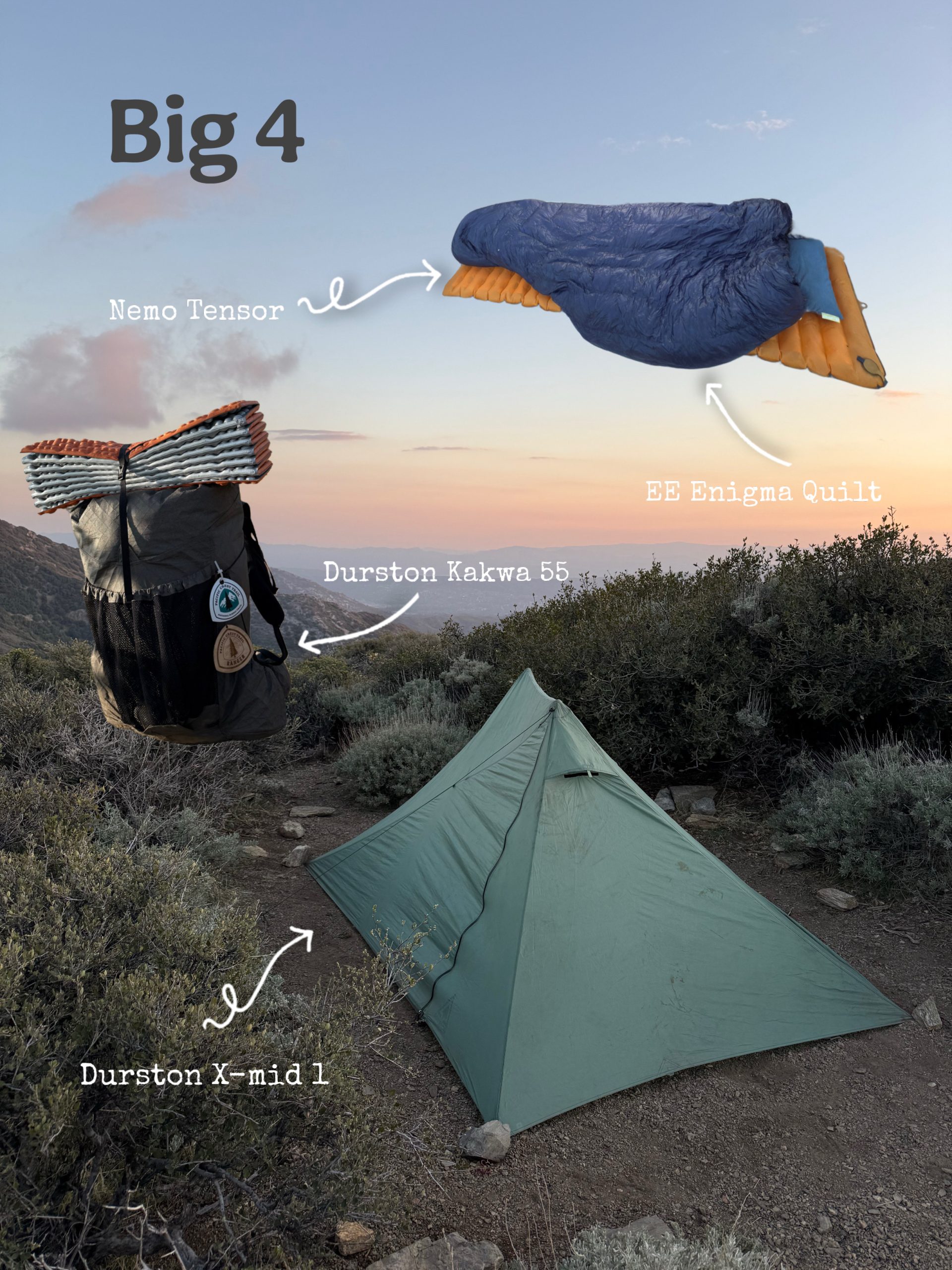
“Big 4”
What I Started With
- Pack: Durston Kakwa 55
- Tent: Durston X-Mid 1
- Quilt: Enlightened Equipment Enigma (0°F)
- Sleeping Pad: Nemo Tensor
What I Kept Until the End
Tent — I used the same tent for the entire trail. Even though I didn’t have the “light” version of the X-Mid, it absolutely did its job. I saw so many people using Durston shelters out there, which really reassured me about how popular and trusted they are within the thru-hiking community. The only downside is that this tent needs a bit of space to pitch, which can be tricky when campsites are tight, but that only caused a problem a couple of times. I recently heard that Durston has improved their tent footprint to make it even more efficient, so I hope I can afford one of the newer versions for my next thru-hike.
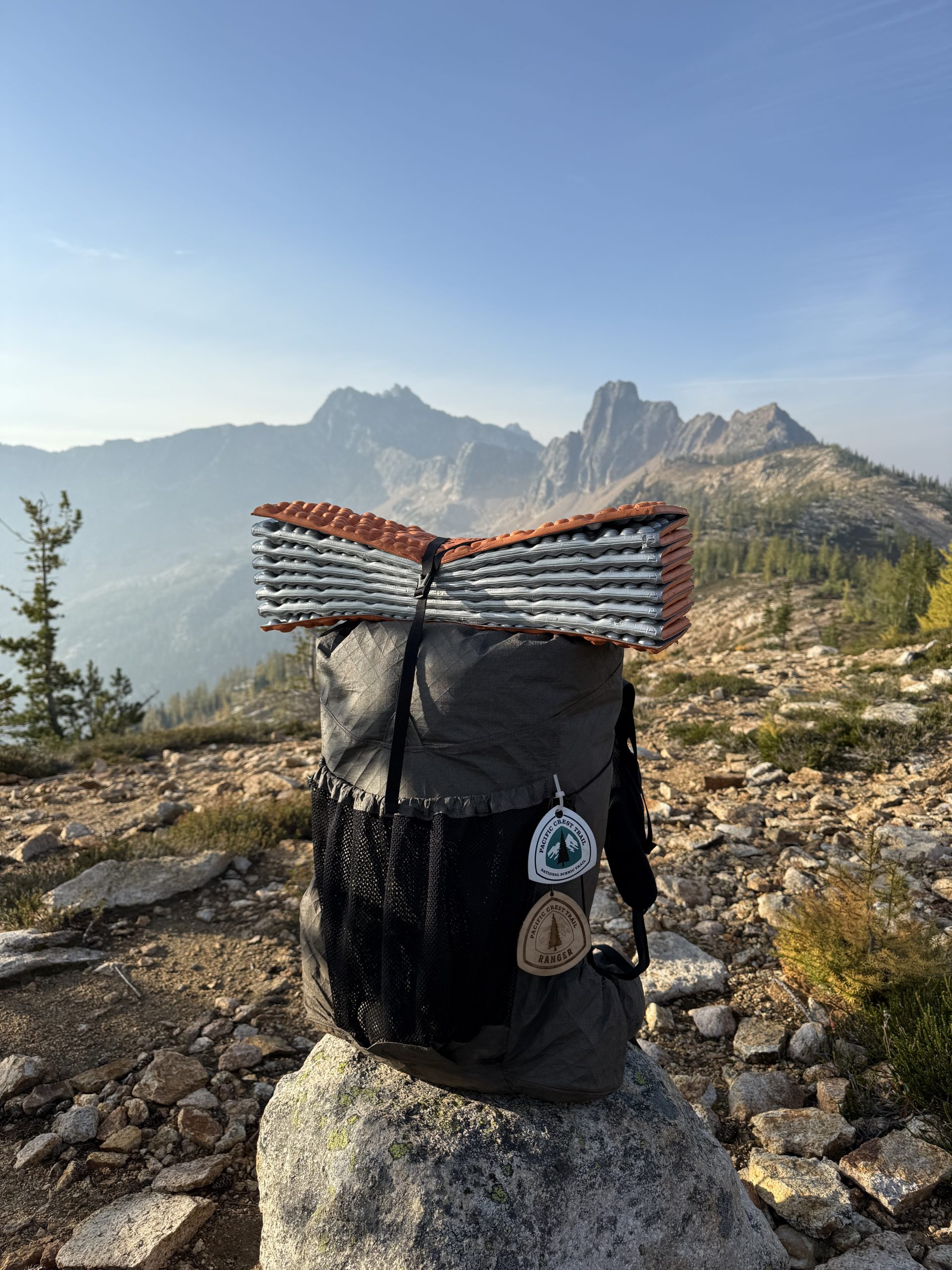
Backpack — My backpack was another Durston item I loved. For my body shape, it worked perfectly. It felt spacious, simple, and comfortable from the start. Right before Mammoth Lakes in the Sierra, a rodent chewed through one of my load lifters and my hip belt was close to tearing. Durston’s customer service was very helpful, and they sent me a replacement pack quickly and with a generous discount. That experience made me appreciate their gear and their company even more.
Quilt — My quilt also made it all the way to Canada. People often say Enlightened Equipment ratings run a little warm (meaning a 0°F quilt might not feel exactly like a true 0°F), but mine kept me warm through the Sierra and again in Washington’s cold September weather. And for your reference: I sleep cold and my quilt is a 0 °F.
What I Changed
The only big swap I made was my sleeping pad. The Nemo Tensor started leaking toward the end of the Sierra, so I switched to a Nemo Switchback foam pad. Part of the decision was wanting a quicker setup and teardown. Just toss it on the ground at night and fold it up in seconds in the morning. In that sense, the Switchback was great.
Was it worth it though? Honestly… I’m not sure. I missed the comfort of a blow-up pad so many times, especially in Washington when the ground was freezing. And the first couple of weeks were rough because my hips hurt until my body adjusted. But at that point in the hike, I didn’t want to spend more money on another inflatable pad, and the foam pad did get me to Canada, plus I used it as a pad to rest during breaks, which was very nice.
Clothes Packed
What I Started With
- Clothing bag: Zpacks Big Dry Bag
- Extra hiking socks: Injinji Toe Socks
- Fleece: Senchi Designs A90 Half-Zip Hoodie
- Gloves: OR Vigor Midweight Sensor
- Puffy jacket: Mountain Hardwear Ghost Whisperer UL Hoody
- Rain jacket: Patagonia Torrentshell
- Sleeping socks: Darn Tough Merino Wool
- Sun gloves: OR ActiveIce Chroma Sun Gloves
- Thermal bottoms and top: Smartwool Classic Thermal Merino
- Underwear: 2x ExOfficio Women’s Give-N-Go 2.0 Sport Mesh
- Wind pants: Body Wrappers Ripstop Pants
- Beanie: OR Trail Mix Beanie
- Bralette for town days: Ridge Merino Merino Wool Bralette
I definitely packed too much, but at the time all of this felt necessary. I went into the PCT knowing I’d adjust as I learned what I actually used and needed, and slowly sent things home as the trail taught me.
What I Kept the Whole Time
Zpacks Big Dry Bag – This dry bag was one of my absolute favorite pieces of gear. It kept everything that needed to stay dry, especially my documents and clothes. I always stored it on top of my quilt inside the liner though.
Sleeping socks: Darn Tough Merino Wool – These stayed with me the entire trail. I sleep cold, so warm socks at night were a must and made a huge difference.
Fleece: Senchi Designs A90 – I love this fleece. I used it early on, sent it home during the warmer stretch in NorCal and Oregon, and then had it mailed back for Washington. It is light, breathable, durable, and truly does its job. Worth the hype.
Gloves: OR Vigor Midweight Sensor – I used these up until South Lake Tahoe, sent them home during the hotter months, and then brought them back for Washington. They were really helpful once the temperatures dropped again.
Thermal bottom: Smartwool Classic Merino – I used this layer in the desert and Sierra, sent it home afterward, and then brought it back for Washington. Warm, comfortable, and worth carrying again.
Thermal top: Smartwool Classic Merino – This was perfect for the desert and Sierra. I sent it home afterward and did not need it again, but it worked well for those colder nights in the early sections.
Wind pants: Body Wrappers Ripstop Pants – One of the best inexpensive investments I made. They were incredibly light and very versatile in wind, rain, cold, and even sun. They somehow survived the entire trail without a single hole.
Puffy jacket: Ghost Whisperer UL – My beloved puffy stayed with me from Day 1 to Day 171. It was perfect for chilly mornings, breaks in the wind, and every night in camp. It was warm, light, and completely reliable.
Rain jacket: Patagonia Torrentshell – I sent this home in Lone Pine after finding Frogg Toggs in a hiker box and wanting to go lighter. It was not worth it. Frogg Toggs tear easily and do not handle heavier rain. I eventually had the Torrentshell mailed back around Seiad Valley and kept it for the rest of the hike.
What I Sent Home, Ditched or Changed
Sun gloves: OR ActiveIce Chroma Sun Gloves – I ditched these early, probably before Tehachapi. I realized I could pull my sun hoodie sleeves over my hands, and that worked just as well.
Extra hiking socks: Injinji Toe Socks – My first pair tore, I replaced them at Kennedy Meadows South, and that pair tore too. I finally switched to Darn Tough and stayed with them. I also picked up an Injinji liner at KMS, which I used occasionally and kept until the end.
Beanie: OR Trail Mix Beanie – I sent this home in South Lake Tahoe. I had enough hoods in my other layers to keep my head warm and did not need the extra piece. I never found a need to send it back.
Bralette: Ridge Merino – This also went home in South Lake Tahoe and I did miss it in towns, but not a vital item.
Underwear – The first pair I started with rubbed and irritated my skin after so many miles. Around Tehachapi I switched to Ridge Merino boy short underwear, which fit better, breathed better, and stayed comfortable through long days. That pair stayed with me for the rest of the hike, along with an extra pair I added so I could rotate between them.
Final (packed) Clothing List
- Clothing bag: Zpacks Big Dry Bag
- Extra hiking socks: Darn Tough Micro Crew
- Liner socks: Injinji
- Sleeping socks: Darn Tough Merino Wool
- Fleece: Senchi Designs A90 Half-Zip Hoodie
- Gloves: OR Vigor Midweight Sensor
- Puffy jacket: Mountain Hardwear Ghost Whisperer UL Hoody
- Rain jacket: Patagonia Torrentshell
- Thermal bottom: Smartwool Classic Thermal Merino
- Wind pants: Body Wrappers Ripstop Pants
- Underwear: 2x Ridge Merino Wool Boy Short

Water System
What I Started With
- Water bottles: Smartwater bottles, four of the one-liter size
- Dirty bag: Cnoc Vecto 2L
- Filter: Sawyer Squeeze
- Chemical treatment: AquaMira drops
What I Kept the Whole Time
Sawyer Squeeze – The Sawyer stayed with me the entire way and I didn’t have to replace it. My filter was not brand new when I started the PCT, but it still worked perfectly as long as I backflushed it regularly. It is not the fastest filter, but it is dependable, and that matters more than speed to me. I recommend getting the Sawyer Squeeze Coupling. It allows you to attach the Cnoc directly to the Sawyer and use gravity filtration, which saves a lot of time and effort when you filter water several times a day every day.
Cnoc Vecto – This was one of my favorite parts of my water system. It made scooping from shallow or slow-flowing sources incredibly easy. Near the end of the trail it developed a tiny hole, but it never affected how I filtered, so I continued using it without any issues.
Smartwater bottles – I used Smartwater bottles the whole hike because they are light, durable, inexpensive, and easy to replace in town, but I tried to not replace them very often. In the desert I often carried four liters plus a 700 ml bottle because of the long dry stretches. In the Sierra I usually carried two liters plus the 700 ml, which was more than enough since water was everywhere. In Oregon, I swapped one of my bottles for a ThruBottle by CNOC Outdoors that I got at Trail Days.
What I Sent Home or Ditched
AquaMira drops – I carried AquaMira as a backup, but I only used it once in the desert and never truly needed it. I sent it home pretty early and did not miss having it at all. The Sawyer was enough for me.
I did not make major changes to my water system beyond this. I mostly adjusted how much water I carried depending on each section. The desert required the most capacity. The Sierra never needed more than two liters because water was everywhere. Oregon and Washington was very similar.
Final Water Setup
- Water bottles: Smartwater bottles and one CNOC ThruBottle
- Dirty bag: Cnoc Vecto 2L
- Filter: Sawyer Squeeze
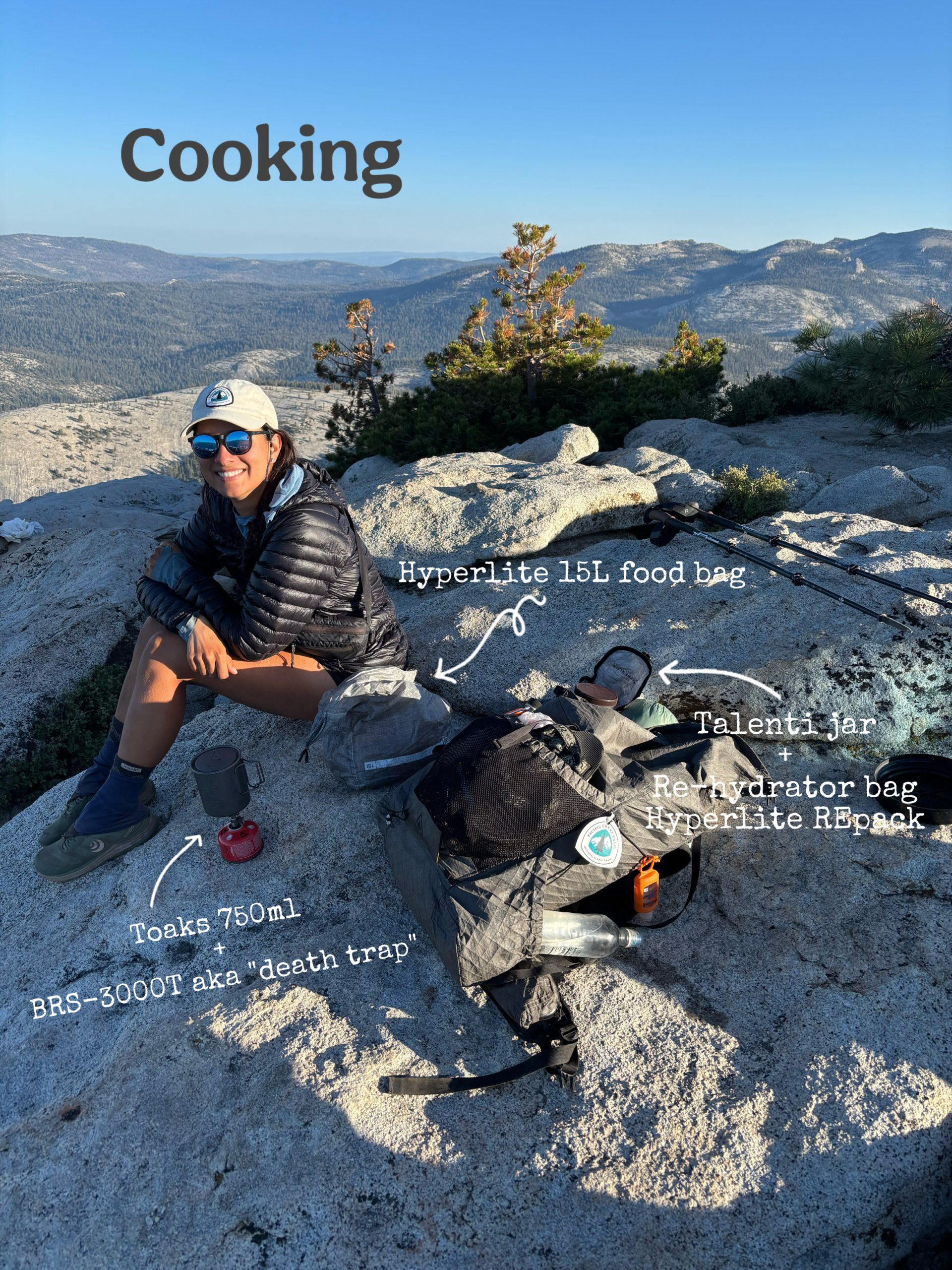
Cooking System
What I Started With
- Food bag: Hyperlite 15L
- Lighter: Mini Bic
- Pot: Toaks 750 ml
- Rehydrator bag: Hyperlite REpack
- Spork: Toaks titanium spork
- Stove: BRS 3000T
- Waterproof matches: UCO Stormproof Matches, stored in my first aid kit
- Coffee mug: GSI
What I Kept the Whole Time
Mini Bic lighter – My lighter stayed with me the entire trail. I carried it even when I was cold soaking and always made sure to keep it dry.
Toaks spork – I love this spork and would definitely recommend it.
Food storage – I kept my Hyperlite 15L food bag until Northern California, then switched to an Ursack and used it until the end. In the Sierra I carried a bear canister, but that will go in the Sierra section.
What I Sent Home, Ditched or Changed
Toaks 750 ml pot – I sent my pot home in South Lake Tahoe when I committed to cold soaking. I did not want to carry the extra weight, and while I am not sure it was truly worth it, I am glad I tried the experience. I got it back for Washington.
BRS 3000T stove – The stove went home at the same time as the pot. A friend once called it a “death trap” because sometimes it acted a little strange, but it never scared me off. I like this stove, it’s very lightweight, and I love the price even more. I have had it for a long time, and even though it is not perfectly reliable, I never had major issues with it. I brought it back for Washington when the colder weather made warm meals feel worth it again.
Hyperlite REpack – I sent this home when I started cold soaking. When I am not rehydrating hot meals, I do not need the REpack, so a simple Talenti jar replaced it, never sent it back later.
Coffee mug: GSI – I ditched the coffee mug very quickly. I still don’t really know why I brought it in the first place.
Waterproof matches – I also ditched the UCO Stormproof Matches very early on. I never used them and honestly do not know why I packed them to begin with, especially since my lighter worked perfectly the whole time as long as I kept it dry.
Talenti jar – I got a Talenti jar (I actually mostly wanted the gelato) in Tehachapi to complete my system, later, it became my cold soak container for NorCal and Oregon. It is light, cheap, and works perfectly for no-cook meals.
Final Cooking Setup
- Food storage: Ursack
- Pot: Toaks 750 ml
- Stove: BRS 3000T
- Lighter: Mini Bic
- Spork: Toaks titanium spork
- Cold soak container: Talenti jar, I kept it to drink coffee in the mornings and occasional cold soaking meals
In part two, I’ll share the rest of my setup, including the clothes I wore every day, my hygiene and toiletries, electronics, other miscellaneous gear, and my Sierra-specific gear.

This website contains affiliate links, which means The Trek may receive a percentage of any product or service you purchase using the links in the articles or advertisements. The buyer pays the same price as they would otherwise, and your purchase helps to support The Trek's ongoing goal to serve you quality backpacking advice and information. Thanks for your support!
To learn more, please visit the About This Site page.
Comments 3
How did the Bear Canister feel in the Kakwa 55? I wanna get a Bear Vault to use with my Kakwa 55 too, but scared it’ll cause issues poking into my back or something.
Hi Tyler! I used the bear canister inside for a bit and it didn’t feel very comfortable unfortunately. So I started using it outside, on top of the pack.
Okay. Thank you for the info!