
 ">


The 2025 Appalachian Trail Thru-Hiker Survey: General Information (Part 2)
Welcome back to the 2025 Appalachian Trail Survey! In Part One, we dove into the demographics and logistics of hikers on trail, including age, gender, start dates, and more. Now, we want to look at hiker habits and hiker experiences, so we’ll go over our survey results surrounding injury, safety, preferences, towns, and thru-hikers’ favorite parts of the trail experience.
As mentioned in the first part, this year we collected 279 responses from AT hikers. We want to extend a huge thank you to those respondents! We hope for this to be a valuable resource for those of you planning your future AT thru-hikes. If you plan to spend time on the trail in 2026, sign up now to be notified when the 2026 survey goes live. Trust me—it’s easier to remember now than it will be after your hike.
Sign Up to Take the 2026 AT Thru-Hiker Survey!
Companionship
We asked hikers about their trail companions—both who they started hiking the trail with, and who they spent the vast majority of their on-trail time with. The results we saw follow the same trend we see year over year.
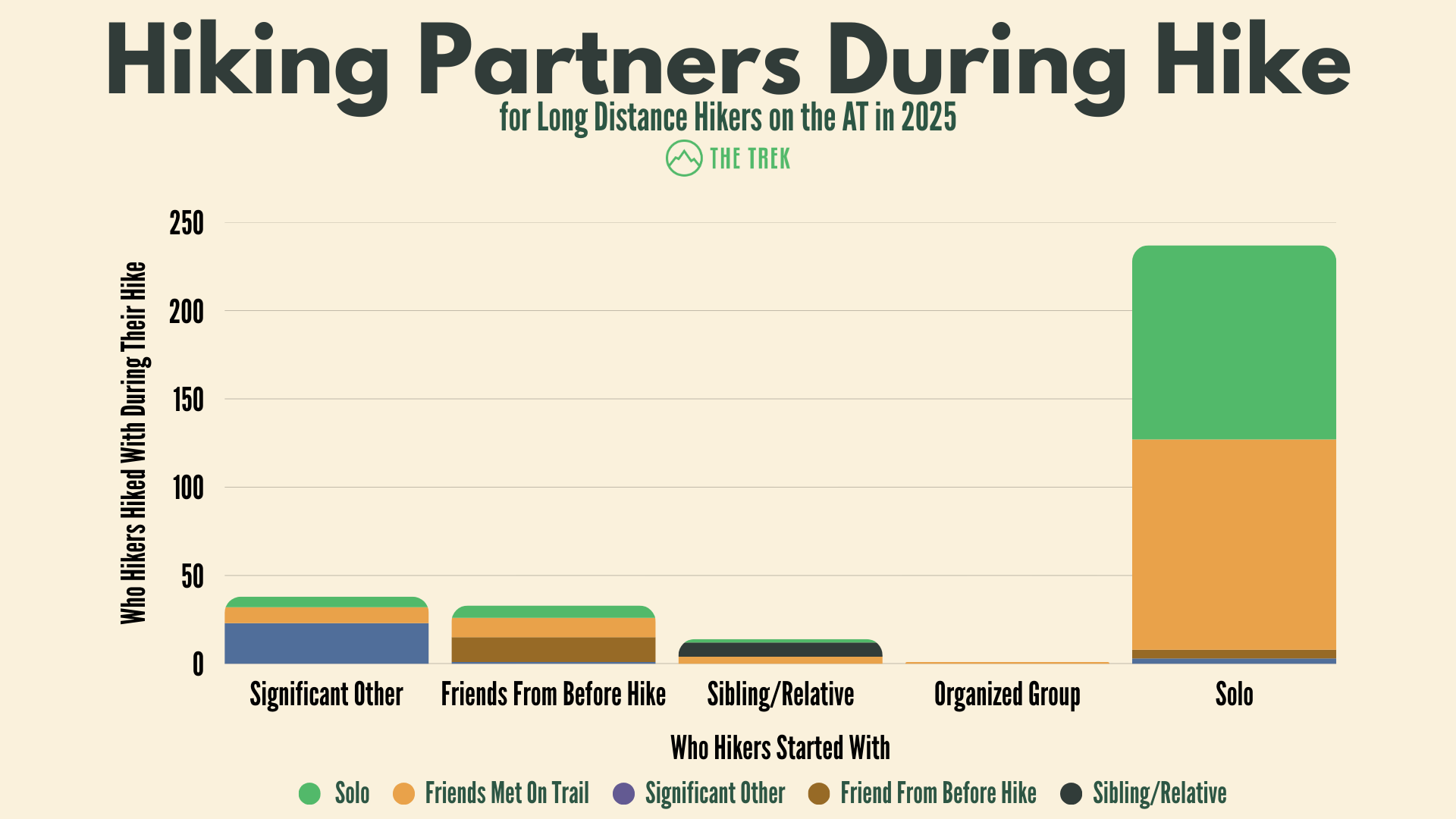
The vast majority of hikers started the trail alone. Of those solo starters, about half ended up hiking with people they met along the way, while most of the others remained solo. (A few solo starters later joined forces with loved ones and hiked the majority of the trail with them.)
We say this all the time, but the Appalachian Trail really is a great trail if you’re looking to make friends, and you shouldn’t be worried about starting alone, especially if you’re setting out around a popular start date.
A decent-sized chunk of hikers also started the trail with their significant other and/or friends from before the hike, with the majority of those groups continuing to hike with their starting partners throughout.
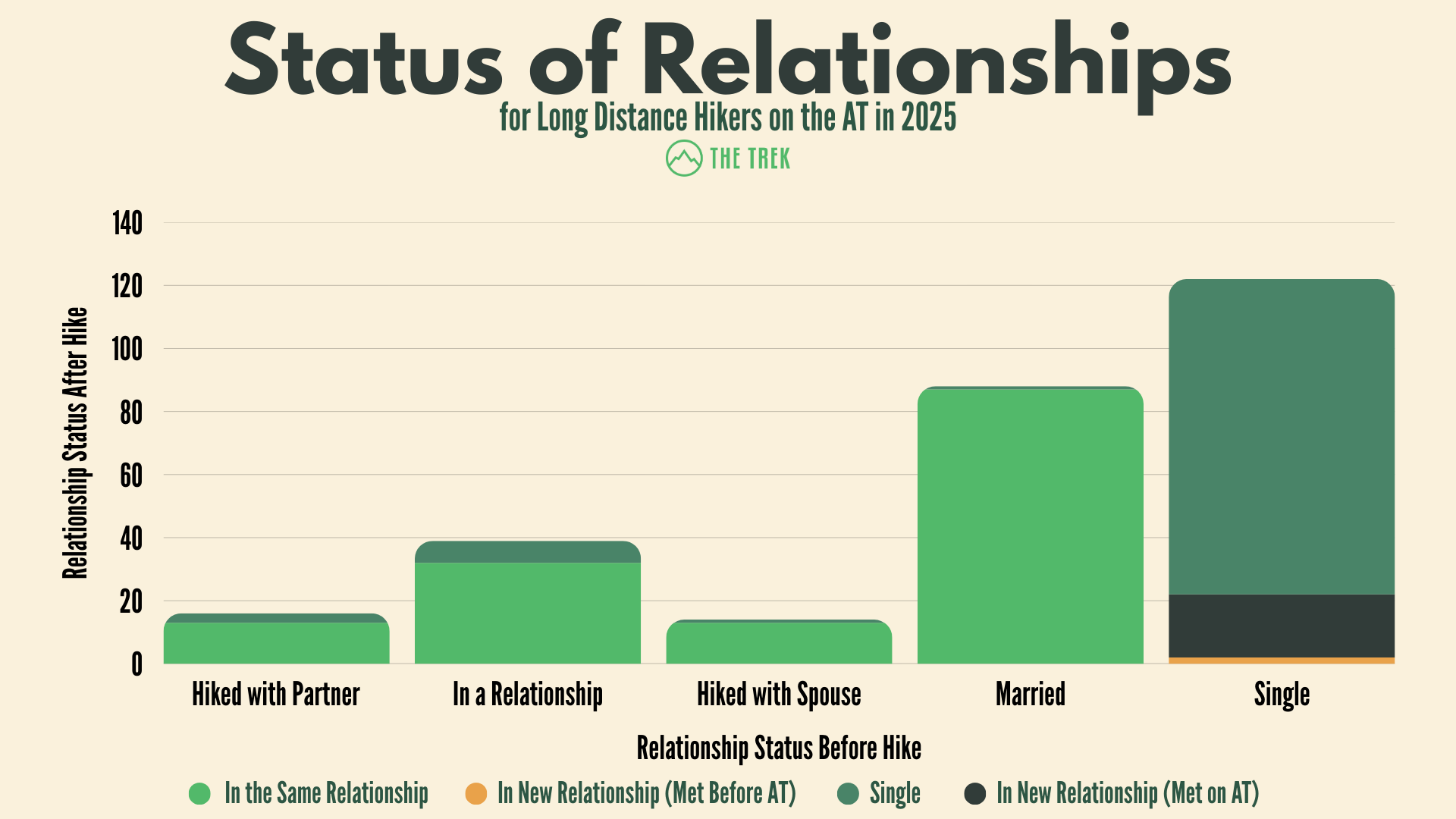
We also asked hikers about their relationship status before and after their AT hikes. As we’ve seen in past years, most hikers on the trail tend to be either single or married.
Most (but not all!) hikers starting the AT this year ended the trail still married, and most hikers single prior to the hike ended the trail still single. However, 20 respondents did indicated starting the trail single and ending it in a relationship with someone they met while hiking.
One interesting correlation is the breakups reported by those in a relationship who hiked with their partner vs. those who did not. The data we received indicates that couples who hiked together were slightly less likely to break up on trail compared to people in relationships who left their partners at home.
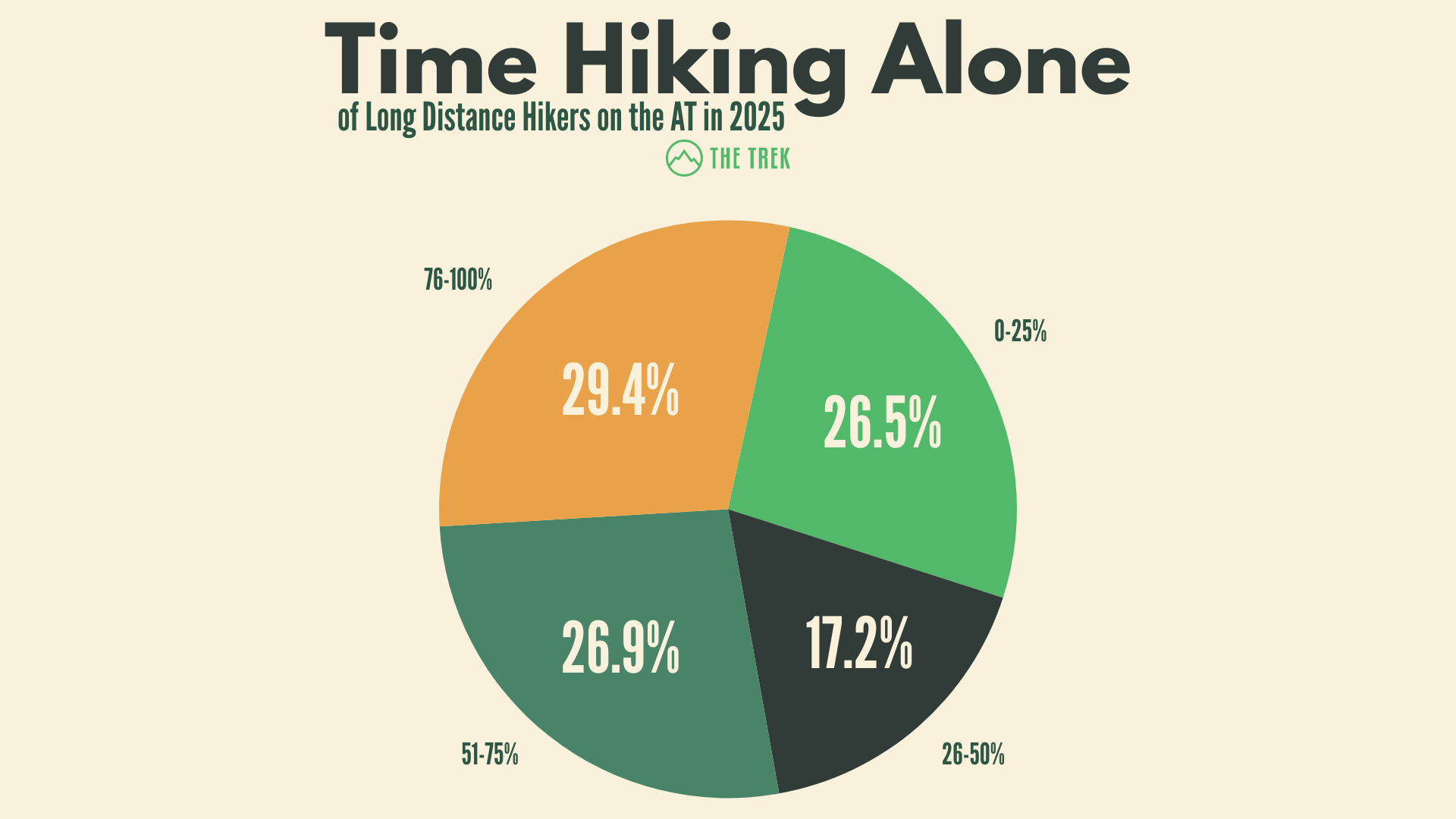
When we asked hikers how often they hiked alone this year, we received fairly split answers. About a quarter of hikers spent a 25% or less of their time alone. On the other end of the spectrum, about 30% of respondents hiked solo over three-quarters of the time.
It’s important to note that we specifically asked about actual time spent hiking alone, regardless of whether you were meeting up with someone at meal breaks or at camp. This means many people hiking in groups could still be spending the majority of their actual hiking time alone. (Recall from above that nearly half of the hikers who started solo this year reported having a hiking partner for the majority of the trail.)
The key takeaway here: hiking with a partner or trail family doesn’t mean you’re required to be in their presence 24/7. It’s quite normal on long trails to hike solo and just meet up with friends at planned or unplanned intervals throughout the day, leaving room for everyone to do their own thing but still have companionship.
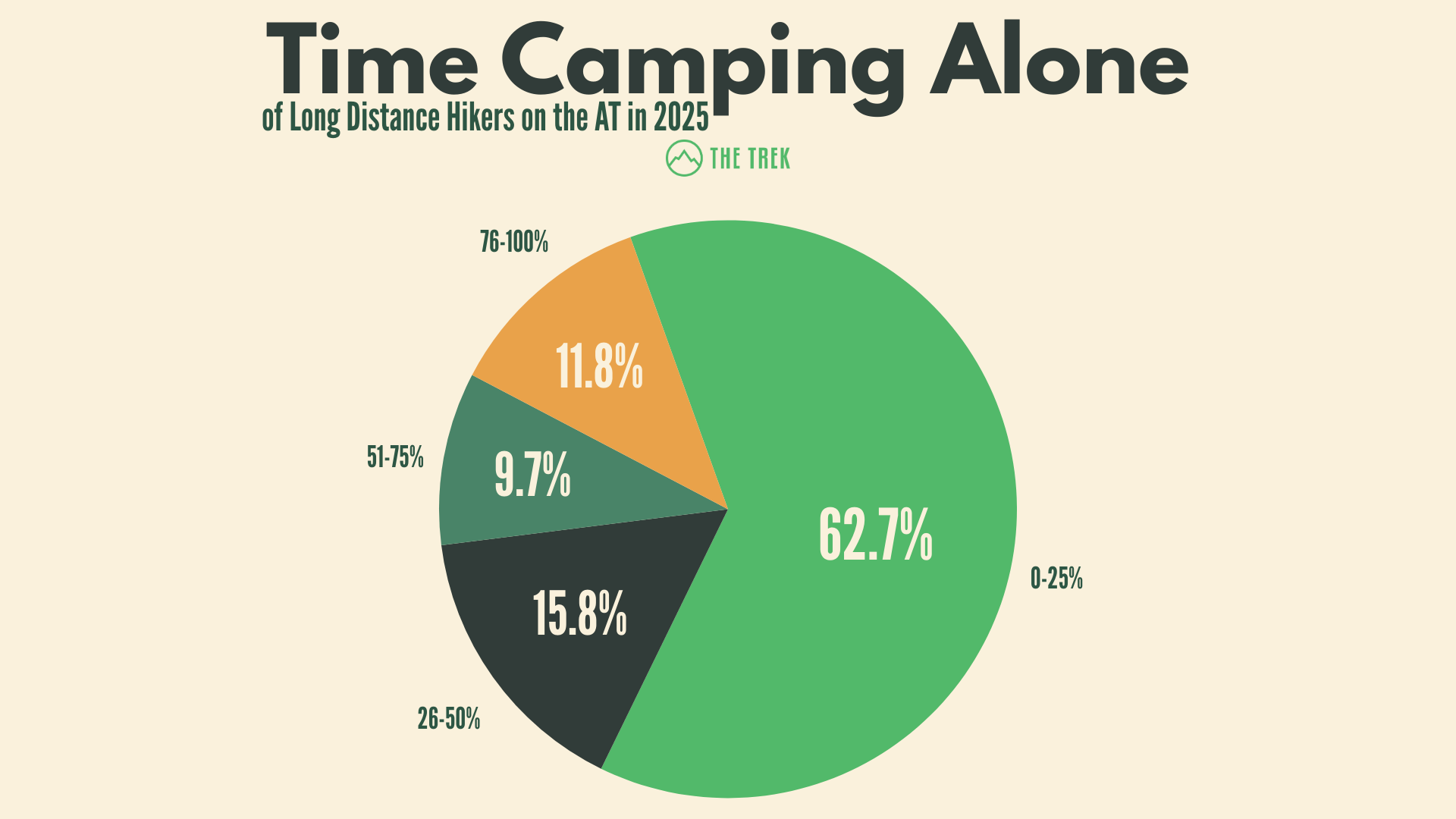
We also asked hikers how often they camped alone, and here the number of hikers in the 0-25% section more than doubled. Almost two-thirds of this year’s cohort rarely (25% of the time or less) spent the night alone. In contrast, only 12% of hikers camped alone the majority of the time, and the remaining quarter of hikers camped alone between 25 and 75% of the time. “Not camping alone,” in this case, just means sharing the campsite with any other people, regardless of whether they were hiking partners.
Hikers who camped alone more frequently were also much more likely to indicate that they did not choose to sleep in shelters, suggesting that those who spent many nights camping alone likely sought out that solitude intentionally.
So again, there’s room for everyone here: if you’re craving a more solitary experience, simply avoiding the shelters will give you a decent chance of peace and quiet. If you want to socialize or dislike the idea of spending the night alone in the woods, the shelters are a great place to meet people.
Crowding
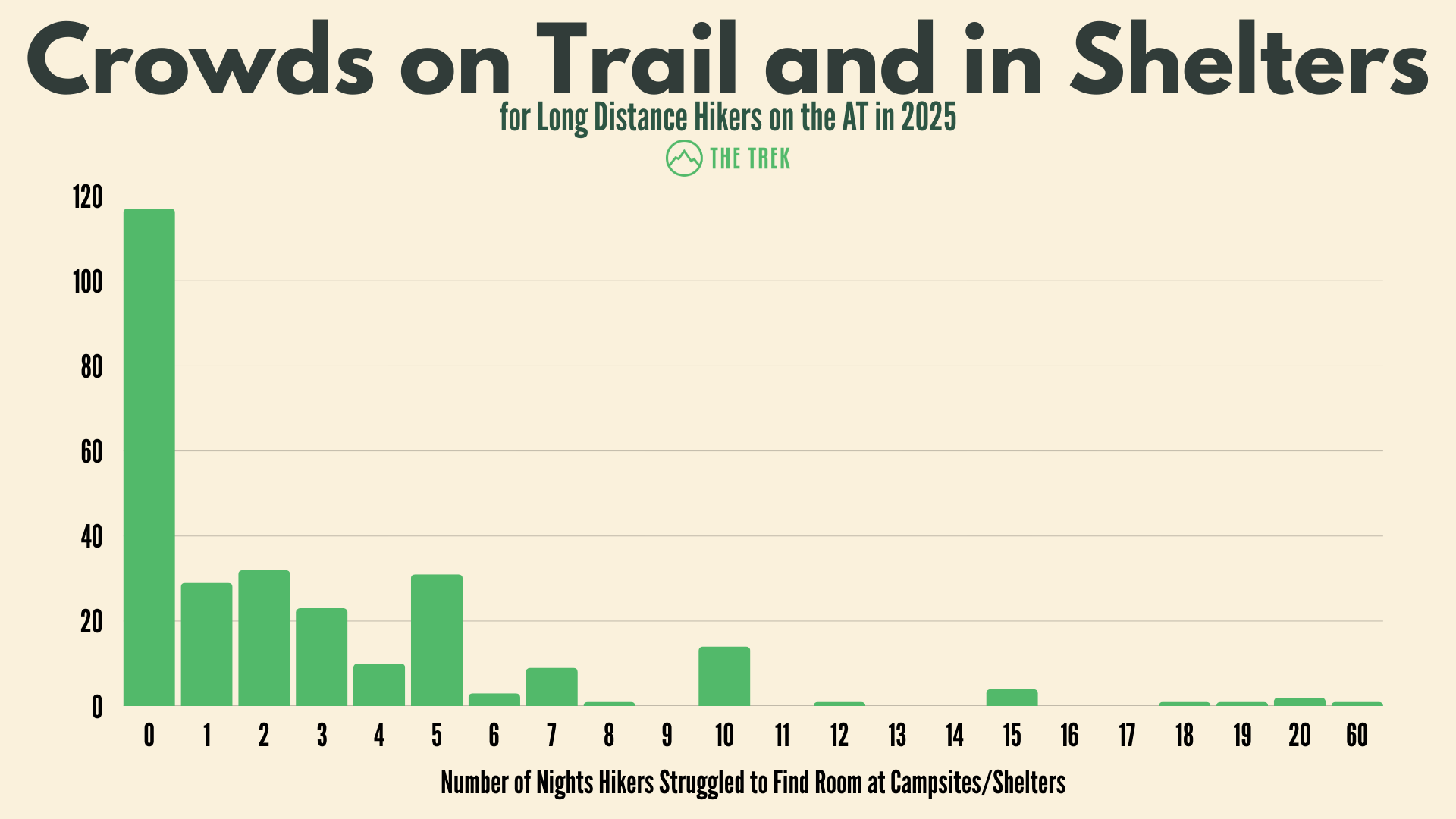
The AT tends to suffer from overcrowding more than other long trails, especially if you pick a common start date (although this year did see a dip in the number of thru-hikers on the trail).
However, when we asked hikers how often they had difficulty finding a campsite, the vast majority said they rarely struggled to find room at a campsite or shelter. Over 90% reported struggling to find room at a campsite or shelter fewer than six times, with most saying they never struggled.
In comparison, Class of 2024 hikers seemed to struggle with crowded campsites slightly more than this year. In last year’s survey, 10% of hikers struggled to find room on more than 1o occasions. This is in line with the findings of relatively more crowding on the trail in 2024. (It should be noted that even last year, most people emphasized that they didn’t struggle too much with shelter crowding.)
We at The Trek would like to offer our formal condolences to the single respondent who indicated struggling to find camping room for 60 of their nights on trail. I’m not sure where they were trying to sleep, but it must have been a party.
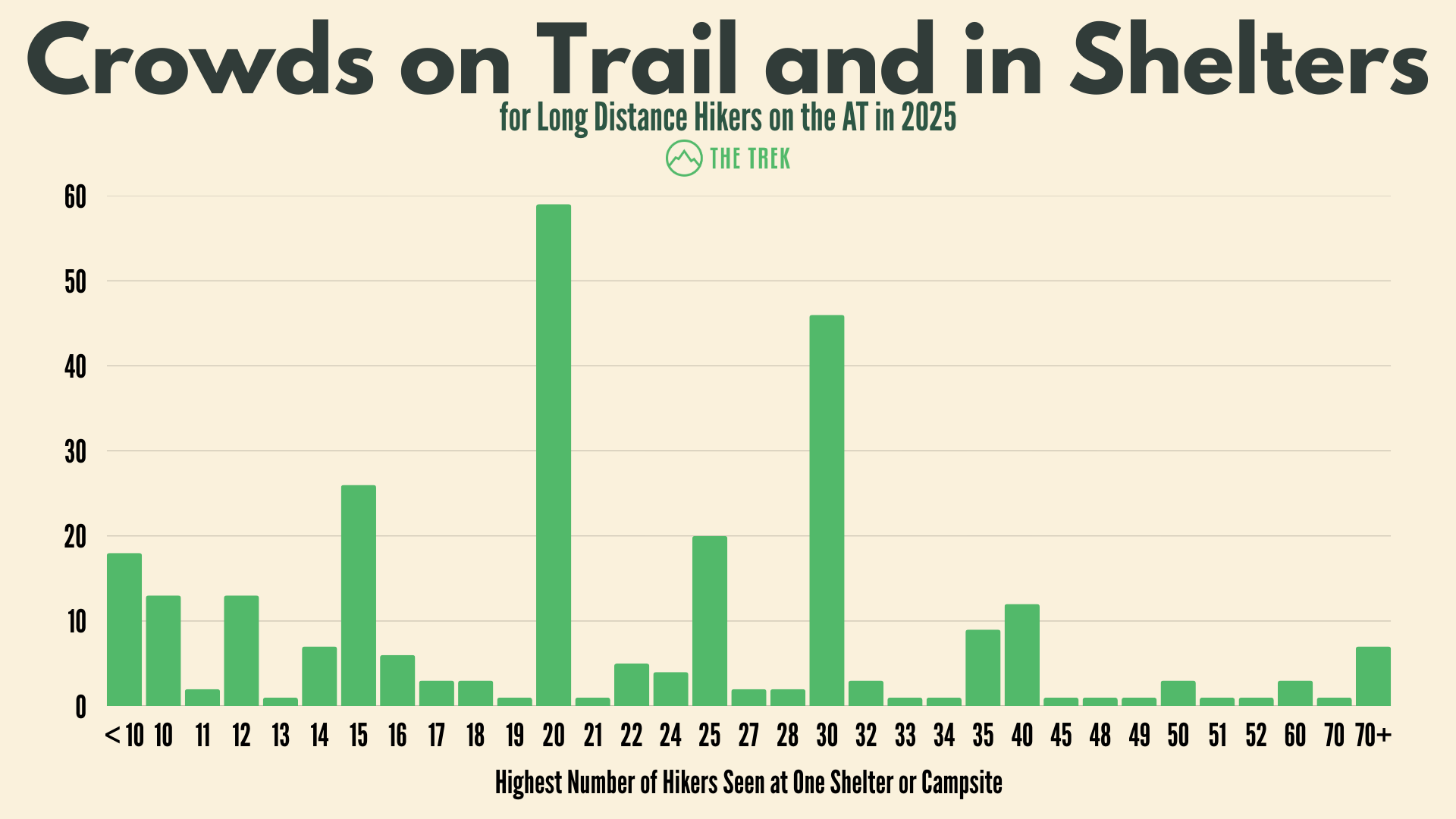
Just because fewer thru-hikers were on the trail in 2025 — and just because you could find room in a shelter — doesn’t mean that those sites were empty. We asked hikers to recall the largest number of hikers they saw at a single campsite or shelter during their hike. The most commonly reported answer was 20 other hikers at a site, compared to 30 last year. This year, 75% of responses reported seeing 30 or fewer hikers at the most crowded shelter or campsite.
There were a few responses indicating 60 or more hikers at a single campsite or shelter. My best assumption there is that these respondents included the festival camping area at Appalachian Trail Days in Damascus, Virginia, as all but one indicated attending the festival.
(Ed. It might be possible to find 60 people at a shelter if it’s near a major population center on a holiday weekend. I recall one Labor Day weekend in northern Virginia when the Tent City surrounding the shelter spilled over into the urban sprawl of Tent Suburbs. I was half expecting a drive-thru Bank of America by the water source. Sixty campers wouldn’t have been an unreasonable estimate that night.)
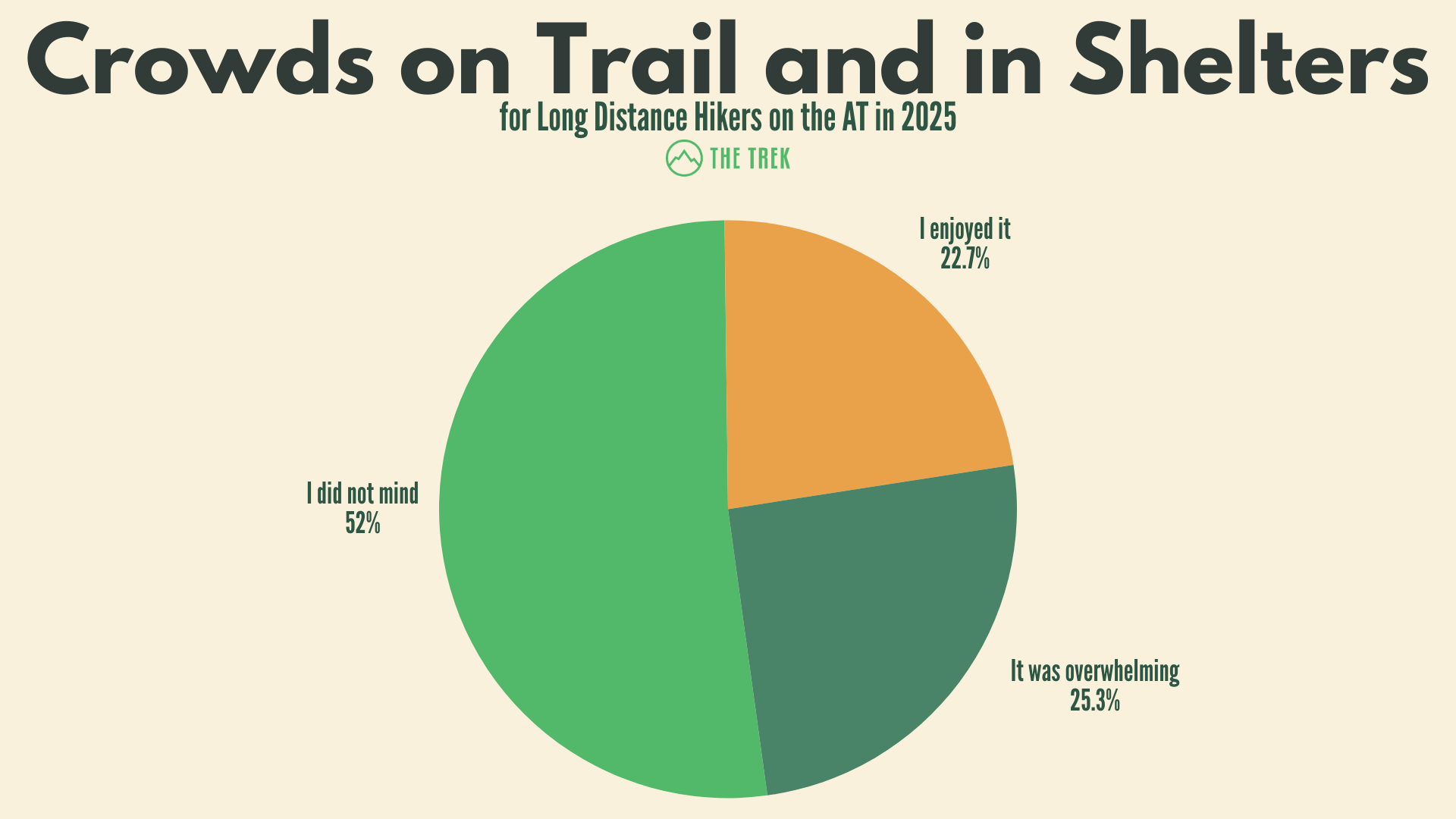
Finally, we asked hikers for the first time this year how the crowds on trail and in shelters affected them. While a quarter of respondents said the crowds they experienced were overwhelming, most (three-quarters) either didn’t mind the crowds or actively enjoyed the social scene of the trail.
Leave No Trace
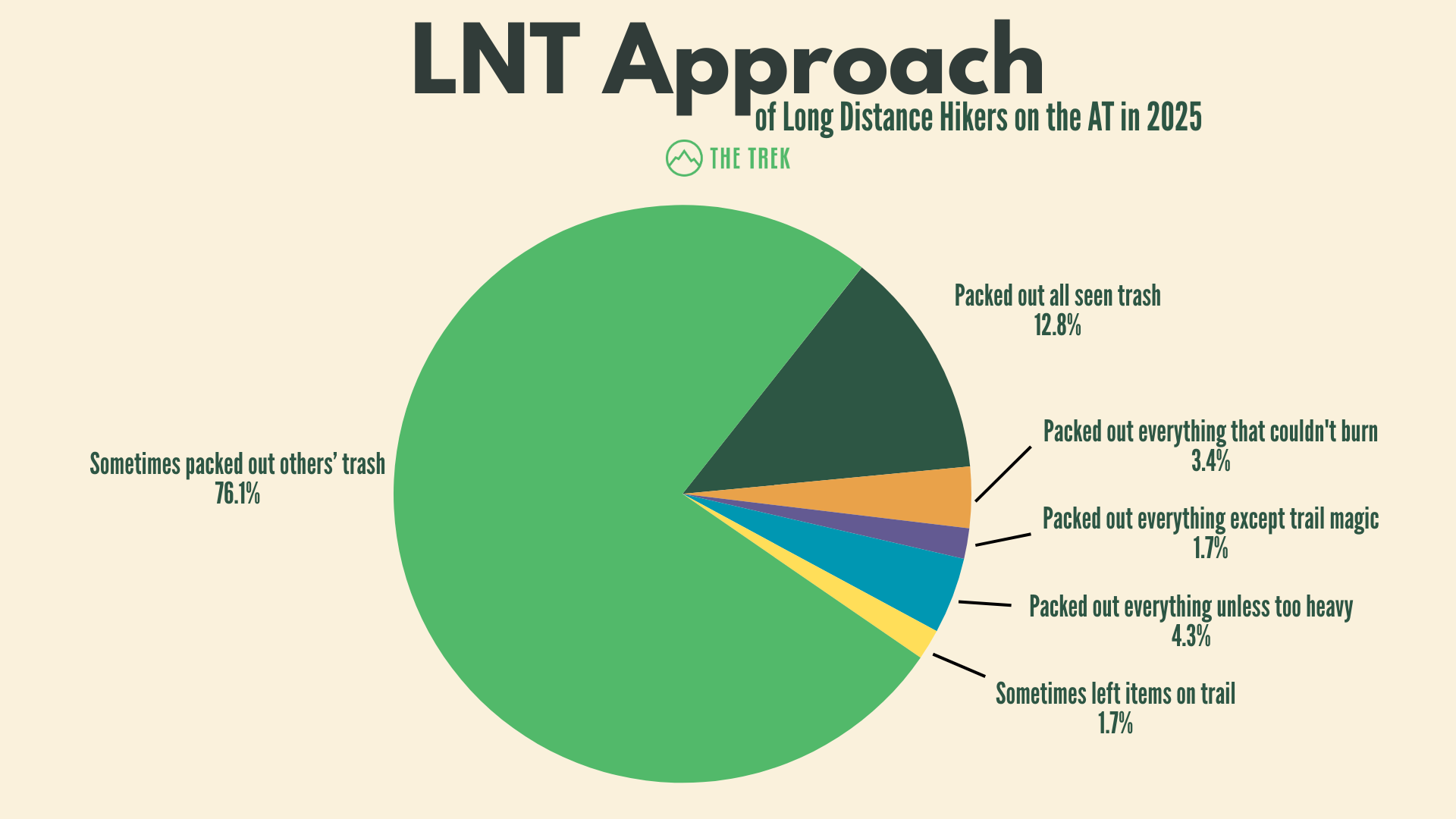
One of the core tenets of Leave No Trace (LNT) is to not leave trash behind. Obviously, we all hope thru-hikers will be good stewards and representatives for our community, and we were glad to see only 6% of hikers reporting leaving trash behind.
Obviously, these numbers are self reported, which likely skews the data when we consider unintentional littering and those who were not totally honest in their response, but I’m happy to see the 89% of hikers who packed out other peoples’ trash along with their own at least some of the time.
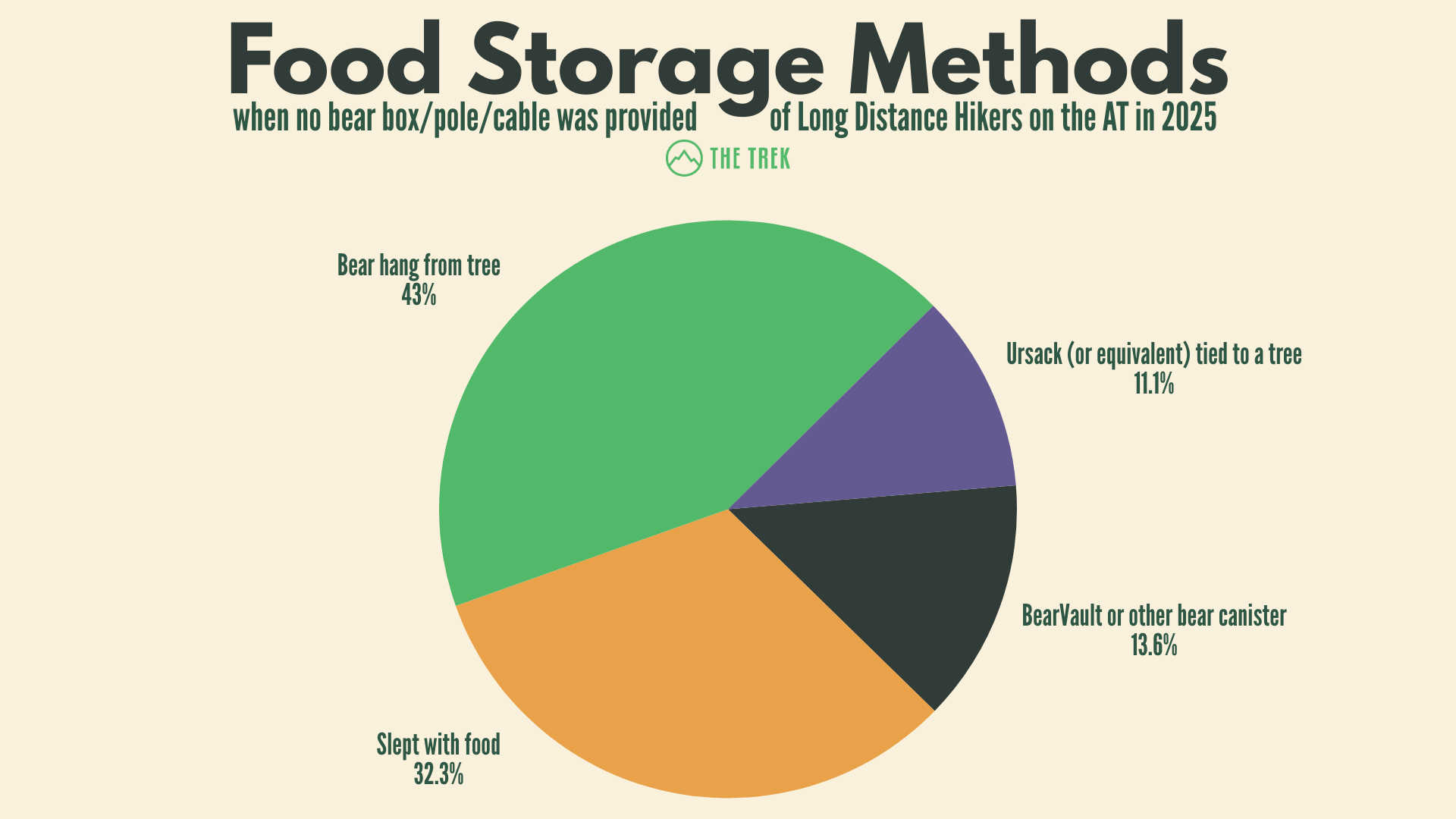
We asked hikers what their main method of food storage was when there was no bear box, pole, or cable available.
The ATC encourages hikers to carry bear canisters due to their reliability and ease of use. Despite that, the bear canister is one of the least popular food storage methods on the AT, coming in just ahead of bear-resistant cloth bags like the Ursack. It will be interesting to watch this trend over the years. Will canisters become more widely accepted as more and more trails nationwide require or strongly encourage their use?
If bear canisters are the most foolproof way to secure food, sleeping with food in the tent is the least. Yet that was the second most popular strategy according to our survey. 32% of hikers said that was their main method of food storage. It’s certainly not the recommended practice, but it does appear to be a common one.
However, compared to 2024, it’s encouraging to no longer see sleeping with food as the most common practice. Instead, in 2025, 43% of hikers reported using a traditional bear hang from a tree to store their food when no method was provided at the shelter or campsite.
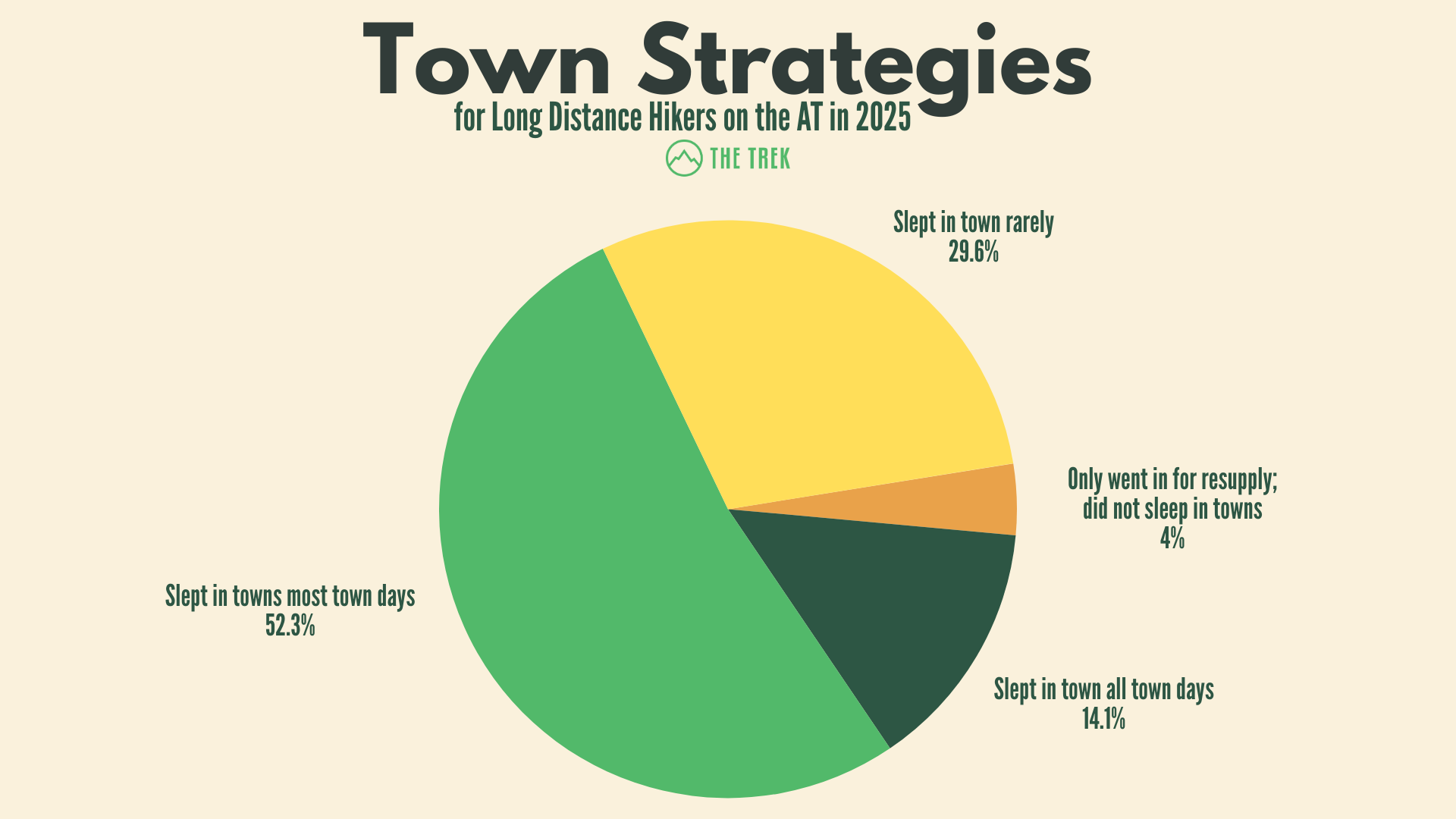
The AT’s town vortex remains strong. Two-thirds of hikers spent the night in town when they went in for resupplies on most or all occasions. Just under 30% said they rarely spent a night in town, and only 4% never slept in towns.
These results won’t be surprising to anyone who’s spent time on trail. It’s simply very difficult to resist the temptation of a shower, a hot dinner, and a warm bed once you’ve set foot in town.
Safety
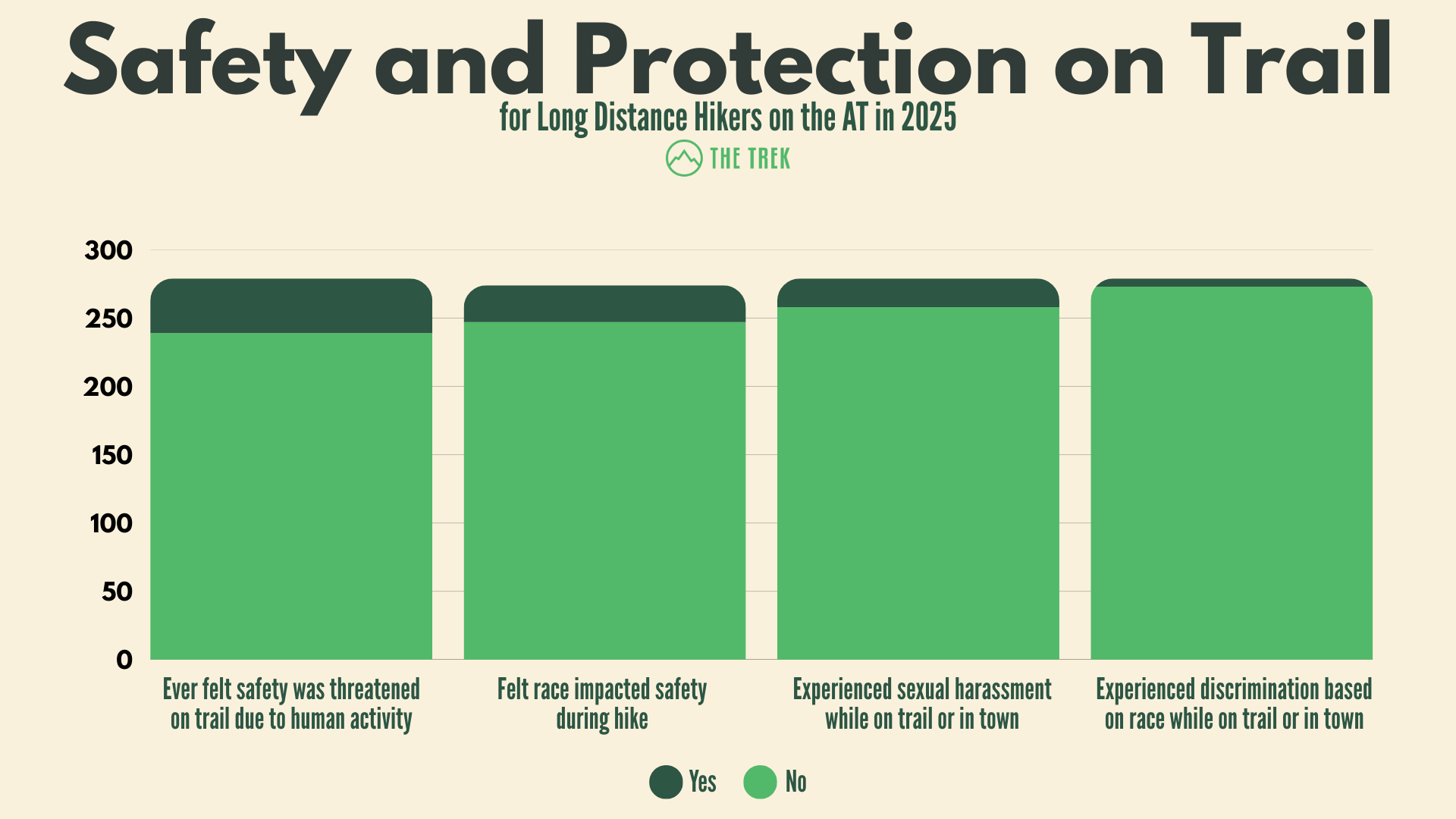
We want every hiker to feel secure, but the reality is that safety issues do happen. The good news is that reports of human-related threats dropped by 4% this year, with only 14% of hikers feeling unsafe due to others. The bad news? When bad things happened, they usually came from inside the community.
Survey respondents indicated that other hikers were more likely to be the source of bad behavior than non-hikers: peers on the trail were blamed for four out of the six reported racial discrimination incidents and 17 out of 21 sexual harassment reports.
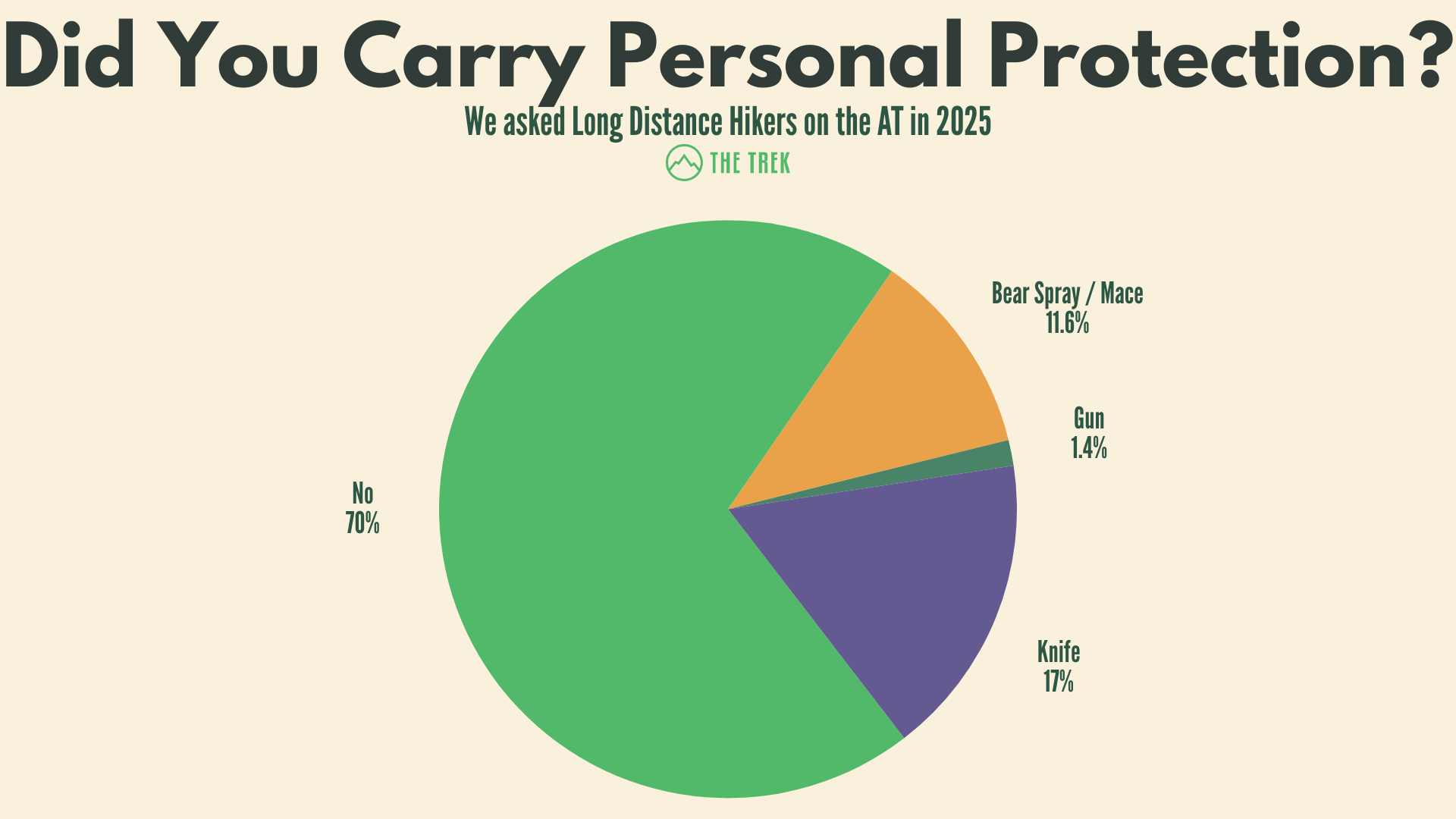
When it comes to self-defense, nearly a third (30%) of the class decided to pack some form of protection. For most, this meant carrying a knife or pepper spray, and some hikers opted to carry both. Firearms remain a distinct minority choice on the trail, with only four respondents reporting that they hiked with a gun.
Injuries
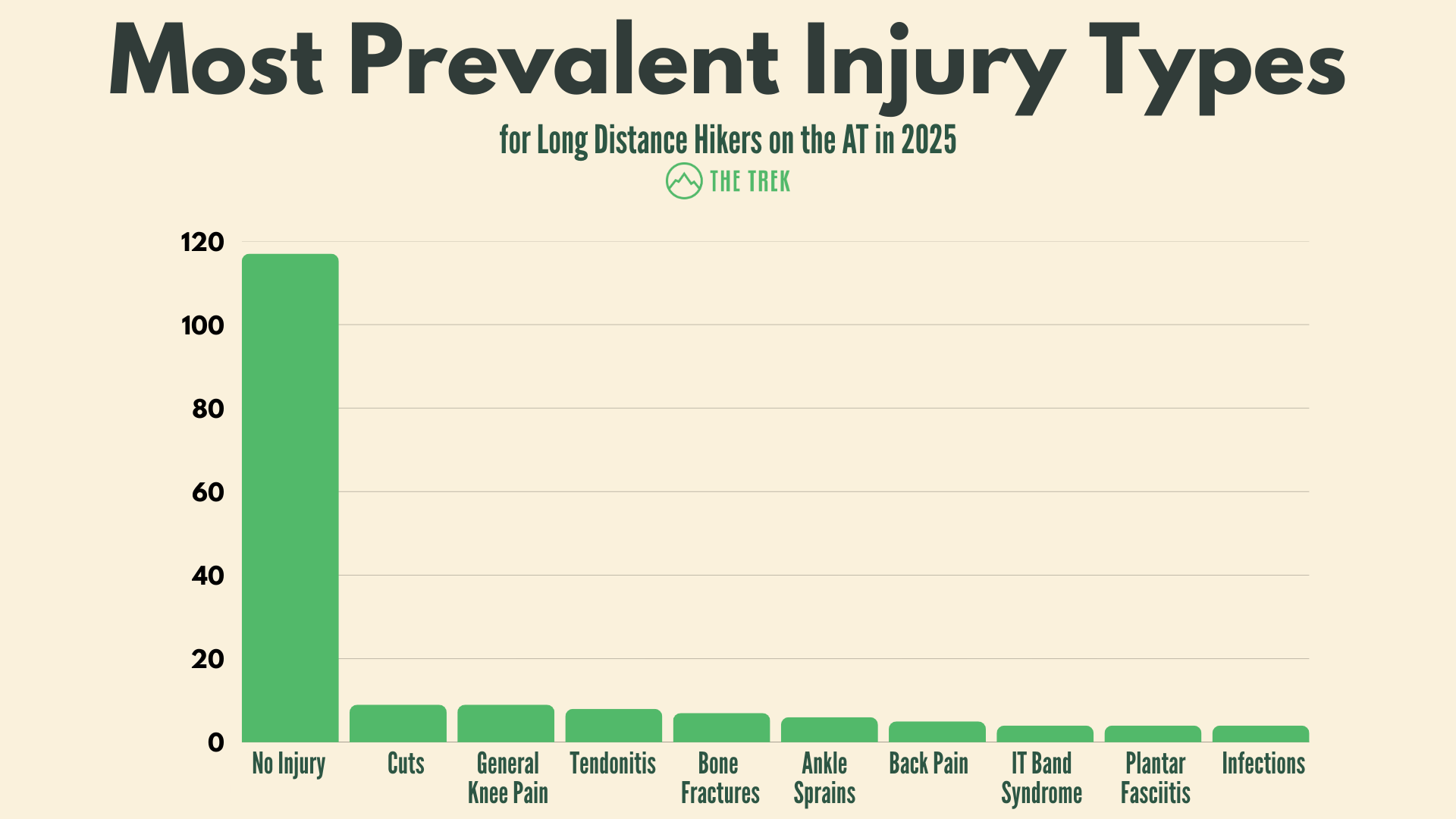
Fewer than half of thru-hikers experienced some form of injury during their hike this year, a noticeable decrease from previous years. However, we do need to remember that this survey is voluntary; hikers who ended their hikes early due to injury are less likely to seek this survey out months later to report their hike’s outcome.
When we take a look at the types of injuries, there is a pretty wide spread across the top 9 most common issues. Understandably, for a trail as slippery and uneven as the Appalachian Trail, major cuts are the most prevalent, followed by nonspecific knee pain and tendonitis.
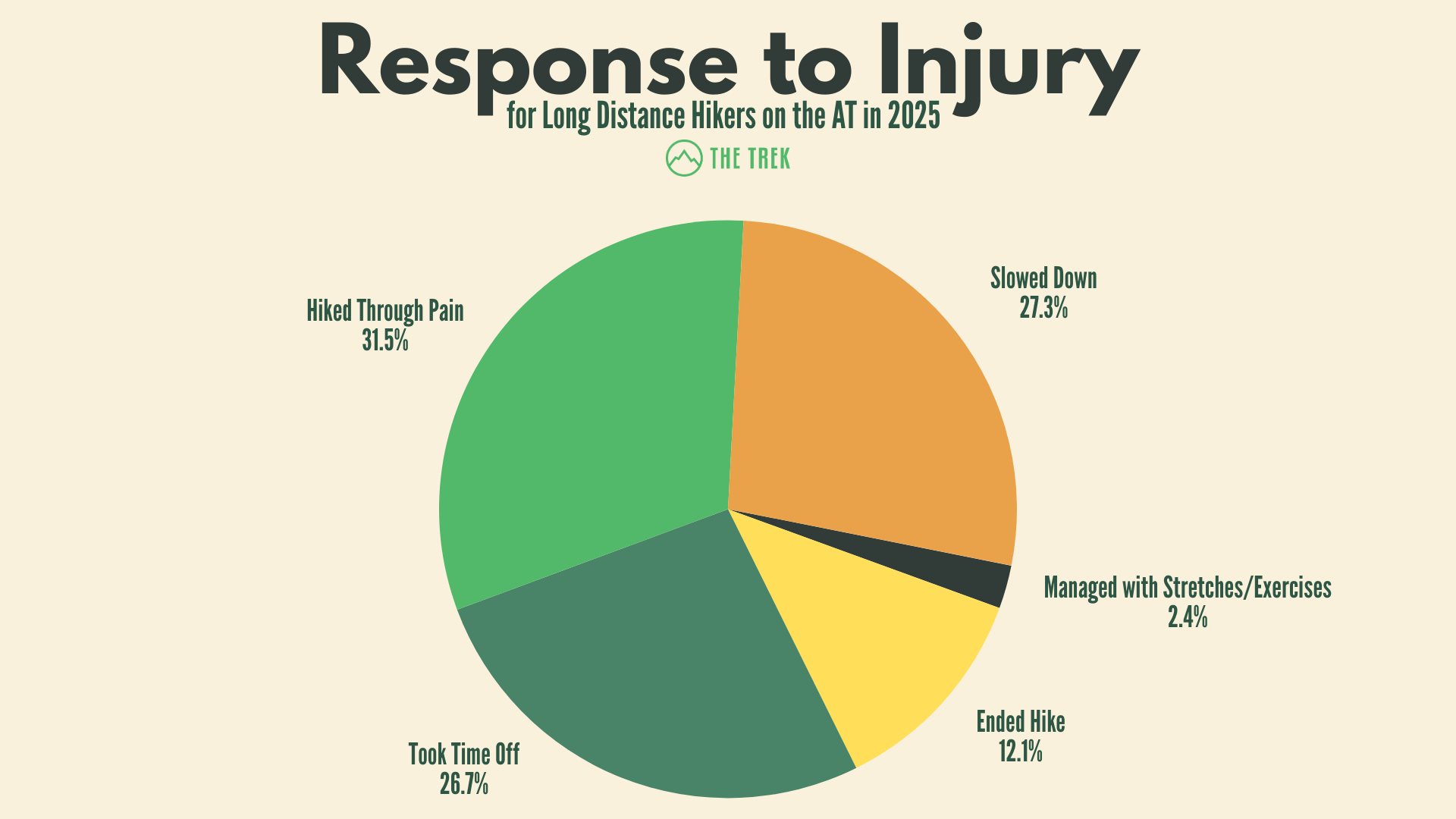
Most of the time, the most common injuries are the ones that affect the hike the most, but tendonitis was a unique nag. It almost never forced anyone to go home, but it did force the majority of sufferers to slow down or take time off to heal. Broken bones were the real dream-crushers, ending the journey for 71% of those who sustained one.
That said, thru-hikers are a stubborn bunch: nearly a third of respondents (32%) refused to let injury dictate their hike, choosing instead to just push through the pain.
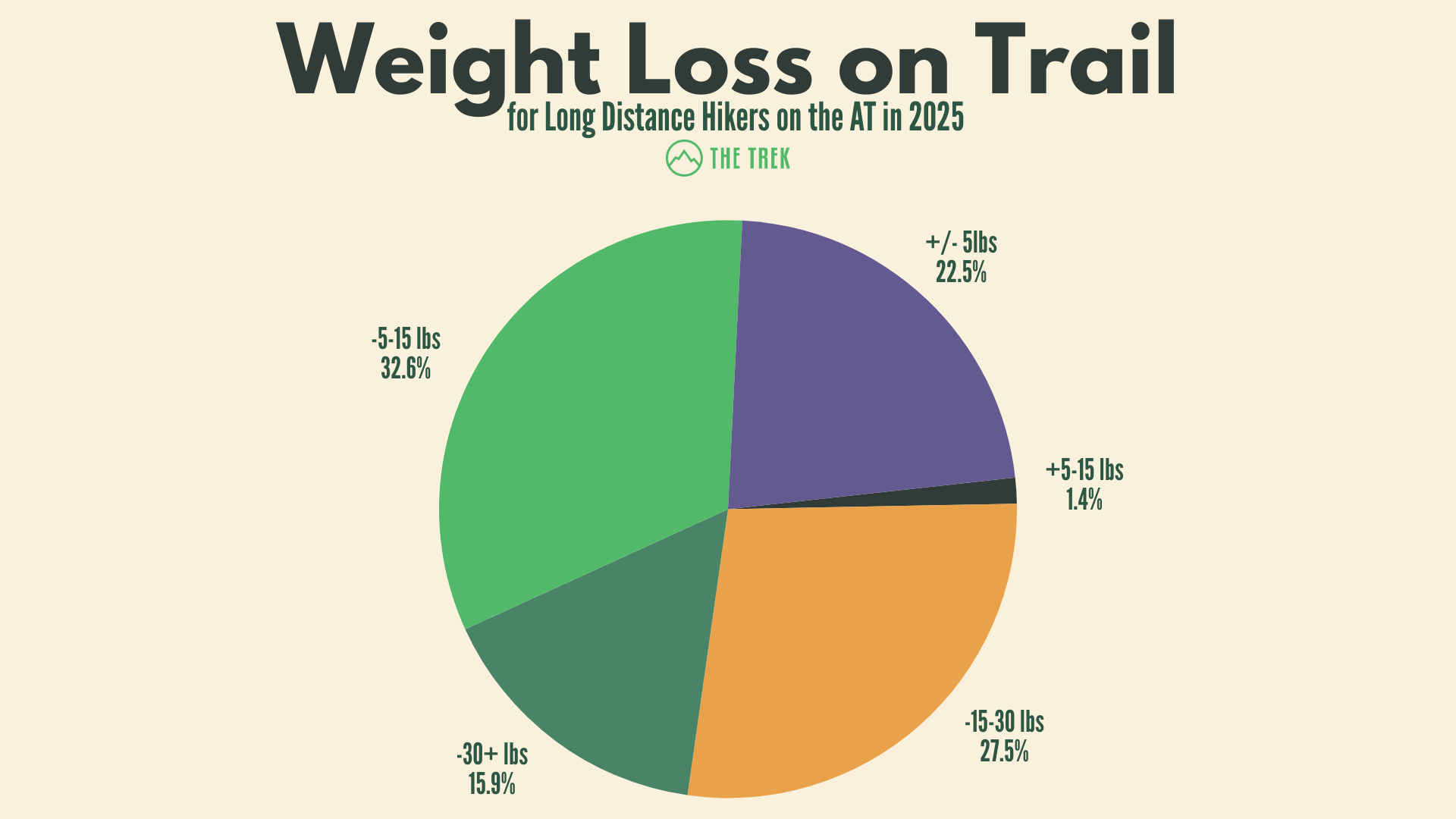
It is no surprise that the “hiker diet” combined with 12 hours of exercise a day usually leads to dropping a few sizes. More than three-quarters of our respondents finished the trail lighter than they started, and absolutely no one reported gaining 30 pounds or more.
When we break it down by gender, things get interesting. Men were much more prone to dropping weight, with 80% seeing the scale go down, compared to just 58% of women. The most drastic physical changes were also largely a male phenomenon; nearly everyone who lost over 30 pounds (40 out of the 44 hikers in that category) was male.
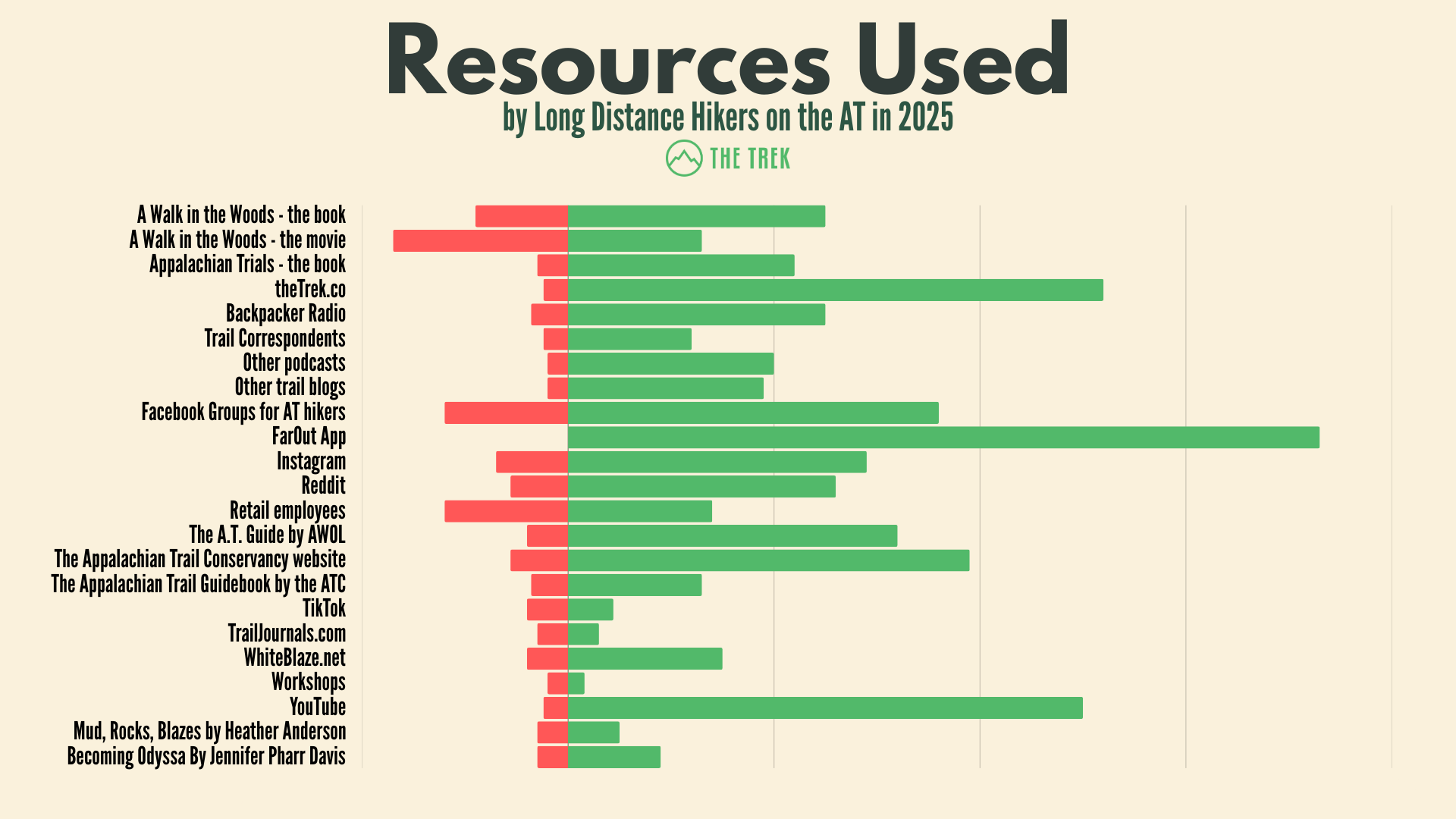
When it comes to planning a thru-hike, not all advice is created equal. We asked the class of 2025 what worked for them, and the results look familiar: FarOut took the gold medal for helpfulness, with TheTrek.co (thanks!) and YouTube rounding out the podium.
On the flip side, Bill Bryson’s A Walk in the Woods (book and movie) and advice from retail employees were rated as the least useful resources. Facebook groups continue to be the “love it or hate it” resource of the trail, with hikers split significantly on whether they provided any actual value.
Favorites
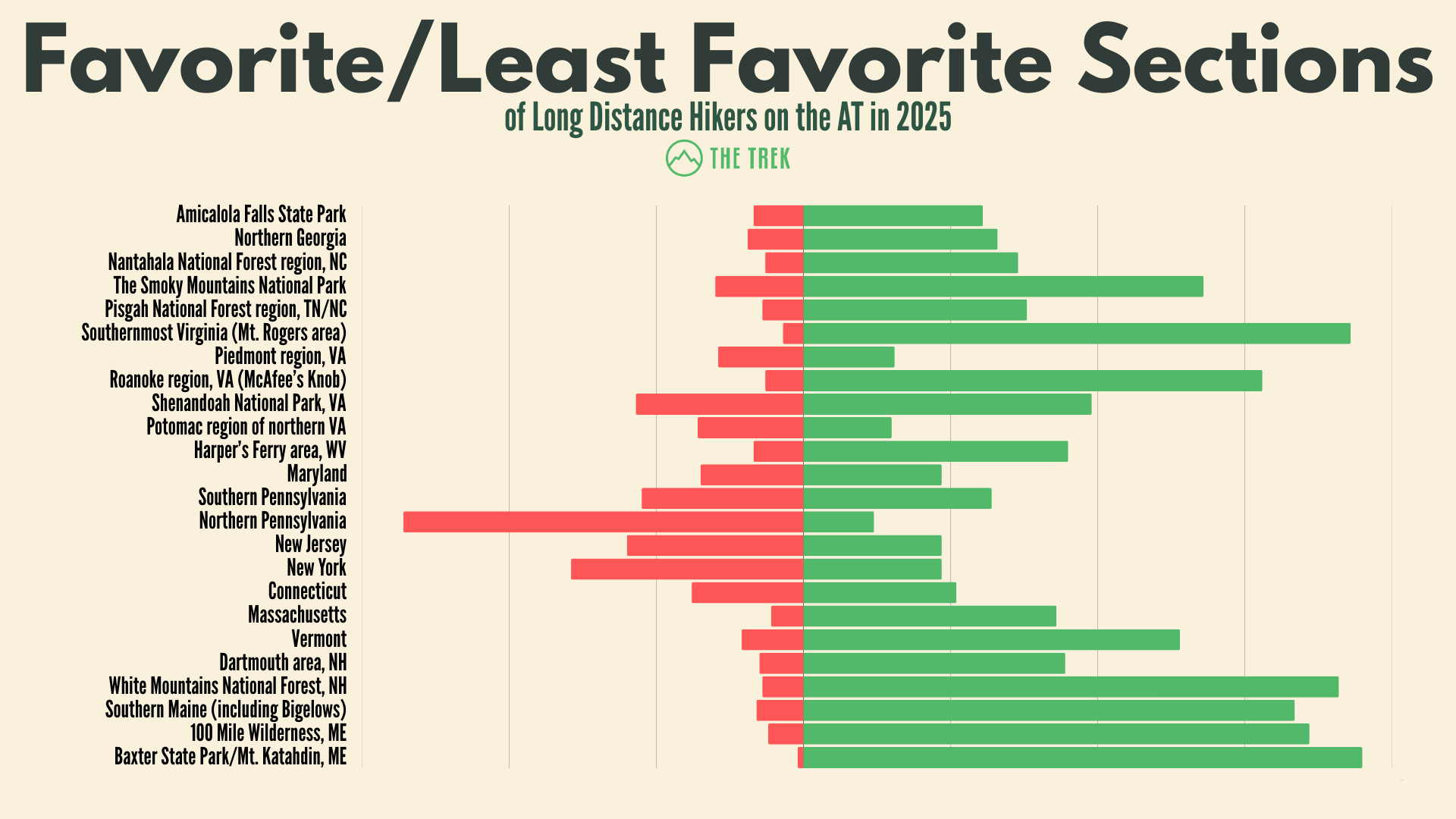
As opposed to last year, Baxter State Park narrowly edges out Southernmost Virginia for the most popular section among hikers. The White Mountains and the 100-Mile Wilderness are the next most popular sections, and Northern Pennsylvania was — again — the least popular section of trail by far.
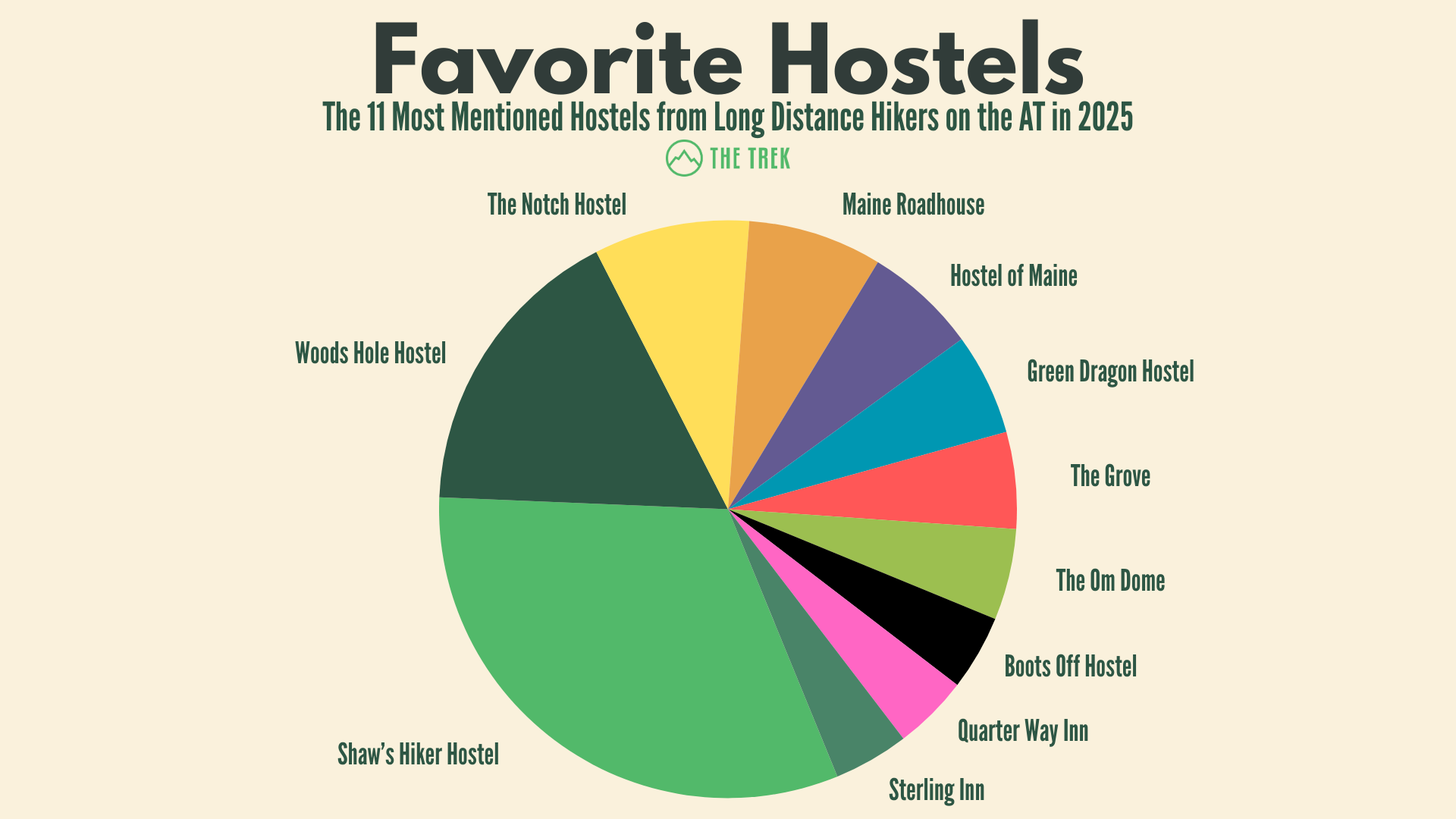
Shaw’s Hiker Hostel in Maine once again claimed the title for most popular hostel on trail. Woods Hole Hostel took a commanding second place, and we saw The Notch Hostel take third place over Maine Roadhouse, which is an upset from previous years.
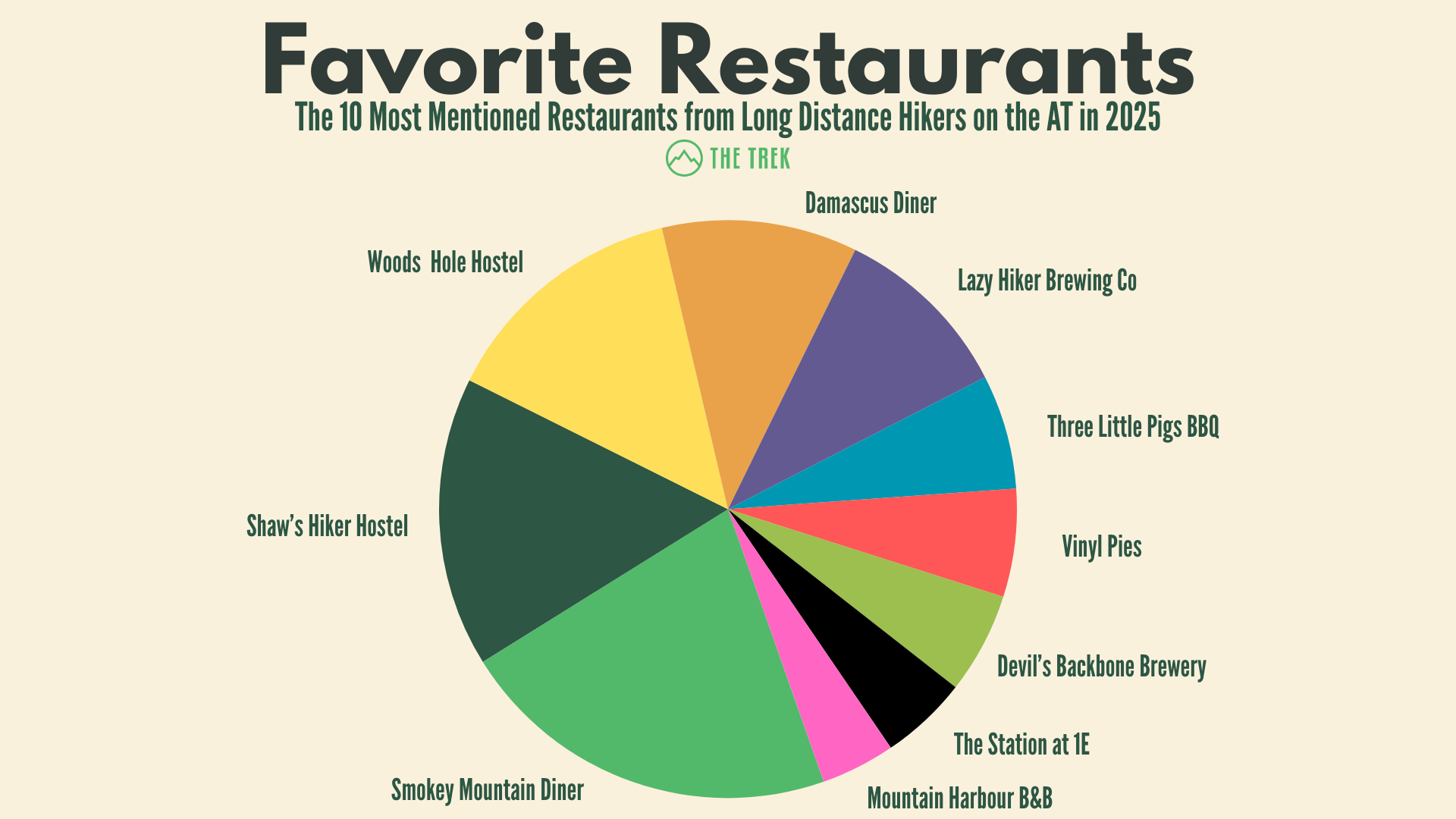
Funnily enough, both Shaw’s and Woods Hole hostels were in the top 3 most popular restaurants as well—but, this year, Smokey Mountain Diner came out on top. Interestingly, four of the top 10 restaurants are hostels that also offer meal service.
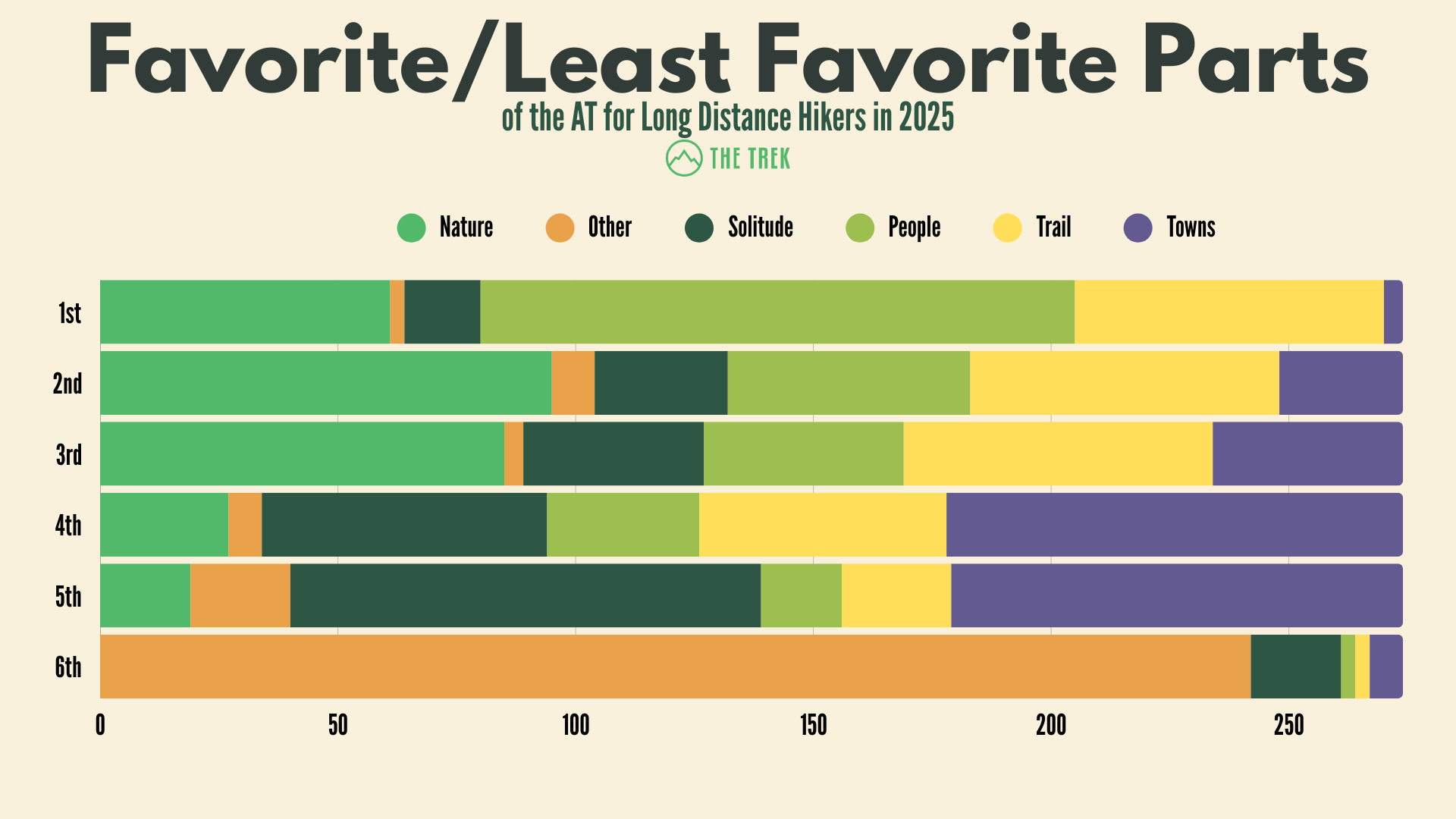
To wrap things up on a high note, we asked the class of 2025 what they loved most about the journey. The answer was clear: it’s all about the people. The community aspect took the top spot by a landslide.
Generally speaking, the hierarchy of happiness went: people first, followed by nature and the trail itself, then town stops, with solitude ranking fifth. Interestingly, many hikers used the “write-in” option to cast a vote for the struggle itself, listing the mental and physical challenge as their favorite part of the experience.
That is officially a wrap on the General Info stats for the class of 2024! We hope these numbers help you plan your own adventure. Don’t worry, we aren’t done yet — stay tuned for deep dives into everyone’s favorite gear, including boots, bags, tents, sleeping pads, and stoves.
The best way to catch those drops is to sign up for our newsletter. A massive congratulations to everyone who walked from Georgia to Maine this year, and a special thanks to those who took the time to share their data with us!
Featured image: Graphic design by Chris Helm.

This website contains affiliate links, which means The Trek may receive a percentage of any product or service you purchase using the links in the articles or advertisements. The buyer pays the same price as they would otherwise, and your purchase helps to support The Trek's ongoing goal to serve you quality backpacking advice and information. Thanks for your support!
To learn more, please visit the About This Site page.

Comments 2
Always fascinating to ponder, so I hope you guys continue these surveys in the years to come.
Shaws favorite hostel!! 🤣🤣🤣 The place is a joke !! Covid and drugs is what its known for! Those staff love screwing hikers out of money 💰 🤑 💸!! We stayed at the lake house after the fat guy who owns the shaws hostel told us it was going to cost $200 WTF !! I dont understand why its called Shaws? But its NOT worth staying at !! Skip that shit hole place! Its a strange place to say the least!! Lots of drinking and drugs !! Lake house is the place in Monson!!
King of pain
AT 2024
PCT 2025