 ">


The Arizona Trail: Why Night Hike?
Part 12: Four Peaks to the Mazatzals
“I often think that the night is more alive and more richly colored than the day.”
— Vincent Van Gogh
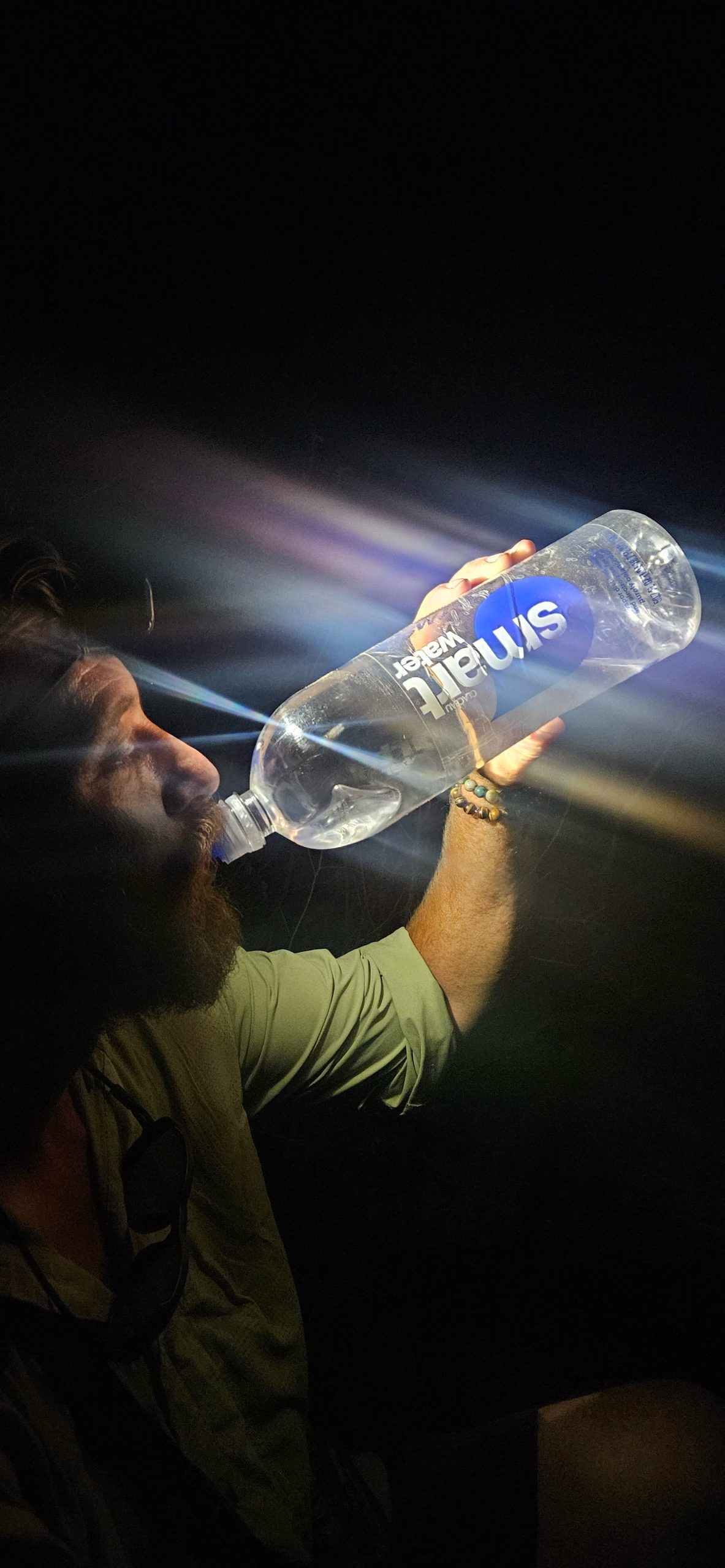
Everything changes when night falls. Humans are wired to fear the dark—Ice Age predators once stalked the gray light of prehistory. Humanoid skulls have been found with punctures that match a leopard bite. That ancestral terror still lingers, yet trails under starlight now feel mostly safe—grizzly country aside.
Night hiking isn’t for everyone. It’s slower, and if miles are your God, then the night is still the devil. Views fade, and navigation has to be more deliberate. Finding a camp is harder, too. Despite these downsides, I still love hiking after sundown.
The melancholic beauty of the dark pulls me in. The vestigial fear simmers quietly, electrifying mind and body. Glowing eyes, yellow in my headlamp’s beam, watch me as I pass—deer? Puma? Bear? I turn around to see if those eyes are creeping up behind. Strange insects and lizards crawl at my feet, bats or night birds flit across my headlamp’s beam. Distantly, or sometimes closer, I hear the call of coyotes, or even wolves.
Ice Cream isn’t a fan of night hiking. Were it not for me, she’d do her best to avoid it. But she knows I love the trail after dark, and sometimes she’ll humor me, as she did tonight.
The sun was going down as we got close to the Four Peaks. Imposing mountains, they stood like a great cathedral in the fading light. Something about their grandeur and shape reminded me of the Sagrada Familia, the world’s largest cathedral, under construction since 1882 in Barcelona, Spain. The great cathedral is scheduled to be finished soon, a terminus of sorts for the people of Barcelona, and a great achievement on a timescale of centuries. The Four Peaks, a work of nature or of God, whichever you prefer, were finished eons ago. Now they are immense mandalas, and the invisible hands of nature will wipe them away in the eons to come.
Blue hour faded, and after passing directly below the Four Peaks, we turned on our headlamps. I set mine to red light, but with semi-precarious drops to our right, Ice Cream decided white beams were better. “You know,” she said, “I strongly prefer not falling to my death.”
“I also prefer you not falling to your death,” I flipped on my high beam. I was using a Nitecore headlamp, a terrible choice for an avid night hiker. The battery doesn’t last a full night hike, even on dimmer settings, and the high beam eats the battery alive.
The moon was nearly full, but with white light on, anything beyond the headlamp was pitch black. “Let’s stop here for a bit.” I switched off my headlamp and sat on a rock. The mountain face was near vertical to our left, and to our right sprawled a massive valley filled with little hills. Once our eyes adjusted, we could see everything in the silver light of the moon. “Beautiful,” I said, flipping my headlamp back on.
“Mmm-hmm.” Ice Cream did the same, her headlamp’s beam bobbing as she nodded. “Really pretty.”
A few miles later, glowing eyes flickered ahead on the trail, yellow pinpricks in the dark. My heart skipped—deer? Javelina? But as we neared, the eyes lifted skyward and vanished, only to reappear farther up. A common poorwill—dazed by our headlamps’ alien glow—froze on the path. “Check it out,” I whispered as Ice Cream crept up behind. “A common night turkey.”
She snorted. “Ah yes, the night turkey. Gobble gobble.”
Its wings fluttered, and it was gone, swallowed by the night.
A few miles later, we cowboy camped near some manzanitas. I don’t know what it is about manzanitas, but when they dominate an area, there’s almost always a flat spot nearby.
As dawn broke, we tarried in our katabatic quilts, procrastinating against the morning chill. The eternal battle. Be bold start cold or Don’t conform, start warm.
Eventually we got up, and got moving. There was a water source in a few miles, a high-quality mountain stream, clear and cold. After filling up, we descended from the Four Peaks’ rugged 7,000-foot slopes, our trail runners gripping rocky terrain, before joining the dirt road to the Mazatzal Wilderness. A few dusty vehicles passed until a gray SUV stopped near us. A lanky, clean-shaven man with a German accent was at the wheel. “Excuse me, do you know if this road leads to Phoenix?”
I looked to Ice Cream, the better navigator between us.
“I have no idea,” she said, “We got to this road by crossing the Four Peaks from Roosevelt Lake.”
The man scratched his chin. “I really didn’t want to backtrack, but maybe I’ll have to.”
We checked our phones, but, like his, they had no service, and our FarOut maps didn’t focus on roads. Ice Cream’s paper maps weren’t much help either.
“Well, thanks anyway,” the man said. “Need water?”
We said we didn’t.
“M&M’s then?”
“Now you’re talking,” I said.
We held open an empty Ziploc, and he poured in half a large bag of M&M’s, plus some Haribo gummy bears for good measure. He wished us luck before turning around and driving back the way he came.
We munched our trail magic as we walked, the dirt road stretching flat and dusty under the midday sun. Not long after, we turned down another road, following the redline on FarOut. In the shade ahead was a red-faced hiker changing his shirt. “God damn, it’s hot,” he said. “I’m sweating like a pig.”
It wasn’t that hot, maybe in the 80s, with a breeze cutting through the open slopes. “Yeah,” I said anyway, eyeing the rocky road ahead. “Sun’s out, guns out.”
“Fuck guns. I’m getting out my entire chest. Damn, I should’ve hiked this before gaining thirty pounds!” His shirt was open to the last button, and he popped open a sun umbrella—either Zpacks or Six Moons. “I don’t know how you’re hiking without an umbrella. Sun’s fuckin’ brutal.”
Shirt changed and umbrella up, he walked beside us. Any hiker knows how this goes—sometimes you just end up chatting because you’re at the same spot on the trail, moving at similar speeds.
His name was Rooster, a hiker of yore. He’d hiked the PCT, part of the CDT, and sectioned the AT over a decade ago. In his glory days, he’d cruised through the PCT, splitting from his tramily and girlfriend, crushing insane miles—back-to-back 30-mile days, sometimes hitting the 40s.
“I just wanted to see what I was capable of,” he said. “I’d wake at 4 a.m., hike until the sun came up, put my headlamp around my neck until dark, then put it back on my head and keep going.”
“What about eating?” I asked, tossing a handful of M&M’s into my mouth.
“Mostly cold-soaked ramen. I kept a jar in my pack’s side pocket. I mostly only stopped for water. Once, I went 30 miles before a break.”
“Dang,” Ice Cream said, channeling her inner Joe Dirt.
“No more, though,” Rooster said, wiping sweat from his brow with a bandana. “Those days are over. Still love it out here though, even if it’s hot as fuck. I swear my blood pressure’s through the roof.”
Uphills behind us, Rooster shared more. He wasn’t just a crusher; he’d been a dealer, too, in the drug trade—some legal, some not. He’d ridden the shift from illegal marijuana to legalization over decades. Now, legalization cramped his style. As with all things in capitalism, the market favored massive operations over mom-and-pop shops. Rooster was ready to throw in the towel and move to Mississippi, retiring on his drug money and investments.
“Sounds like a great plan,” I said. “I know a guy from Mississippi. Seems to like it well enough.”
“That’s what I want to hear,” Rooster said. “I figure it’ll be quiet and down to earth. I’ve heard great things about a little town down there.”
More hills came, and he fell behind as we climbed. It made me think of hikers I’d met who drew self-worth from being Big Mile Speedy Bois. Not the chill ones. The other ones. If you’ve been on a big trail, you know the type. When they could no longer derive their self-worth from being “better” than others, what would they do?
Rooster caught us at the next water source, a gorgeous shaded oasis around a wildlife catchment. A half-dozen hikers joined us, and we shot the breeze for an hour. Ice Cream and I left first, and soon after, as I picked my way down a rocky downhill, Rooster passed me. His old speed was apparent now that he wasn’t fighting gravity. He cruised by at an easy 3.5 mph, umbrella in one hand, trekking pole in the other.
Again, I thought of the dick-measuring in the hiking world. We all do it, and it’s healthy and fun if done in the right spirit. But, as Rooster illustrated so well, no one stays on top for long. His shift to a quieter life and a slower pace showed what matters in the long run: inner worth, not value mirrored in other’s eyes. If we don’t have that to fall back on when the time comes, we might find ourselves gray-haired and bitter rather than gray-haired and wise.

The Four Peaks.
Unless given express permission for their use, all names and trail names in my articles have been changed. Any resemblance to real people is coincidental. If you enjoy my writing, please feel free to subscribe.

This website contains affiliate links, which means The Trek may receive a percentage of any product or service you purchase using the links in the articles or advertisements. The buyer pays the same price as they would otherwise, and your purchase helps to support The Trek's ongoing goal to serve you quality backpacking advice and information. Thanks for your support!
To learn more, please visit the About This Site page.