
 ">
The Backpacking Cook System I’d Recommend to Anyone
One of the best parts of backpacking is eating. You can do it at home, but it’s so much more gratifying when you’re on trail hiking.
I have put in a lot of miles and I’ve eaten a lot of food. Some of it bad, some of it good, some of it even out of a crotch. But I like to think that I’ve perfected my backcountry kitchen setup.
Today I’m going to walk you through what I bring with me on trail in my backcountry kitchen.
All right, there you have it. I mean, this is my food bag and all the crap we’re going to use today in my backcountry kitchen. Let’s find out what my mom packed for me for lunch today.
What’s in My Backcountry Kitchen?
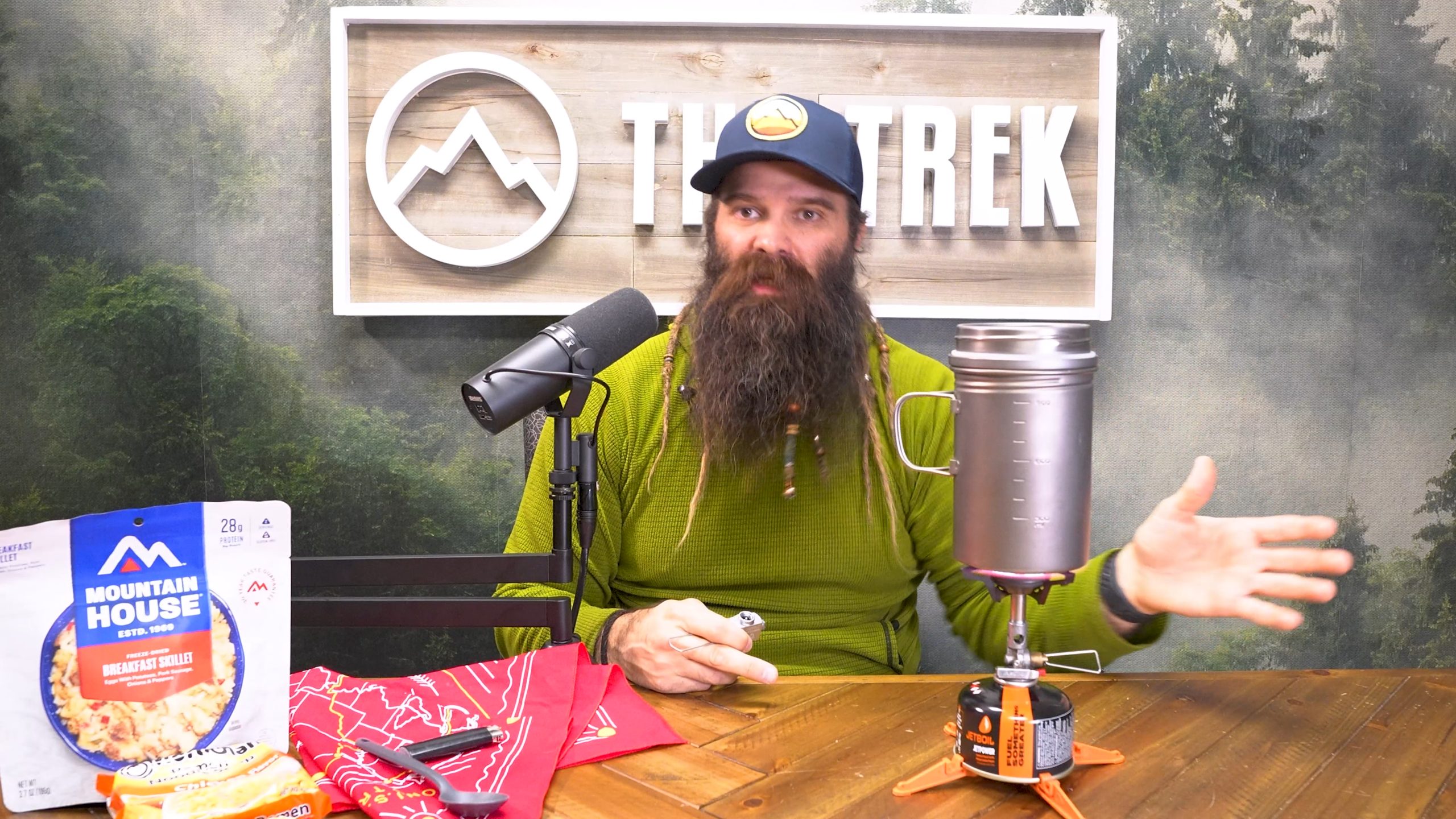
First off, most important piece, your Bot, my Bot, my VARGO BOT. It is a bottle, it is a pot. That’s why they call it the Bot.
It is the one-liter HD. It’s got handles, it’s got a lid, it screws on, it’s very versatile. I’ll talk more about it here in a minute.
We’ve got a Smartwater bottle. That’s important. We need water. We’ve got a spoon. I still can’t find my spoon. This is not the spoon that I typically hike with, but it’s going to work for today. A spoon is a spoon. You can use any spoon you want. It doesn’t matter.
I’ve got a lighter, and that’s backup for me. That’s just in case my igniting stove won’t turn on, which I will show you in a minute. I also have, for today’s purposes, a stand for our cooking.
We’ve got food. We’ve got a Mountain House, and we’ve got some ramen. I even have a fuel transfer device, which we can talk about or we don’t have to. I even have a Crotch Pot because you never know when you want to keep your food warm when you’re hiking and cold-soaking.
This is obviously my HMG food bag. I mean, we’re talking DCF. That’s Dyneema Composite Fabric. This one happens to be Hyperlite, but you can find a whole bunch out there that suits your purposes.
All right, now let’s talk about what’s inside my Bot, because there’s space in here and I don’t like wasting space. So you screw the lid off of the Bot. That’s the best part of this, unscrewable lid.
I got my bandana in here. That’s a big piece of my backcountry cook kit, actually. I got my stove in here, and this stove has seen some shit. I’ve had this for nearly a decade at this point.
Soto WindMaster Stove: My Go-To Backpacking Stove
This is, and I’m trying to unveil it for you, the Soto WindMaster. It is perfect as far as I’m concerned. I do not stray from this stove ever.
It’s so simple. It’s so easy. It’s got an igniter. The igniter still works after all these years. It’s incredible. And it has a recessed, I think it’s 11,000 BTU, burner in there. That’s the part of the WindMaster for this thing. It helps protect it from the wind. There’s a reason they call it the WindMaster.
And this one’s been around the block. It’s all bent up, it’s all beat up, it’s all worn. And I keep going back to it. I haven’t used a different stove in my kit since I got this in 2017.
And then, of course, beyond your pot, beyond your stove, it’s pretty important to have fuel. And I always choose fuel that fits inside my Bot.
All right, let’s make some lunch and I’ll walk you through everything that’s in my kit and why it’s so important.
Setting Up the Stove
All right, let’s just get it all over here. First things first, let’s grab the stand so we can conduct indoor cooking without burning the house down.
So this stand is from Jetboil, and I got it as part of another cook kit that Jetboil sent me. And while I don’t use that cook kit too frequently while I’m thru-hiking, having a stand for indoor cooking is safe. And that’s what we’re doing here today.
This little stand is perfect for the small ones or the big ones. You can see there’s a little slot cut out here for a bigger one. That takes both.
Next, we’re gonna put the stove on top. You’re gonna screw it on. And if you’ve never done this before, first of all, make sure it’s full, righty-tighty, all the way off. You don’t want it to just be leaking fuel on you right away.
So, and it’s always gonna do a little, like, burst as you’re screwing it on. So you screw it on, you’ll hear the little shh coming, coming, there you go. You screw it until you don’t hear that anymore.
All right. Okay, so like I said, this is the WindMaster made by Soto. And this is 67 grams, or 2.4 ounces. If you’re a gram weenie, those 67 grams, it’s pretty light, you know? There’s not too many stoves lighter than this one, especially with the BTUs that this puts out.
That’s why I keep coming back to it. I love it so much.
But I’m using this particular very lightweight stand for my more narrow pot. I have a narrow pot here. If you happen to be using a wider pot, if you actually like doing more actual cooking and you have a wider pot, they do make a much more stable four-prong stand for larger pots. And I never use this.
Vargo Bot HD 1-Liter: My Favorite Backpacking Pot
All right, now let’s grab my Bot.
This right here is the Vargo Bot HD one-liter. It’s made of pure titanium. This pot is gonna run you 153 grams, or 5.4 ounces. I have been using this pot since this came out, which was a long time ago. And I’ve been hiking for about 14 years now.
So it’s my go-to. It’s the one I love using the most. It’s the one that’s the most versatile. You won’t find another one like it out there.
The defining feature of this pot is the patented screw-on lid. It makes it so versatile in so many ways.
The reason it’s called the Bot is because it’s a bottle or a pot. So what does that mean for you?
It means you can cold-soak in it. It means you can use it for a water-carrying vessel if you have longer water carries. It means you can store food in it for longer if you don’t wanna finish the meal you made inside of it. It means you can pack food out from town in it.
Sometimes I put, like, a hoagie, or sometimes I go to Whole Foods and pack salad bar stuff in here and pack it out from town. It just gives you a lot of functionality and a lot of options while still allowing you to flip it around and have a nesting pot lid for when you’re cooking.
You do not wanna screw this on while you’re cooking. That’s the whole point of the reversible pot lid. Otherwise, you’re gonna make yourself a bottle-pot bomb.
Oh, by the way, we have graduations on here. 900 milliliters, I think we got 600 milliliters, 300 milliliters, so that when you’re reading what’s on the back of your food or just whatever, to give you some reference points, you don’t mess it up.
Cooking Ramen With My Backpacking Kitchen Setup
All right, let’s get some water in here and let’s start cooking up some lunch. Gotta pour in some water here, huh?
All right, so I carry a Smartwater bottle typically. There’s a lot of reasons why you might and a lot of reasons why you might not, and we’re not gonna get into all those reasons right now, but I just stick with the Smartwater bottles for now.
This one happens to not be a full liter. It is a, I think, 750 milliliter if I’m not mistaken, and we’re gonna make ramen today. So I’m just gonna go with all of that.
Oh, I lied. It’s not 750, it’s 591. So that’s 20 fluid ounces. I’m an idiot.
These are the kinds of bottles you put right here if you want. I just brought this so it was the exact amount of water that I wanna use today.
Okay, so all right, we got our water poured. Now let’s light our stove. The fun part, the fireworks.
Open it up, not all the way, till you hear the sound. There it is. Light it. There you go. You don’t gotta open these things up all the way, at least right away.
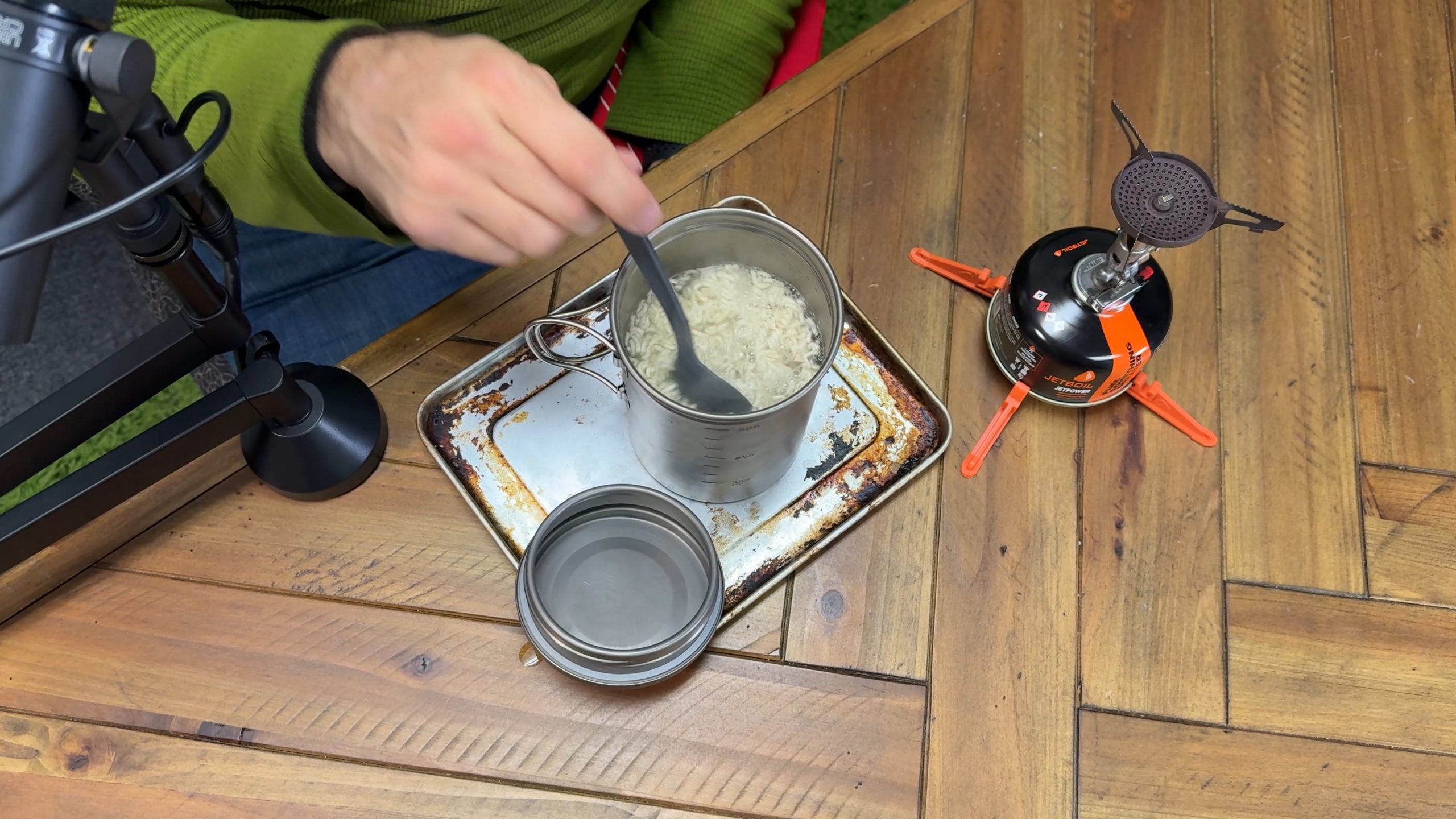
All right, put that on there, okay? And put the lid on. That’s how you keep your fuel efficient. So you trap the air in and you get it nice and hot and you boil it, and you’re saving fuel.
Why I Always Carry a Backup Lighter
Now let’s start with this ignition system. You know, a big part of the problem with a lot of stoves like this is the ignition systems fail. This particular one has been so reliable for me. I’ve literally never had it not work in almost 10 years.
But that doesn’t absolve me from being ready for if and when it does. I always bring a lighter, whether it’s a mini Bic or the full-size Bic. I always bring a lighter for multiple reasons.
One, in case that fails, you need it. Two, in case I need to start a fire, and I know that’s a whole other conversation. We won’t talk about how we should or shouldn’t have fires out there in the backcountry.
Sometimes in emergency situations, you might need to make one. And the other beautiful nature of a pot like this one is you can actually cook on open flame with this. So my whole system has multiple functionality within it, depending on the circumstances and situations.
Fuel Transfer Valves: Getting Free Fuel on Trail
All right, while that’s boiling, let’s quickly talk about the fuel transfer valve here.
If you don’t use one of these, maybe it’s because you don’t know about them yet. But the best part about using one of these is you can get free fuel on trail.
And I would preface this by saying that the best way to utilize this and justify the weight for this is if you’re on more populated trails. The Appalachian Trail, the Pacific Crest Trail, even the Continental Divide Trail, the Colorado Trail, the JMT, the Arizona Trail. Trails that are populated with hikers who are maybe ditching their fuel in town, and maybe those fuel cans have half or a third fuel left in them, and you can capitalize on it by getting their free fuel.
So yeah, this one is made by a company called FlipFuel, and this one weighs four ounces. I know some people are gonna find that hard to justify, but if you stack that up over hundreds or thousands of miles, free fuel might be worth its weight in gold here in just a measly little four ounces. And it’s such a small form factor too, and it will fit inside your cook kit easily.
Why a Bandana Is Essential to My Backcountry Kitchen
Oh, we got some steam coming through. She’s starting to shimmy and shake a little bit.
Now, I’m gonna show you why I bring a bandana.
While this has handles, that’s nice, this heat travels right up. It’ll super-cook that. We don’t wanna burn our little thingies on that. That ruins your day on trail.
So let’s turn this off. Whoa, not off, off.
All right. This bandana is a lifesaver in a lot of ways. It has a lot of uses, but I don’t wanna burn my fingers, man. I use my hands all day on trail.
Preparing the Ramen
Okay, so we’re gonna prepare our ramen.
I like to do a crack that way and a crack this way into quarters, break it into quarters in there. If you wanna crunch it a little more, you can. You wanna do that ASMR crunch. Jess is off-screen loving any bit of ASMR here.
All right, so crunch it up. Make sure you don’t break the bag too bad where all the ramen comes spilling out, all right?
So what I like to do, I pull that off. Oh, look at all that. And I pour these in.
All right, you see all that goodness in there? Stir it up, gotta stir it up. Little darling, stir it up.
Make sure it all gets down in there and soaked and coated. And I like to use as much water as possible because that’s more broth for the belly. You know, to, like, trick myself into thinking I ate more or something.
Because frankly, you know, this is roughly 370 calories. Sometimes I add stuff to this, tuna or whatever. Sometimes I’ll do this same method with, like, instant rice too.
And just the more water, the better as far as I’m concerned. And you pour that in there, you know. And instead of, like, continually cooking this on the stove, wasting fuel, you just put the lid back on and you just, like, hang out at camp, you know.
Talk with your buddies or, I don’t know, do other chores while that’s steeping or whatever.
And like I said, I’ll add some sort of protein to this. Maybe, you know, if it’s rice, I’ll add cheese to it. Even various oils. If it’s instant rice, I’ll add, like, either coconut oil or olive oil, something that helps bring more calories or something that makes it fattier, or even, like, hot sauce to make it tastier.
And if it is rice, I’ll put it all in a nice tortilla to really up the caloric content.
More Uses for a Bandana
But while that is steeping, let me talk to you about the bandana situation.
If you don’t hike with a bandana, that’s fine. That’s okay. You know, I get it. You don’t feel you need it, but this is a pot gripper. This is a napkin. This is a washcloth. And it has uses outside of backcountry kitchens.
You can use this for, like, a bandana, literally, like on your head if you really want to.
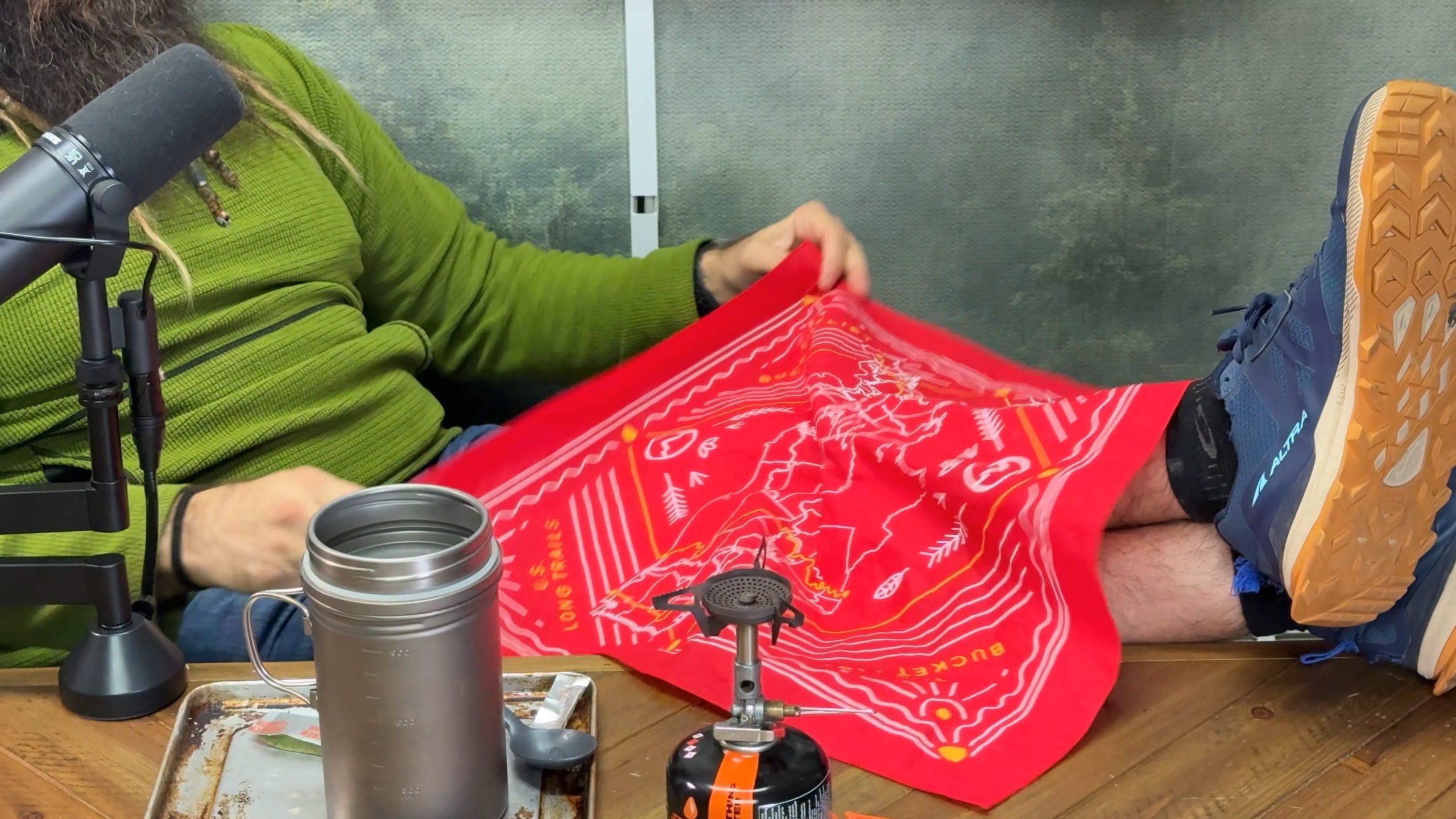
And one of my favorite uses of a bandana, see how I’m wearing shorts? I like to hike in shorts. And at night, the bugs like to come out and bite me while I’m eating dinner. So I like to throw my bandana over the skin of my legs to keep the bugs from me, to keep me warm, and to keep the pot from burning my legs.
This is living.
Cold-Soaking Backpacking Meals to Save Fuel
All right, while this is still steeping, let’s be efficient with our time, like we’re being efficient with our fuel.
Cold-soaking doesn’t take any fuel at all. And I don’t cook breakfast, I don’t cook lunch, unless I’m really famished and I have, like, extra food or something like that.
When it comes to lunch, sometimes I just, I want a ramen, but I don’t want to cook a ramen because I didn’t necessarily budget the fuel to have lunch cooking.
So what I’ll do is I’ll throw my ramen in my pot. I’ll throw not a lot of water in the pot. I’ll throw enough water in the pot that it will still reconstitute the noodles, but not be so much that I’m, like, carrying extra water on my back because maybe I’m hiking for, like, an hour or so or more, depending on how rapidly I want to eat it.
Using the Vargo Bot for Dry Camping
If you’re dry camping, the best part about the Vargo bottle-pot is you can put the water that you’re going to boil in this pot before you actually get to camp.
So put as much water as you want in there. I like to fill it up all the way because some of it I’ll pour into a bottle, filter and drink, and then leave whatever I need for cooking.
But that is a very efficient way to make sure you can dry camp without having to sacrifice just your drinkable water for your cooking needs.
Cold-Soaking Instant Potatoes
So another thing I eat for lunch sometimes is instant potatoes. And I’ll eat those cold even.
Now, you don’t have to cold-soak instant potatoes, but they have high caloric content. It’s about 420 calories, if I’m not mistaken, for one packet of Idahoan instant potatoes.
But you can just dump the instant potatoes in the pot and just pour water while you’re mixing over top of it. Before you know it, boom, cold instant potatoes.
Is it delicious to eat cold instant potatoes? No. But at that point in time, if I’m trying to do 20, 30-plus miles a day, time is of the essence, but I want to get something really filling in me, and potatoes can be really filling.
So I will cold-make potatoes. I sometimes will add tuna with that. I sometimes will add extra seasonings or hot sauce within that. But that could be a nice lunch for me. I’m not saying that’ll be a nice lunch for you, but that could be a nice lunch for me.
Why I Avoid Cooking Food Directly in My Pot
One nice thing about cooking or cold-soaking with using a pot like this is that it makes cleanup pretty easy if you’re not doing the actual physical cooking within it, where you have the pot on the stove while you’re stirring it and sometimes you burn it to the bottom, and cleaning gets really difficult at that point in the backcountry and your pot just gets really mucked up and gross.
So part of the reason I do things the way I do is to keep my pot looking, smelling, being fresh every time I go to use it. It makes the pot last much longer.
And a part of what I love about the way I use and utilize my gear and take care of my gear is I try and think about using my gear for as long as possible. I think it’s very beneficial for people to use their gear as long as they can to prevent us from wasting resources that this planet generously gives to us.
Backpacking Utensils: You Don’t Need an Expensive Spoon
All right, let’s talk about utensils.
This is a standard plastic spoon. This is not the spoon that I hike with. I am in an all-out war with my garage right now, and I can’t find my spoons anywhere. My long-handle Vargo spoon or my folding Vargo spork. Those are my two go-tos.
If I can’t find my Vargo long-handle spoon, I use my Vargo folding spork, and they are nowhere to be found. But luckily, I have all kinds of other utensils, and here’s the real deal.
If you can’t find your favorite spoon, spork, whatever, and you lose it on trail or whatever, it’s not the end of the world. Like, in town, you can find silverware. They exist. I mean, your motel probably has one floating around somewhere, whether it’s plastic or metal.
We’re not stealing, we’re borrowing.
But truly, any utensil can work. So you don’t have to go spending your money on, like, titanium spoons and sporks and forks and all that kind of stuff. You can literally just use a spoon from your kitchen if you want to.
My Favorite Ways to Eat Ramen on Trail
All right, I just hiked 25 miles. I’m ready to shove food into my mouth.
The only thing that matters all day every day is eating, especially at the end of the day. I am always famished.
So let’s dig in. And I’m actually starving because I haven’t eaten a thing yet today in preparation for my delicious ramen meal.
Oh, it tastes like I’m on trail. Oh, I love it. ASMR.
I’m a very verbal eater. And part, if I didn’t already mention, about carrying a bandana is having a napkin for this giant hairy face of mine. It’s a must. I don’t need bugs flocking to my face from the food that I’m eating. Gotta wipe that stuff off.
People have been thru-hiking with ramen for probably centuries at this point. Ramen is a choice amongst thru-hikers. There are multiple ways that I will gussy up some ramen.
Double Ramen
And one of those ways is I’ll double up my ramen in my one-liter bottle-pot.
I will shove two packs of ramen into my one-liter pot, and I will let that reconstitute to the point where it’s brimming out of my Bot like spring-loaded snakes in a can.
And that’s what I’ll do if I’m starving.
The Ramen Bomb
Another thing I’ll do when I’m starving, if you haven’t heard of it, it’s called the ramen bomb, all right?
And people do their ramen bombs a little bit different. But the whole thing is you do a ramen and you do an instant potato together. And then I like to add a packet of tuna or a packet of Spam or some kind of meat I’ll add in there.
And that gets extremely filling. That’s like if I did a 30-plus-mile day and I didn’t eat for a while leading up to dinner. That’s how I’ll do my ramens.
They’re super cheap. They’re super light. They’re not super packable. They take up space. But, like, honestly, I’ll take the lightness. I’ll take the cost.
How I Clean My Backpacking Pot on Trail
All right, let’s talk about cleanup.
You’ve eaten, you’re tired, it’s dark. You wanna be in your tent. Maybe you’re already in your tent, I don’t know. Maybe you’re already in your sleeping bag. Maybe you’re already asleep.
One of the beautiful things about the Vargo pot is if you’re too tired to wanna clean up, you can just seal that sucker up and deal with it tomorrow in the daylight.
But if you’re gonna clean up that night, this is what I like to do.
I like to pour a little bit of water in. And if you’re camped at a water source, it makes this a lot easier. You can just go down to the water source, fill your pot up, walk away from the water source, wipe your hand in there or your bandana, if that’s what you like using to scrub it clean.
I don’t do that a ton unless it’s absolutely dire. I like to keep my bandana as fresh and clean as possible for all the multiple uses that I use it for.
But what I like to do is put some water in there, and I use the spoon. I use this little, the bottom part, and I’ll rub it all along where all the stuck pieces of the food are. I’ll scrape it, I’ll scrape it, I’ll scrape it.
And then you dump it away from camp. You dump it away from the water source. So you don’t wanna contaminate things. You don’t wanna bring critters around.
And you wanna—frankly, here’s what I really do. I actually end up drinking it.
I know that sounds disgusting, but I especially do that when I’m dry camping because water’s precious, especially in arid climates, especially in the desert, when every ounce you carry matters to you, matters to your body.
You wanna rehydrate. You don’t wanna carry stuff you don’t need.
So I will scrape it, scrape it, scrape it, and then I will drink it because also there’s probably calories in there too.
And then when you get to town, if there’s still disgusting pieces of your pot in town, you clean that shit real good when you get to town.
There are times where I will carry, say, like a little thing of Dr. Bronner’s. If I need to, maybe I’ll do that. But honestly, I’ve got it dialed into the point where it’s very rare that my pot requires significant cleaning.
And titanium is antimicrobial by nature. So if you just wipe it pretty good and rinse it real good, you’re good to go.
How to Prevent Rust Stains Inside Your Pot
Another thing when it comes to cleanup that we wanna mention, all right, your fuel can, especially when you’re putting it on the ground, it condenses, it gets frozen, frosty, and dirt sticks to it and it has water all over it.
And this aluminum ring will make your pot look rusty and disgusting. Your titanium is not what’s rusting. It is this, it is your fuel can that is rusting.
So a huge piece of why I carry a bandana is I wrap my fuel can with my bandana and shove it in there, and it prevents all that rust from ever happening.
And I will show you right now what that looks like if you’ve never had that happen. This is what happens.
It is a monstrous pet peeve of mine. I loathe it, I detest it, because I don’t wanna be cooking food in with rust. Who wants that? I don’t wanna taste iron while I’m making food.
Ruins my dinner, ruins my day, ruins my night.
So we don’t want the rust, do we? Nope. So we use bandanas, people. We use bandanas.
And you can get yours at The Trek for $5.99. I have no idea what it costs.
Finding the Right Backcountry Kitchen Setup for You
All right, listen.
This is how years of backpacking have condensed into my cook kit and how I go about things.
We’re all different. We all want different things. Some of you literally wanna cook in the backcountry. Like maybe you actually like cooking salmon in the backcountry, I don’t know. I’ve seen people do it. It’s insane, but we all have different tastes. We all have different needs.
I am very rudimentary. I am very functional. I am very just, like, calories over content in a lot of ways. So I’m not looking to have culinary delicacies. I’m looking for cheap, I’m looking for quick, I’m looking for easy, and that’s what suits me on trail.
It might not suit you, and it might take you years to discover what your backcountry kit is. I never really looked to anyone else to discover what mine was, but I hope that what we did here today can help you form what you think you wanna do with your backcountry kit.
All right, so hasta la pasta. Get out there, figure out what your backcountry kit looks like.
Why don’t you write to us, comment, like, subscribe, and we’ll figure it out for next time, people.
I’m Jabba, the Real Hiking Viking. Thanks for tuning in. We’ll see you next time.

This website contains affiliate links, which means The Trek may receive a percentage of any product or service you purchase using the links in the articles or advertisements. The buyer pays the same price as they would otherwise, and your purchase helps to support The Trek's ongoing goal to serve you quality backpacking advice and information. Thanks for your support!
To learn more, please visit the About This Site page.

Comments 1
Somebody’s been watching a little Airplane movie. “She’s starting to shimmy. She’s starting to shake.”. 🤔