
 ">


The Perfect Smartwater Bottle Replacement for Thru-Hikers
I have been trying for some time to find the perfect, reusable Smartwater bottle replacement. Maybe you read my article here, where I ranked all the bottles on the market at the time against each other to find my perfect fit. I judged the bottles against three criteria: weight, material, and water filtering ability. By the end of the process, I’d found a few options that were pretty good, but nothing that I thought could truly replace the functionality of a Smartwater bottle.
Until today.
I’ll go ahead and spoil this one in advance: the brand new Cnoc ThruBottle is the perfect Smartwater bottle replacement — at a wonderfully affordable price. Let’s all celebrate this one together; it’s been quite the journey.

Cnoc ThruBottle At-a-Glance
Price: $12.99 (compared to $2.89 for a Smartwater 1L bottle or $2.19 for a 750mL Smartwater bottle with a sport cap)
Volume: 1 L / 32 oz
Weight: 3.18 oz / 90 g (compared to 1.2 oz for a Smartwater 1L bottle)
Material: BPA-, BPS-, and BPF-free High Density Polyethylene (HDPE)
Dimensions: 12 x 2.9 x 2.9 in (functionally identical to a Smartwater 1L bottle)
Bottle Threading: 28 mm (compatible with Sawyer Squeeze, Mini, or Micro, the LifeStraw Flex, and the HydroBlu VersaFlow water filters)
Why Does Water Bottle Material Matter?
Although popular among long-distance hikers due to their ideal size and rigidity, standard PET1 plastic Smartwater bottles pose an active health concern. Because PET1 is designated for single use, the common practice of reusing these bottles daily throughout a hike accelerates the shedding of both microplastics and nanoplastics into the water within.
The actual long-term health impact of consuming microplastics remains scientifically inconclusive. While current laboratory studies and emerging human data suggest potential adverse effects — including links to chronic inflammation, autoimmune issues, and endocrine disruption —definitive conclusions are not yet available. Nevertheless, minimizing exposure seems to be a pretty safe call where we have control.
Cnoc ThruBottle Material
The Cnoc ThruBottle is made from BPA-, BPS-, and BPF-free High-Density Polyethlene (HDPE). Let’s break down what this means to understand what makes this material the nearly perfect, low-risk material choice for a thru-hiking bottle.

A bottle on a thru-hike will be exposed to three of the largest contributors to microplastic shedding: UV rays, mechanical stress, and heat.
Are HDPE Water Bottles Safe?
The safety of HDPE in a water bottle starts from the material’s molecular structure. HDPE is formed from long, tightly-packed chains of ethylene molecules. This molecular arrangement creates a high ratio of strength to density, which is also great news for ultralight nerds (me) who are unwilling to carry a dense, heavy bottle.
This dense, linear structure is what makes the material remarkably inert. The molecules are so tightly bound that the material does not easily react with water or other common chemicals. Importantly, this means the HDPE bottle does not readily leach additives or shed molecular material into the water inside the bottle, at least not to the extent that single-use plastics do. The polymer is naturally opaque, which reduces UV light exposure on the bottle and helps prevent shedding caused by sunlight.
The ethylene chains also give HDPE a lot of durability and resilience, so the bottle is able to resist the physical force we place on it while filtering water. Reduction of mechanical stress is another big win for the bottle, since microplastic shedding has also been linked to physical abrasion (like repeated squeezing).
Also, it’s recyclable!
Circumstances of Review
To really put my money where my mouth is, I took two ThruBottles on Vermont’s Long Trail to see exactly how well they would hold up on a thru-hike. Over the course of the two weeks, I filtered from one bottle to the other 71 times. Yes, I counted.

Both bottles fit well in the side pocket of my pack.
For this trail, I carried the bottles along with the rest of my standard gear. With my system and setup, I need two one-liter bottles, and I need them to both fit in one side of my backpack. In terms of what I expect from a water bottle, I’m not too picky. I just need them to be self-supporting, totally leak-free, squeezable enough to filter water, and lightweight.
Cnoc ThruBottle Features
I think we can all agree that we don’t actually need or want many extra features on a water bottle. Cnoc delivers on this, providing a minimalist, lightweight bottle with a handful of intentional and well-designed inclusions.
The side of the bottle includes built-in ounce and milliliter lines, which come in handy, particularly when cooking dinner. The cap is tethered to the bottle, making it hard to lose but easy enough to take off and replace with a sport cap if you want. A small nylon cord was added to the bottle to make it easy to pull from your pack and carry to a water source.
Other than that, Cnoc has chosen to save as much weight as possible in the lightweight and slim-profile bottle.
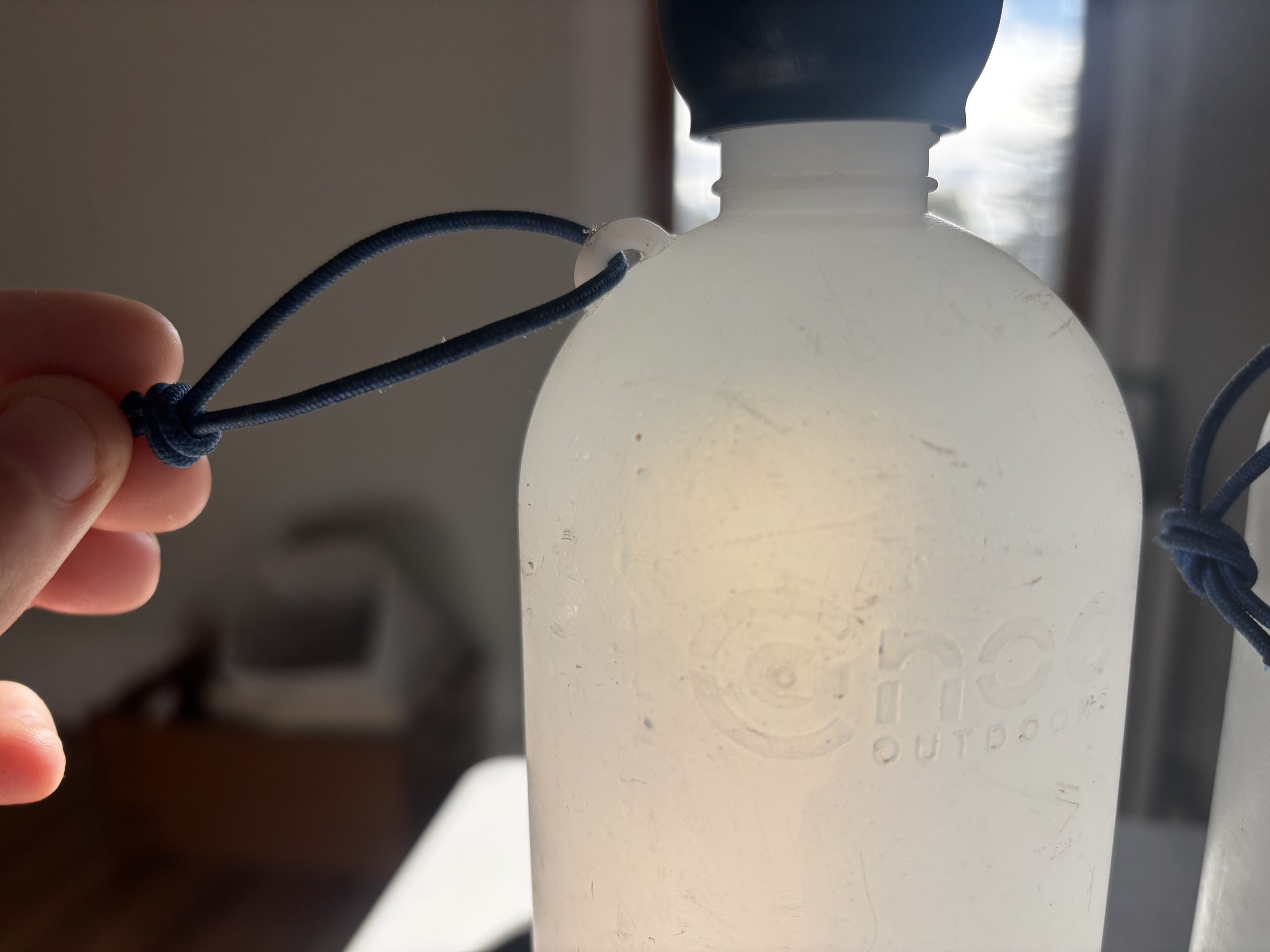
A look at the nylon cord. If you didn’t like it, it would be easy to cut off.
Usability
When I talk about the usability of a water bottle, I’m referring to drinkability and filterability. Those aren’t words, but you know what I mean.
In terms of drinkability, I have very little to say; it’s a normal water bottle! I appreciate the rigidity of the bottle as compared to the Vessica bottle. I can hold and drink from the bottle normally without having to balance it on my arm or use my other hand to support it.
Mainly because I’m a creature of habit, I did end up replacing the standard cap with a Smartwater bottle sports cap. The original cap is small enough that I could drink from it without any water spilling on myself or having to stop walking to avoid splashing.

I have NO idea why I’m making this face, but the mouth of the bottle is small enough to prevent splashback.
The HDPE is more rigid than a Smartwater bottle, so the only learning curve came in the filtering of water. It took just a bit more effort to squeeze the bottle hard enough to get flow through my filter, and it took about 15 filters before the plastic softened up slightly. Even by the end of the trail, filtering took a little more effort, but squeezing from the same spot did a lot in terms of making the process smoother over time.
I can filter 1L of water from a Smartwater bottle in about 10 squeezes; by the end of the trail I could filter the same amount from the ThruBottle in around 13 squeezes. Slightly harder, but not the end of the world.
Durability
By the end of the hike, the bottles looked practically brand new. They have a little dirt on the outside and a few superficial scratches visually exacerbated by the dirt, but they cleaned up great. Both bottles are slightly dented in the area where I squeezed them the most, but I look at this as a good thing. The slight indentation actually made the filtering process easier and is not enough to affect their balance or performance.
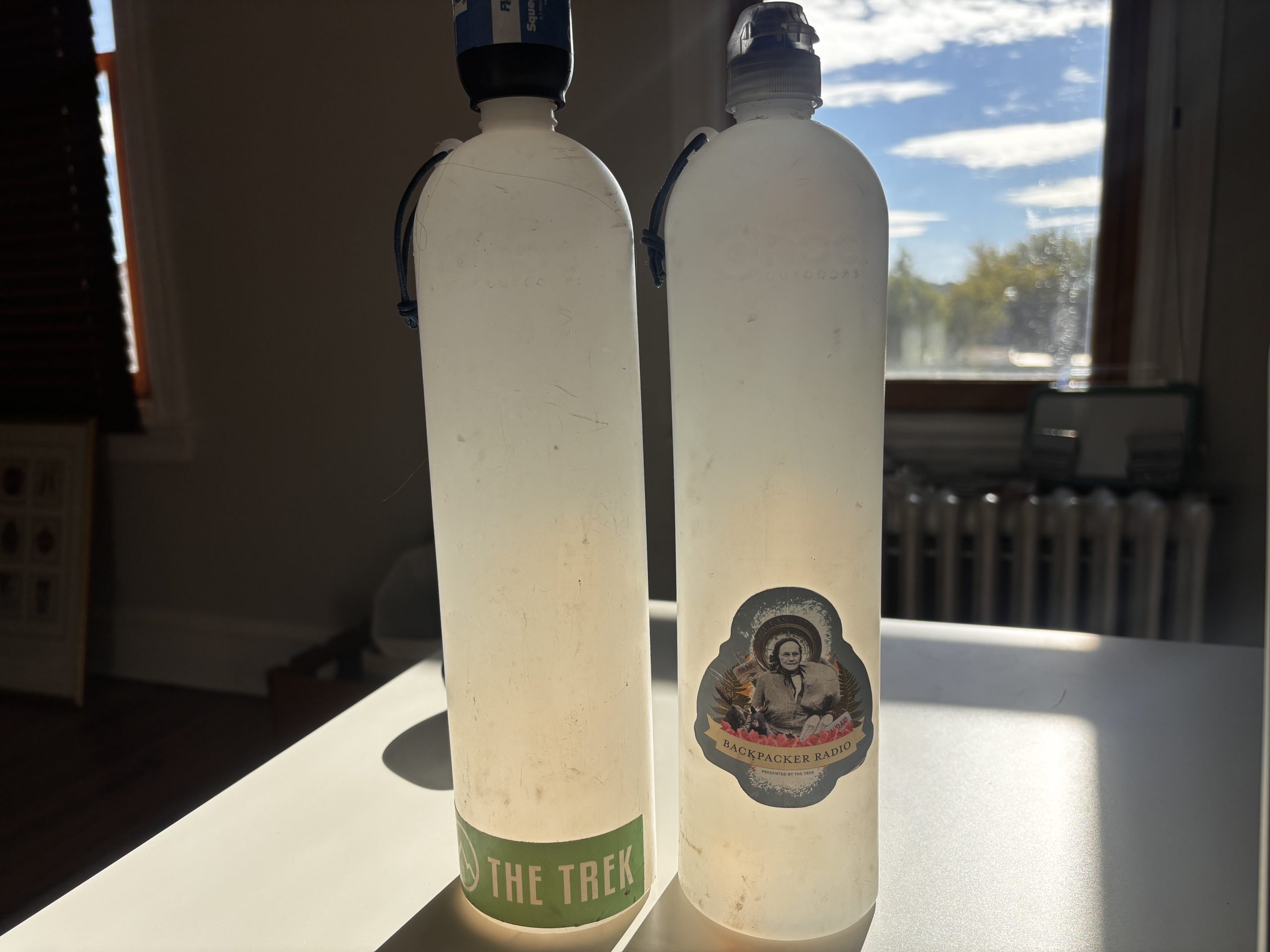
The bottles after 17 days of hiking.
Flavor Retention
I don’t know about you, but I hate adding drink flavoring to a single liter of water and still getting whispers of that flavor hundreds of miles later. Each day for the first week, I added Skittles Powder to my last liter of water for the day (I don’t drink electrolytes, but I love sugar and food dye). For the second week, I reverted back to plain water.
The Skittles flavor didn’t linger at all, despite being ridiculously concentrated and intense. Once again, this is a big win over a Smartwater bottle. While single-use plastics like PET1 are somewhat porous and allow tiny flavor molecules to seep below the surface, HDPE has a tightly bound structure, giving the material low permeability. There are very few microscopic channels for the highly concentrated, intense flavor oils and dyes to penetrate and become trapped within the plastic’s matrix.
Cnoc ThruBottle Pros
Better Material: No plastic container is 100% immune to micro- and nanoplastic shedding. Still, the ThruBottle’s use of BPA-, BPS-, and BPF-free HDPE — a highly inert and stable polymer — minimizes the shedding inherent to repeated use of PET1 plastic in a Smartwater bottle. This is the single biggest win for the hiker’s long-term health.
Zero Flavor Retention: Due to HDPE’s tightly bound molecular structure and low permeability, the bottle remains entirely flavor-neutral. Concentrated additives (like my absurdly intense Skittles powder) rinse out completely, offering an advantage over porous single-use plastics that ghost flavors for hundreds of miles.
Identical Logistics: It retains all the functional attributes of the original: the 28 mm threading ensures compatibility with the most popular filtration systems (Sawyer, Platypus Quickdraw); the dimensions are nearly identical for easy packing; and the integrated volume markers are invaluable for cooking and tracking intake.
High Durability with Benefits: The HDPE is resilient; after 71 filters and weeks of abuse, the bottles were virtually pristine. The slight denting observed in the high-pressure squeezing area is actually a pro, as it makes subsequent filtering easier without compromising the bottle’s balance or stability.

I never had any leakage around where the filter screws into the bottle.
Cnoc ThruBottle Cons
Increased Filtering Effort (Initially): The HDPE is more rigid than PET1, requiring slightly more physical effort to squeeze water through the filter. This minor resistance softens up after about 15 uses, but it remains a noticeable difference from the easily compressible Smartwater bottle.
Limited Filter Compatibility & Use Cases: The line is currently limited to one thread size (28mm), meaning hikers using popular filters like Katadyn are left out.
Furthermore, due to the nature of the plastic, the bottle should not be used often with prolonged exposure to hot water, limiting its function as an emergency hot water bottle for cold-weather hikers. To be fair, though, no one is out there pouring boiling water in a Smartwater bottle either (or, at least, you should not be!).
Sticker Placement: The plastic dents in high-pressure areas, so stickers tend to peel or wrinkle in the center. This is such a minor gripe in the grand scheme of things, but I had to toss one of my favorite stickers because it half-peeled off the center of the bottle and lost all adhesiveness. If you’re a water bottle decorator, concentrate your stickers at the top or bottom of the bottles.

The bottle is rigid enough that I cannot filter basically at all with one hand, which I can do a little bit with a Smartwater bottles.
Would I Recommend The Cnoc ThruBottle?
Wholeheartedly, yes.
The few minor compromises — a slightly stiffer squeeze and the limitation to the 28mm thread — are insignificant when weighed against the overwhelming advantages. This bottle solves the biggest issues I’ve had with my Smartwater bottles (the single-use plastic and microplastic shed) while retaining all the best features for thru-hikers.
By building a bottle that is functionally equivalent to a Smartwater (in terms of weight, shape, and filter threading) with HDPE material that resists shedding, Cnoc has delivered a product that makes the choice effortless. Unless you are attached to a water filter that is not compatible with the current 28mm release, I truly do not see a single reason to continue using single-use plastics on the trail.
The negligible extra cost is a wise investment in your long-term health, and the bottle’s high durability ensures it will last for multiple thru-hikes, making it a definitive yes from me. You can finally stop using that disposable bottle now!

Comparable Items
HydraPak Flux
Price: $27
Weight: 3.4 oz
Threading Compatibility: 42mm (compatible with Katadyn filters)
Mazama Designs M!go Bottle
Price: $18.95
Weight: 4.7 oz
Threading Compatibility: 28mm (but with a screw-off to a wide mouth)
The Cnoc ThruBottle was donated for the purpose of review.

This website contains affiliate links, which means The Trek may receive a percentage of any product or service you purchase using the links in the articles or advertisements. The buyer pays the same price as they would otherwise, and your purchase helps to support The Trek's ongoing goal to serve you quality backpacking advice and information. Thanks for your support!
To learn more, please visit the About This Site page.

Comments 6
Been eager to hear about this one!!
2oz penalty for longterm internal organ piece of mind, and little less gross residue harboring- I’m in. and i still use the sawyer squeeze bag to scoop and filter/fill personally so not concerned about that part. thanks for review. lighter than the migo too, wow.
Hurray! All our water bottle dreams have come true. This will legit save lives because of the reduced exposure to chemicals leaching from UV-degraded PET.
I’m sold!
One bad anecdote: Perhaps a bad batch or user error, but I could not get the sports cap to fit on the Thru Bottle.
That’s so interesting! Which brand sport cap did you use? I never considered that maybe there are slight variations between brands (maybe LifeWater vs. Smart Water vs. something else?).
I had success with a sport cap from a Smart Water 750mL bottle; curious if the mouthpiece rings are inconsistent between batches.