
 ">

The PNT Brought a Stiletto Knife to a Fistfight
And then it got me to punch myself in the face. The Pacific Northwest Trail fights dirty, is what I’m saying. I am, however, willing to forgive and forget, for one simple reason: you need to see the PNT. Not just in an “OMG it’s awesome” sense, but also because I’m concerned about its future.
My first two National Scenic Trails (NSTs) left me with impossibly high expectations. The PCT and AZT are well maintained, and they set the standard for my subsequent thru-hikes. I now realize that these NSTs are probably the exception rather than the rule. The CDT is more rugged and less traveled, for sure, but as one of the big three, it’s already achieved critical mass. Its popularity, funding, and maintenance create a positive feedback loop that all but guarantee its survival. I’m less certain about the PNT. While the other trails need some attention in some places, the PNT needs a lot of TLC, ASAP. It’s one of the newest NSTs, and unlike the CDT, there’s no “PNT Completion Act”.
Having read most of the PNT Association‘s website before starting my thru-hike, I was expecting a bare-knuckle fight from start to finish. While I wasn’t entirely wrong, several rounds left me scraped, battered, and bruised. Some hikers I spoke to during my prologue in Glacier National Park were aware of the PNT’s existence, and worryingly, they all said the same thing. “It’s a bushwhack, right?”
I met only one eastbound thru-hiker and two westbound (WEBO). Our paths crossed once, and never again. I have a few suggestions for improving the PNT’s reputation and increasing its popularity.
Don’t worry about the weather
The climate of the Pacific Northwest is damp, to say the least, but the showers I experienced were typically short-lived, and I usually had plenty of time to dry out. There was only one day I’d describe as a supremely soggy super-soaker.
As I hiked west, things improved. During the first half of the trail, there was a 33% chance of rain in any given day. For the second half of the trail, that probability was 6%.
Finally, here’s a bonus WEBO advantage: storms that blow in from the Pacific move east, so you’ll spend less time under the weather than EABOs.
Let’s whack some bush!
As a WEBO, I had to wait 245 miles for a bushwhack. I’d already encountered plenty of overgrown trail and abandoned dirt road, but this was to be my first official bushwhack. It was actually pretty straightforward: half a mile with no trail, through old growth forest that was dark enough to prevent dense brush from thriving. I simply followed my shadow, clambering over fallen, sometimes rotten trees, and trampling enough thimbleberry shrubs to leave me with a guilty conscience. So many squashed berries. So much of their blood on my hands. And arms and legs.
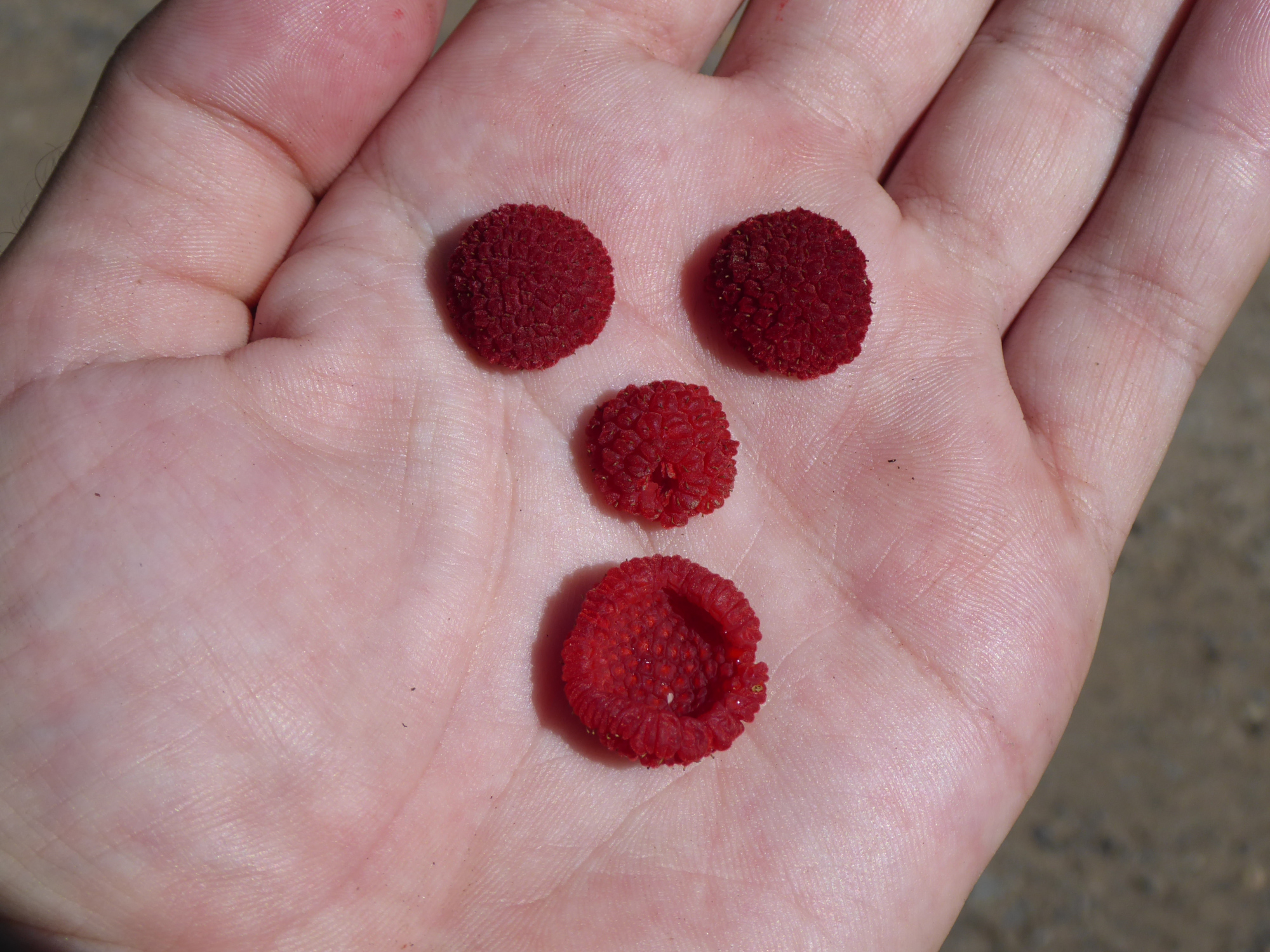
Mr. Thimble just realized what’s about to happen.
What I didn’t know at the time was that this intro to bushwhackery was a ploy. The PNT was just lowering its guard to draw me in closer. It patiently waited just a little while longer before attempting to land a knockout blow.
Two days later, I reached Ball Lakes, and the beginning of a much longer gap in the PNT. For the next six miles, the FarOut redline gets a bit fuzzy, and the comments get a bit spiky. It’s a polarizing bushwhack, but here’s a summary of the opposing positions.
“It’s bad.”
“No it’s not.”
I agree with the first group, but I also have the numbers to prove they’re in the majority. The Lion Creek bushwhack is 6.6 miles long, and I averaged 1 mile per hour. Some of the commenters provided enough information for me to calculate their speed: 0.5, 0.6, 0.7, 0.8, 0.9, 0.9, 0.9, 1.1, 1.2, 1.2, 1.3, 1.3 mph. Average: 0.95 mph.
Conclusion: most hikers will describe this bushwhack as bad.
Rope-a-dope
True, there is an alternate: Lions Head Ridge. But it’s longer than the Lion Creek route, and judging by the FarOut comments, it’s even worse. One of the two WEBOs I spoke to (Heebiejeebie, excellent trail name btw) voiced her concerns about the imminent Lion Creek shitshow. I was only vaguely aware of it then, because I hadn’t read the FarOut comments too far out.
No man should know too much about his own destiny.
Emmett L. “Doc” Brown
After some research, I decided that Lion Creek was the lesser of two evils, so that’s the way I went. Here’s my summary of the bushwhack.
- Climb: easy.
- Traverse: simple.
- Ridgeline: cakewalk.
- Descent, part A: overgrown but straightforward.
- Descent, part B: the most frustrating hiking I’ve ever had the misfortune of stumbling into.
The source of my frustration was blowdown, plain and simple. I’d be following a faint game trail, encounter a fallen tree, and the trail would disappear. Reacquiring any semblance of a path was extremely time consuming and soon enough, painful. The undergrowth was dense; mostly willow bushes ranging from waist height to shoulder height. They seemed intent on tripping me up, and succeeded several times. Even when they failed, they raked my arms and legs, resulting in a tiny amount of additional, persistent inflammation. As each scrape became imperceptibly more painful, it took an hour or two for me to realize this was “death by a thousand cuts.”
Additionally, my OpenTopoMap didn’t show the creek, so I missed several crossings, and had to backtrack or improvise.
Sockdolager
Then, an opportunity presented itself, and I couldn’t resist. I found a short cut; a cheat code; a last resort. A huge tree had fallen, laying down a section of bare, branchless trunk almost 100 feet long and 30 inches in diameter. Pointing in roughly the direction I needed to go, it was an elevated freeway through a rough part of town. I clambered up onto it, and enjoyed a brief respite.
This short section of highway even had an off-ramp. As I reached the crown of the tree, and its branches prevented further progress, I spotted my exit. Mere inches away from my tree-trunk was the exposed root-ball of a small, uprooted tree. It was at the perfect height to use as a step down to ground level, so I stepped. I may as well have stepped into thin air. Although the root-ball looked solid, it had the structural integrity of a wet cardboard box. It was covered with pine needles, which might be why I misjudged it. In any case, my right foot met no resistance, and I immediately lost my balance. I squatted heavily down on my left heel, and for an instant, remained frozen in time and space. Then, oh-so-slowly, I started to topple backwards.
Generally speaking, if you ever experience bullet time, something’s gone wrong. As my backpack hit the tree-trunk, and I started rolling to my right, my mind was already racing. As sky and earth swapped places, I raised my right hand in front of my face, palm outwards, knuckles just an inch from my nose. One final thought.
“You’ll break your fingers. You’ll need your fingers.”
I closed my right hand into a fist.
Lights out
I’m pretty sure the tweeting birds were real. I’m pretty sure the distant voice of a referee was imaginary.
“Seven… Eight… Nine…”
I lay there for a moment, waiting to see which parts of me hurt enough to be a concern.
My nose. I squeezed the bridge of my nose with my fingertips, but it didn’t appear to be broken. A cut across the base of my right thumb was bleeding, but not deep. I carefully extracted myself from the mess of brush and branches, then slowly stood up. My ribs were tender in two places, lower left and upper right, but other than that, no injuries. If there’d been any witnesses, I would have felt embarrassed. Fortunately, I was the only person for miles in every direction, so nobody will ever know what happened that afternoon.
Rehab, part one
The surgeon poked, prodded, and manhandled my left knee. It was about ten days since he’d replaced the Anterior Cruciate Ligament, and the rehabilitation process was just beginning. The only signs of surgery were a shaved patch of skin and four small scars. As he finished his examination, he seemed pleased with the results.
“Minimal swelling, minimal scarring. Very good.”
His comment reminded me of an old joke, and for a split second, I considered giving it a shot.
“But I thought orthopedic surgeons dig scars.”
“No, that’s chicks. Chicks dig scars.”
“Ah. I stand corrected.”
I decided not to risk it. Instead, I just smiled, thanked him, and limped out of his office.
If that surgeon saw my legs today, he’d be disappointed that I haven’t taken better care of his handiwork. It’s been 13 years, and those four scars are now hidden among the many left behind by several thousand miles of hiking.
I can only link one of the scars to a specific time and place: in the summer of 2021, section K of the PCT in Washington was pretty overgrown. My left kneecap struck a flinty outcrop of granite in some brush, resulting in a two-inch-long cut.
Almost every other scar was caused by a random encounter with a tree that had fallen across the trail. Where there were once branches, I found an array of daggers, several inches long, waiting to impale the unwary or uncoordinated hiker. I avoided most of the wooden weaponry, but in the end, it’s a numbers game. Sooner or later, another stiletto would inevitably make its mark.
Rehab, part two
So here, at last, are my suggestions for kick-starting the PNT’s rehabilitation process.
- Narrow the definition of “bushwhack” to include only conditions like Lion Creek. Decommissioned roads and overgrown trail don’t automatically qualify. Neither do beach-walks. Update FarOut’s tracks and waypoints using this new definition in order to set hikers’ expectations appropriately.
- No bushwhacks on the redline. Some hikers, perhaps blindly or zealously, always follow FarOut’s redline. It shouldn’t necessarily be the line of least resistance, but it should be the line of least consequence. Confining bushwhacks to the alternates will result in fewer injuries.
- When it comes to maintenance, prioritize blowdown. I only encountered two bad PNT sections, each a couple of miles long, but I avoided the approach to Frosty Pass entirely. A fire in 2022 devastated that section of trail.
- Decommissioned roads need maintenance too. In the years since they were abandoned, nature’s been doing a good job of reclaiming them. Saplings that can currently be removed with loppers will soon need a saw.

My first decommissioned road on the PNT, west of Polebridge, Montana.
Afterthoughts
To finish up, here are a few totally real and definitely-not-at-all-made-up opinions about the PNT from some of the locals I encountered.
The blowdown. That’s what gets my goat.
Billy Bighorn, Polebridge, MT.
The abandoned roads can be slow going, but berms and ditches turn them into a real time-suck. Probably adds 10 minutes to my commute.
Joan Doe, Bonners Ferry, ID.
The PNT? I’m new in town, but sure, I’ve heard of it. It’s a bushwhack, no?
Gary “MunchaBunch” Grizz, Pasayten, WA.

This website contains affiliate links, which means The Trek may receive a percentage of any product or service you purchase using the links in the articles or advertisements. The buyer pays the same price as they would otherwise, and your purchase helps to support The Trek's ongoing goal to serve you quality backpacking advice and information. Thanks for your support!
To learn more, please visit the About This Site page.

Comments 1
Great post!